Monday, February 07, 2022

Golden

Halfway through Daniel Walker Howe's What Hath God Wrought: it thoroughly deserved its Pulitzer. 

The biggest illumination from my American history binge so far: the Civil War was every bit as popular in the North, at its outset, as in the South. Finally the gloves were off. The South had held the Senate in a hammerlock for long enough. The North was going to kick the slaveholders' butts six ways to Sunday, and it was looking forward to it. Volunteers flooded in faster than they could be armed and organized.

The war was a religious one. They were going to purge America of sin. And what would become of the slaves and free blacks afterwards... well, that would fix itself somehow when the time came. What the pro-war Northerners wanted was not so much to release the slaves, as to release themselves from the South's continual sabotage of their efforts to create the Great Universal Republic of the New World. They wanted to be emancipating slaves, building canals and railroads, facilitating capital, civilizing savages: the Southern bloc prevented them at every turn. They couldn't just let the South go, because it was bound up with dreams of empire and manifest destiny. A rival republic was the last thing they wanted, politically or ideologically. They considered their virtue and their polity the manifest endpoint of history, the denouement of God's plan for bettering mankind. I think you miss the point of the Civil War if you don't grasp just how offended and insulted the North felt.

Of course there were individuals who were motivated by compassion for the slaves, and even a few who would subsequently welcome free Blacks into the North. But there weren't all that many. Mostly they were fighting for that shining city on the hill. It's a story that gets into your blood. We sang that song again in the 1970s:

We are stardust; we are golden.

And here we are: having learned nothing: wanting to learn nothing: itching to resume the war.

---

Personally? I would fight the Civil War over again in a heartbeat. If General Grant sent me against the trenches at Cold Harbor, up and over I would go. I'm not immune to the shining city.

---

But if we are going to draw any lessons: surely the first is that problems do not fix themselves.

---

Well. A dirty sky, and a dreary cold day ahead. This winter has settled into my bones as no other ever has: for the first time I understand people going away to sunny places for vacations. I could stand a week or two dreaming in the sun.

Saturday, January 29, 2022

Joy in Wapping

 My weight-loss endpoint has hove (hoven? heaved?) into view again, and this time I'm more ready for it: I have made the plan to stay "inside the box" completely precise and concrete.

The endpoint, as my long-suffering readers well know, is to have my waist measurement be 90% or less of my hip measurement. I take these numbers daily, and although they are irritatingly bouncy -- any one measurement of the hips has a play of 1/4 inch; and any one measurement of the waist has a play of 1/2 an inch -- they are the most direct measurement I have of what I'm most interested in: to wit, minimizing my visceral fat while maximizing my muscle mass. 

I've hit that endpoint three times: briefly once, and for a couple of weeks twice. I have found it difficult to stay there, and it's possible of course that it's the wrong endpoint: I might wrestle less with 91% or 92%. But I suspect the difficulty is not where the endpoint is, but simply being at the endpoint. The interest goes out of the game, after you've won it.

So the new game, when I get there again, is the game of staying inside the box, that is to say, keeping that number -- which is an 8-day rolling average -- in between 89.5% and 90.5%. And the way I do that is by having two triggers for slightly changing my calorie intake. If I see 89.5 (or smaller) I'll increase my snack from 1/8 of a cup of peanuts and one small banana to 1/4 cup of peanuts and one large banana. If I see 90.6 (or greater) I'll go back to the smaller amounts. 

I may of course need to adjust either one of these amounts -- they may not be enough to make me "change direction." But I have enough experience now to know that I can't be far off. If I cross the upper bound while eating the smaller snack, or the lower bound while eating the larger, then I'll know that the amounts need to change. That's not hard.

There's not much glory in "maintenance": but it's where push comes to shove. 

The five-year anniversary of when I started this project comes up in May, and I devoutly hope to be inside the box when it does. 

Oh there was joy in Wapping when the news flew through the land;
At Maidenhead and Henley there was dancing on the strand.
Rats were roasted whole at Brentford, and at Victoria Dock,
And a day of celebration was commanded in Bangkok.

Friday, January 28, 2022

Reading American History

I've wandered into reading the Oxford History of the United States, starting with James McPherson's Battle Cry of Freedom. I already knew quite a bit about the Civil War, and the immediate run-up to it, and its aftermath, but I thought: I really need to know what happened in the era before that. I've never much liked reading American history, but it seems desperately important to understand, right now. So I put the volume before it on hold at the library. It was taking a while to come in, so in the meantime I read the volume before that one, the beginnings-of-the-republic one, Gordon Wood's Empire of Liberty. It was fascinating to read a full-bore partisan of Jefferson, at this late date: I'm still digesting that. When I was young of course I was devoted to Jefferson. In sour middle age I became more of a John Adams guy. In my dotage, here, I'm simply lost: I find it harder and harder to manufacture opinions, or to believe they would matter if I did. Still, I ache to understand.

So now I've got Daniel Walker Howe's book, What Hath God Wrought, which is really the book I wanted to read in the first place. But I'm glad I read Wood first, because I'm nicely grounded for finally tackling the Age of Jackson.

It's a vain quest, looking for the solution to the present in the past: but it is comforting, in a melancholy way, to find that Americans have been at each other's throats for most of their history. We are all Americans, Biden is fond of saying, but -- which kind of American? The kind of American, like Jefferson, who would betray us to the godless Jacobins of France, or the kind of American, like Adams, who would betray us to the priestcraft and aristocracy of England? 

And so it goes on: and in American history I find myself most moved by Ulysses S. Grant, who thought -- of the Mexican War, but I suspect he thought of the Civil War this way too -- "if we must fight, let's get it over and done with quick, so that we can be friends again." (Don't quote me here: that's from memory.) Grant, swamped, as president, by an economy and a history that no one yet could understand; clinging to fundamentals -- gold and friendship -- that turned out to be phantoms. I hope we may yet restore Grant to his historical place: he's been shamefully misused. If there are great men, he was a great man.

Anyway. The days tick by. The sun has taken to get up earlier: there's a faint light behind the curtain when I awake. This winter will pass, like every other; like the one that eventually takes me with it.

Monday, January 17, 2022

Because The Tuning

Because the tuning of my ears is out, 
and I can no longer hear music --
only remember it. Because dawn comes as I write 
and in the stillness before the first bird 
there is a restlessness, and the trees rock, and trail their fingers
over the fence tops; and the last bit of moon 
is eaten up by cloud.  Because the new crop will happen
after my time, and in this now, the wrinkled apple
is the sweetest to be found --
because the truth is, no one wants the truth.

Tuesday, November 16, 2021

The Foggy World of Misplaced Righteousness

Yesterday I was hungry -- somewhat late taking my nap -- had run short of romaine so had a smaller salad than usual -- thought, “after all, these bananas are smaller than usual -- and so I after having my “snack,” my banana and ¼ cup of peanuts, I had a second banana and a second ¼ cup of peanuts.

I’ve gone back and forth in my mind about whether this counts as a “binge.” If the defining characteristic of a binge is eating off-regimen, and engaging in self-deception (how exactly did the size of the bananas justify the extra peanuts?), then it was a binge. But if the defining characteristic of a binge is eating treats uncontrollably -- not being able, for a certain period of time, to recover even the intention of staying on regimen -- then it was not. I’ve decided that I’ll choose not to call it a binge or record it as such, for the rather unrespectable reason that chasing the record of “bingeless days” seems to motivate me to stay on program, and setting that counter back to zero would be discouraging. It’s paltering, maybe. We’ll see. If it encourages us actually to do more of the same behavior, then it will have been the wrong choice. But the decision is made: yesterday counts as my eighteenth bingeless day. Ipse dixit.

I believe the largest contributor to my lapse was that Martha asked me to buy chocolate ice cream -- a treat we don’t usually keep in the house -- and I was working not to cave in to eating it. This translated, in the foggy world of misplaced righteousness where all these decisions take place, as having earned the right to a minor indiscretion. Earned? Right? Good Lord. Save us from this sort of juvenile moral arithmetic. What has all that to do with eating the way I want to eat?

Monday, November 15, 2021

An Unexpected Reprieve

This is my fifteenth binge-less day, so I think we can affirm that the collapse of Favierian civilization has been postponed. My ambition is to have no binge days at all. I have three feast days scheduled during the year, which I will not count as binges: Thanksgiving, my birthday (in March) and some as-yet unspecified high summer date in July or August.

Since I have been tracking binges, my longest binge-less streak has been 46 days. My primary focus right now is securing the habit of binge-less eating: what happens to my weight or waistline is irrelevant if it’s not under control and sustainable. So while I still have the goal of getting a 90% waist-hip ratio, eventually, and/or my 32” waist, it can wait indefinitely while I nail this down: it doesn’t much matter which way the ship happens to be pointed if I have no steerageway. I’m going to be very wary of cutting my calorie intake while I get this settled. I’d do it if my waistline started expanding, I guess, but I won’t do it just to make it shrink. A 34” waist is fine, and a timeline of five years to get to my final goals would be fine. First things first.

I suspect, though I don’t know -- sample of one, & all that -- that fasting destabilized me, and that it may not be a tool I can use. Anyway, I won’t be experimenting with it again for a while.

---

The longer I think about my truncated icosahedron, for representing my world, the happier I am: thinking of the pentagons as open sea was one kind of delightful, but another and even more delightful thought is that they can be otherworldly places. Annuvin. Faerie. Mordor. Places you can't see into from outside, and where, once you have crossed their thresholds, the rules are all different. Maps don't quite match up: but what else would you expect? It's not actually a game defect: it's a game opportunity.  Sure, you can go there, but can you get back? You go over a few restricted passes, or through a tunnel, or you open a gate, and suddenly you're not in Kansas any more. Making some of the world by hand will be its own kind of delight.

---

Washed clean by the autumn sun, and by the wind blowing from the fresh snow in the mountains, and by the serious rains rolling in over the Coast Range. This Indian summer of my life: I have never been so happy, or so at ease. An unexpected reprieve. May it come to all of us.

Thursday, November 11, 2021

A Truncated Icosahedron

I think that by the time I finish the first project in Python Crash Course I’ll have the tools to proceed with my to-do list thing. But really, the more I’ve looked at them, the more I think I want to do all three of the projects in the book: they’re all things that I’d like to be able to do. 

I start to wonder about the difficulty of representing a sphere tiled with hexagons. Take a fishnet stocking with hexagonal windows, rather than square ones, and pull it over a globe: if the hexagons are small enough, could only very small tweaks in the side lengths  accommodate the sphere? The problem is beyond my casual geometric imagination, but I bet somebody has thought it out. It would be cool to have an imagined planet with its whole surface tiled with a hexagonal grid. You could always hack the seams with inaccessible polar ice caps, but it would be splendid to have a real and elegant solution.


Note post hoc: Amit Patel, as usual, was there way before me, and the the answer is: no, there’s not a real and elegant solution. But there is a solution in which you hide the inevitable pentagons in inaccessible regions. Of course, quite a bit of distortion and irregularity is perfectly acceptable if you place limits on zooming -- all that matters is that it *looks* like a hexagonal tiling, locally, and that the vague relationships (i.e. Siberia is closer to Alaska than Hawaii is to California) be more-or-less observed. For pre-Steam human history, this works fine: no European really knew how long it was going to take to reach Japan. It was just over there across the ocean. If your sea travel is simulated at all well, distance distortions will impinge far less than storms and prevailing winds… look at those awful Mercator projections I grew up on: I still learned geography.


Comparison of truncated icosahedron and soccer ball
Image by Aaron Rotenberg via Wikimedia Commons


The best solution for my purposes might be a truncated icosahedron (the soccer ball pattern) with the pentagons being the seeds for seas: the constraint would be that all (reachable) land would have to lie within the hexagonal regions (which after all are well over half the surface of the polyhedron). That’s plenty of land surface available, for an earthlike planet with a surface that’s largely water. It would rule out a mega-continent like Eurasia, but I’m not particularly attached to megacontinents. Open sea navigation could be handled (if it were handled at all) totally differently. It was not until the 20th Century that fleets could really find each other at sea. For technology of the 15th through the 19th Centuries, a player could just kiss their ships goodbye, when they entered the open sea, and hope they showed up on the far side somewhere, some months later. Actually kind of a nice representation. It’s ridiculous to have a simulation that suggests that Ferdinand and Isabella were conducting business by nudging model ships over a map of the Atlantic ocean. Columbus disappeared: and then maybe he showed up again, or maybe he didn’t.


So my world map would basically be twenty hexagonal maps stitched together at the sides, each map with land on it bordering (at most) three other maps. Sea travel that you could *see* would be limited to some coastal zone.

Wednesday, November 10, 2021

State Transitions

Pomodoro 1. 8:30 - 8:55. Github: go to the site, read about what they offer, sign up, upload the files in my python_work directory… Hah! I got so far as reading and signing up. I suspect bad estimations of how long things will take play a key role in procrastination… so this is useful. Orientation takes time: it’s not wasted time, it’s necessary time. And now I will take a walk. (The new walk rule is that I walk at least twice a day. No rule on how far. It could be to the end of the driveway and back, I don’t care. Once I’m out the door I will actually walk, because I like walking. But walking is like showering -- an activity I like very much, but it involves a… what? … a state transition?... that something in me resists mightily. So I need to reduce the friction as much as possible.

In Middlemarch, George Eliot praises the parson Farebrother for going out to speak with an errant parishioner despite the fact that it entails putting his boots back on: I've always thought that was a keen moral observation. You can see the same resistance to state transitions in children, who generally love baths, furiously objecting to taking them. Once in, they'll be perfectly happy. It's the transition they're resisting, not the activity. I can make the walking easier by dressing for it well before I'm actually going to do it. Much easier to get myself out the door if I already have my boots on.

Pomodoro 2. 9:50 - 10:15. Do the github hello world tutorial. Yikes! Github is huge: I was imagining something much leaner. A person could wander around there for weeks. But anyway, I’ve gotten what I first wanted: a transfer and version-control site. (And yes, this took two full pomodoros, and no, I wasn’t wasting time.) Uploaded task.py.


Pomodoro 3. 4th chapter Stars.


Pomodoro 4. 8:15 - 8:45. Python Crash Course: got so far as creating an empty screen with pygame; created it as a project, and checked it in, like an actual programmer :-)


Monday, November 08, 2021

The Terrain Ahead

 Pomodoro 1. 5:35 - 6:00  I should make five pomodoros today. The first one is this: a planning one. Of the remaining four, three are to be devoted to learning git and github, and one to reading Perhaps the Stars. After my first, I’ll go shopping. I have a zoom meeting for work at 10:00. Tomorrow’s going to be busy, with work, and a dental appointment in the afternoon, and a massage in the evening. So better get the shopping done today.


A broad sketch of the terrain ahead: one of my primary goals is to put my Python skills to regular use at work. One trouble there is I have two environments -- my workstation at work and my laptop -- and they don’t work exactly the same way, and transferring files between them is harder than it ought to be. If github is what I think it is, it will at least solve the file transfer problem. And if I’m going to do any serious programming, I need to have version control: the fact that I haven’t had it so far is a total embarrassment. After that, I have two ways I could go: do the first project in my Crash book, or invest some Pomodoros in actually, finally, getting competency in using the Windows command line. The fact that I’m going back to Unix someday doesn’t mean I need to tolerate being a crippled Windows user. I realize that I still have echoes of the trauma of my corporate career whenever I think about using unfamiliar operating systems. It really sucks when you don’t have enough time to do what you need to do. But I do have enough time. I realio trulio do. And I can lavish as many pomodoros on it as I need or like. The whole point of my life for the past fifteen years has been getting enough time to be able to do things efficiently. Now I’m there, and I can actually do things in the order that makes sense and gets the most done. What most impedes me right now, in putting my programming skills to work, is not the programming skills -- which are fine, and brushing them up is basically just a matter of learning a bunch of Python libraries, at this point -- but the mechanics of getting the scripts from one place to another, and deploying them efficiently on the Windows ground. This is not rocket science, and it’s not beyond my capacity. It only takes turning my full attention to it until it’s done. So -- we start with git and github.


Pomodoro 2. 6:15 - 6:40. Installed git and created a project environment So far so good :-)


Pomodoro 3. 11:08 - 11:33. Ran through typical git commands. Seems pretty straightforward, though I’m getting interference from dim memories of clearcase :-)

Tuesday, November 02, 2021

Sufficient for the Day

Four non-binge days running, so that’s encouraging. I’ve been being very exact, which takes a great deal of the pressure off. Any leeway fills up with mental disputation and uncertainty, cunning arguments from the first lieutenant and vague policy rants from the captain. It’s not worth it. Easier to follow my own rules to the letter. There’s a time for changing rules -- it’s Wednesday morning, after the weekly averages have been reckoned. At no other time are the rules even to be questioned. That’s not what we’re doing.

I’m not gung ho on psychological approaches to weight control: I think it’s fundamentally a hormonal problem, not a psychological problem, and that psychological solutions mostly miss the point. Conceptualizations don’t trump hormones -- they just make excuses for them. My job is primarily to prevent temptation from arising, or to make succumbing to it difficult. But when I do  fail at that, and get into a conceptual tussle with myself, I get some use out of a simple phrase that I mutter to myself: “that’s not who I am any more.” I used to be someone who engaged with temptation, took it seriously, struggled with it: now I just don’t have time for it. I don’t have to be that person. I can just step out of that skin and walk away. It’s a mental shrug, shaking it all off. I used to be that person, but I got tired of it, and now I’m another person.

The other thing I find helpful is reminding myself that the binge is lying to me. On the far side, it says, will be peace and contentment. But what’s on the far side is actually ever more wanting, ever more restless looking for more food, more piquancy, more indulgence. There is no end to it. There’s no contentment on the other side. There’s a moment or two of pleasure and relief, and then it’s back to relentless temptation. If I want some freedom from craving -- and do -- the only way to get it is to interrupt the craving/indulgence cycle. Wait. Let the craving burn itself out. It usually does it quicker than I expect.

This week I bump my work hours per week from twenty up to thirty, to deal with the increased volume of the giving season. It’s a little embarrassing to realize how large an impact that makes on my disposable time -- it’s only ten hours, after all! But it’s actually very large, and I have to cut back on my ambitions in other areas to accommodate it. I’m going to cut back my workout schedule a bit. (from 1 every 3 days to 2 every 7 days, to be exact. Not a huge change. It’s much easier to that way to make the exercise days not land on work days.)

I’ve also abandoned my program of progressively increasing my walking-time, at least for now. I had weekly totals I was trying to reach, which seemed like a reasonable approach, but involved just a bit more tracking and remembering -- the sort of first lieutenant versus captain disputes that wreck my eating program. I really can’t afford to maintain any additional regimen with a memory that crosses the sleep country. Yesterday has to utterly vanish. Let the day’s own trouble be sufficient for the day. The moment my head hits the pillow, all debts are cleared. I had to do that with eating too: what I ate yesterday, whether I binged or fasted or whatever, has no implications for today at all. I get what I get: I don’t try to repair the past or steal a march on the future.

There are a few things that have to be planned and remembered across the sleep boundary: in particular, shopping and food prep. But every one drains my energy and capacity for self-regulation: so I have to be thrifty with them. I can’t wantonly take on new ones.

Wednesday, October 27, 2021

Naps, Binges, Bright Lines

 Pomodoro 1. Yet another food binge yesterday. Worked late, skipped my nap. The connection of binge-eating and extended reading is established beyond doubt. This is how I read my way through the corpus of English literature. I ate my way through it. Can I read multiple hours per day without binge eating? Is there some other way to do it? I wonder.

In any case, another thing is established beyond doubt: I must nap, no matter how late it is, or I will binge. Maybe I will binge also if I nap late: maybe it will mess up my sleep: but I don’t know those things yet. I do know I will binge without a nap. We should have plenty of opportunities to experiment with late naps, as the giving season gets into full swing.


A third thing established beyond doubt: it’s all got to be bright lines and exact measurements for me. Even a slight deviation or indulgence goes straight to full-blown bingeing: there’s no in-between space. In most parts of my life, I want to eschew black-and-white thinking and catastrophizing: but in this one, it’s the suitable way to think. If I don’t want a fifty+ inch waist and an early death, it’s 100 daily grams of burger, not 101, and it’s 500 daily grams of potato, not 501. That’s just how the Favier brain works. 100 grams of burger is 100 grams of burger, but 101 grams of burger is three bowls of ice cream, multiple bars of chocolate, and triscuits with cheese. It doesn’t make sense, but sense is not what we’re trying to make here. What we’re trying to make is a functioning dietary economy.


The mantra that has worked for me has been: “You don’t have to be heroic, but you do have to be exact.”


As far as the pomodoros go, the evening pomodoros are -- at present -- simply reading, and I’m marking them by page count: the first time with a book I establish how many pages makes a pomodoro, and just go by that. Easier than tracking times. 


Pomodoro 2...8:  9:45 - 1:00  Python. Working with JSON: quite a rabbit hole here, because my Crash book did not give a good explanation AT ALL of what we were actually doing. I’m a bit peeved about that. I’m going to need a different book.


Pomodoro 9: Nickleby, 16 pp.


Pomodoro 10: Richardson, 25 pp

Tuesday, October 26, 2021

(Accountability Post)

Pomodoros 3: Handicap 4

Pomodoro 1,2,3: Heather Cox Richardson, How the South won the Civil War, 75 pp. So far a disappointing book, but at least it’s a fast read.


Monday, October 25, 2021

What is a Pomodoro?

 Pomodoros 6: Handicap 2 

Pomodoro 1: I should have explained at once what a “pomodoro” is. It’s the common Italian noun for “tomato.” The tomato is a new world fruit, and we derive its name from the Nahautl word tomatl, but when it arrived in Italy, the Italians named it pomo d’oro, “golden apple”: apparently tomatoes back then were yellow. 


But how does it come to mean “a measured chunk of time devoted to a task”? That comes from the Italian student Francesco Cirillo, who in his first year of university found himself unable to focus on his homework. He grew more and more frustrated with his procrastination and distractions, until one day he seized his kitchen timer -- one of those kitschy ones, shaped like a tomato -- and set it for five minutes, muttering, “can I even study for five minutes?” It turned out that he could study for five minutes, with a timer running: and it turned into his main method of focusing and organizing his time. And so the chunks of time became pomodoros, and he called his strategy the Pomodoro Method. I have his book on hold at the library, and when I actually read it, I may have more to say. At present that’s all I know.


Pomodoro 2,3: Python. 7:15 - 8:05. Class names are written in CamelCase; instances and modules should be lowercase_with_underscores. Every class and module should have a docstring. NB you can use forward slashes in file names and they will work even on Windows! Yay!


with open(filename) as file_object:

    For line in file_object:

        print(line)


Python will close the file when the “with” block finishes. Nice.


with open(file_name, ‘w’) as file_object

    File_object.write(“some text to the file”)


Fine and dandy, but if there was something IN file_name when you started, Python erases it before handing you the file_object. Yikes. There are other modes: ‘a’ is append, ‘r+’ is read-write. If you don’t specify you get ‘r’, read-only.


JSON stands for JavaScript Object Notation, but it’s been generalized to a common format.


Pomodoro 4,5: Palmer: finished Will to Battle


Pomodoro 6: Nickleby, 16 pp.


Sunday, October 24, 2021

And Some Days Are Just Busy

 Handicap 7, so I really can’t expect much to happen today. A plausible sighting of Kiki up on NE Davis & 87th yesterday, so there will also be some cat hunting.


Pomodoro 1: Palmer, 12 pp.

Gives me 8

Saturday, October 23, 2021

Letting "What am I really doing?" Percolate

 Handicap 2, so I come out at 9

Pomodoro 1: planning 6:41 - 7:01  Posted yesterday’s stuff. Yesterday was also a huge improvement over the past few months, so I will continue with this. Having a structure to my time and a certain amount of accountability reassures me immensely. My list of handicaps grows: I have nine now (Though I’m not going to put all of them up on the blog. Not all handicaps are for display!) I think it’s all right to let the “what am I really doing?” question percolate a while, without forcing it. It’s not settled. But the ship was not going to respond to the helm, with no way on it. Move first, steer later. I have not forgotten. And I like having these planning pomodoros to bring me back and remind me of that. The programming project is only one of the three that occurred to me, and was by no means the frontrunner at first. There’s the how-to-live project, and there’s the grand appreciation of writers project. Something like them, or growing out of them, will happen. 


A sketch of the programming project: go through the Python book; learn the GUI, go through an introduction to graphics, create a hexagonal grid world, make a history game on it.


Pomodoro 2,3,4: Python Crash Course. 7:06 - 8:35 Create “Task” class. Wow. Actually coding absorbs time like a sponge. All I did was create a class and print it out :-/


Pomodoro 5,6: Will to Battle, 24 pp.


Pomodoro 7: Python Crash Course. Had to play with print and formatting functions a bit.

Friday, October 22, 2021

Getting Meta

 Today is a work day: -4, so I come out at 8

Pomodoro 1: planning 7:35 - 8:00. Yesterday was a grand success. The main insight gained: I read at a FAR slower rate than I thought. Either I have slowed way down, or I used to spend a lot more time doing it. To cover the Dickens ground at the rate I feel that I ought to -- about a hundred pages per day -- I would need to be reading over three hours per day. So, that insight alone was worth the price of admission. Yesterday I did a Planning, a Palmer, two Pythons, and a Dickens: 5 pomodoros, bumped to 7 by my handicap. 


I still don’t know what I’m doing with my life, but at least I’m doing something. Which is a huge relief. I don’t think I knew just how much being dead in the water was distressing me, till I got a little way on the ship. Just to have a wake again, and the sea whispering under the planks. And maybe, after all it doesn’t matter so much what I’m doing: I’ll figure out what I’m doing partly by doing it.


At present, the most important thing would be either Python or the blog, I guess. The blog. I love writing and being read: but it may be that the blog is a dead end. Blog readership is falling off, for one thing; and for another, I am constrained by my past there, by the speaking voice and choice of topics my readers are used to. How many times can I run my stumbling toward enlightenment schtick? Okay, I’m overwhelmed by the intensity of beauty, and I can’t summon what it requires of me: what good does it do to say that over and over (and to exaggerate it)? My handful of readers loves it, but that doesn’t make it the right next thing to focus on. We have lingered in the chambers of the sea. Maybe the time has come to leave them.


Pomodoro 2: blogging 8:05 - 8:30.  Okay, this is getting meta, as the kids say nowadays: I spent a few minutes revising & posting my Pomodoro notes from yesterday as a blog post. In for a penny, in for a pound. Whether they’ll be of interest to my readers, I don’t know: but that’s their business, not mine. “Planning” and “blogging” may actually be merging into a single thing. I’ve always used the blog partly as a planning device -- am I doing the right stuff with my life, in the right way? Am I on track? So this is not such a radical departure as all that. And what the hell, warts and all has always been my motto. I can write up what I’m doing here and maybe fluff it up (and censor it a bit) and post it on the blog, next day: it will keep me honest, insofar as that’s possible.


Pomodoro 3: Python Crash Course: 8:35 - 9:00.pp 157-180

Just reading, this session. Classes! Object-oriented programming was the hot new thing when I was doing my computer science degree: I always expected it to fizzle -- it struck me as the exact equivalent of literary “realism” in programming -- but it’s still here, twenty years later, so I better come to grips with it. Classes and inheritance and all. I’ll make my daytimer out of a “task” class. And now -- I better get to work. A lot to do today.


Pomodoro 4: Nickleby, 16 pp.


Thursday, October 21, 2021

Pomodoro


At present, frankly, three pomodoros in a week would be a triumph :-(

Today is an Exercise day: -1 so I come out at 6


Pomodoro 1: planning 7:40 - 8:05. Well, sticking to THAT was easy-peasy, but of course there’s first-time excitement here. Next up: Will to Battle.


Pomodoro 2: Will to Battle 8:15 - 8:40.  Note: the 5 to 7 minute break to get a second cup of coffee and wash the breakfast dishes doesn’t break the flow: if anything, it enhances it. Just add the extra time to the pomodoro. (So: 8:47). So: exactly 12 pages. Now THAT is information. A flood of light, in fact. If I read these books at the rate of 30 pages per hour, then no wonder it’s been taking me so long. I’m not entirely sure how much of my time was fiddled away on washing dishes and fixing the candle (which needed tending) but anyway, it’s a data point. This gets me, anyway, to the end of Chapter 16, and a respectable amount of the book to talk with Jarrett about. W to B is no longer “important” this week. Now I will do some exercise stuff.


Pomodoro 3: Python Crash Course 10:05 - 10:30.  Pp 148-150

Parameter name of *args is a tuple of arbitrary length for passing who knows how many elements to a function

Parameter name of **kwargs likewise, is a dictionary of arbitrary length

“Python matches positional and keyword arguments first and then collects any remaining arguments into the final parameter”

Well, that time went by quick, but it was also just two pages :-)


Pomodoro 4: Python Crash Course 12:10 - 12:35.  Pp 150-162

import file_name  … all functions available; invoke as file_name.function_name()

from file_name import function_name  … brings the name into this file: invoke as local function

from file_name import function_name as fn … likewise, but the local name of the function is now fn

import file_name as fn … does the same as the first but invoke as fn.function_name()

from file_name import *  … makes all the functions in file_name local ones, with possible havoc. Doan’ do this.


Pomodoro 5:  Nicholas Nickleby, 16 pp


Planning Notes 


Approximate values (how many fewer pomodoros to expect on days of particular sorts):


Work day -4

Exercise day -1

Soup-making day -2

Shopping day -1

Massage day -1

Dad-in-Eugene day -6


I can adjust these as I actually get data


Current projects: 


Planning (metapomodoro)

Reading Will to Battle

Studying Python / to-do project / hex-map project

Reading Nicholas Nickleby

Writing blog posts


Is there a limit to how many projects I should keep current, or will that be self-regulating? I guess the Pomodoro idea is that you re-evaluate what the most important thing to work on is at the end of every session, so things will just naturally come and go. I don’t really need criteria: a minute’s honest reflection will tell me what the most important thing to work on is.


Open question: do I want to keep studying Spanish? If so, how? I guess the main thing is, I don’t want it again to displace everything in the pomodoro space, which is what it did before: I do want to do it, but I don’t want it to be the main thing I do. If it were a third of my pomodoros, that would be fine. Half is not fine. Most is very not fine. It becomes in that case a form of procrastination. So I guess the rule here would be I only do a Spanish pomodoro after I’ve done two non-Spanish pomodoros. But if I have the “most important” rule, and observe it, I might not need any other. Today I guess the second pomodoro will be reading Will to Battle, since I want to be sure to have enough to talk about with Jarrett on Saturday.


This is actually very exciting: I feel like I’m finally coming to grips with this thing. The most important two things generally, here, are going to be the planning and the python: really half of my pomodoros, in general, should be devoted to those two (Planning hopefully falls off rapidly -- I won’t really have that much planning to do. But I do have some!) And it’s not all meta-planning: there’s planning within the projects to be done. The basic, real aim here is to put my weight where I want to be putting it: NOT to let myself be diverted into the vales of vague self-improvement, but to actually be making things, and developing skills that I will immediately use.


I may want to make a radical distinction between morning pomodoros (only Most Important Things) and day/evening pomodoros (Anything Is a Win).


Saturday, October 09, 2021

The Quiet and Dark of Winter


She's gone: missing three days now. Martha thinks she's just hunkered down somewhere. My conviction immediately was that she is dead: that she sensed the onset of heart failure, or kidney failure, and crept under a bush somewhere to be still. I walk around the neighborhood, making my little "come get dinner!" clicks, and calling softly, sometimes. But I'm not really calling: I'm summoning the past. 

We've done all the things, of course. Now the days just drift by. On one of them we'll wake up with the new reality as settled business. Not quite yet though. 


A rare, obscure impulse to take a selfie on Sunday: there I am, still embodied, with a mask around my neck.

The rains are here, finally, but the lawns haven't even yet entirely greened. Still, this battered little city seems to have escaped the drought summer without a major smoke event, so we can count ourselves lucky. And now we go on into the quiet and dark of winter. 

---

And, just like that, two weeks gone. I didn't feel like posting this right away and getting a lot of "hope your cat's okay!" and "my uncle's cousin's stepbrother got his cat back by posting tuna fish pictures on the internet," and so forth. Also actually posting a picture of myself as an old man held me up. I keep thinking there's some mistake: I can't actually be old. If I come back to the post, and the picture, surely something other than an old man will be looking back out at me? But he's still there, so -- out into the world he goes.  Whoever he is.

---

How am I to live? I don't even know if that's the right question. Or rather, I suspect it is a question that answers itself: as a directional indicator, at least. If you wake up wondering, "how am I to live?" then you can be confident that you're moving, or at least facing, in the wrong direction. At present the sun is obscured in a pure white sky, so it's difficult to guess where the it might be. And likewise, every way I face seems to bring the same question. The failure of orientation is so complete that it suggests a sensory breakdown. If no attempts at light bring anything but darkness, then Mr. Occam would suggest that the problem is not a lack of light, but a lack of sight.

So "how am I to live?" has a simple and direct answer, valid under all circumstances. "Not this way."

---

Lear.  ...who is that can tell me who I am?

Fool.  Lear's shadow.

Lear's mistake is to try to lay down his burden. He thinks that he has earned a rest. Nobody earns a rest. We just go to our rest, when we are called. All that trying to lay your burden down ahead of time does, is deliver you to the mercy of hellkites, and take your true and loyal daughter away from you.  You may not understand it, but you are holding something together. It is not your job to second-guess the future. It is your job to pay attention to your nearest and dearest, and use whatever meager discernment the years may have given you.

Thursday, September 23, 2021

Equinox

It's an effect that's easiest to see on a wet winter night, with a streetlight shining through a tangle of bare tree twigs: the surfaces that most directly reflect the streetlight to the observer form a circle around it, a halo of streaks. Each streak is itself more or less straight, but they're arranged in a circle, a sort of crown of thorns. It moves as you do, tracking with the light.

You don't usually see it with the sun, I think because the sun is just too bright: if you're looking that directly towards it you're too dazzled to see anything else.

The week of the fall equinox, though, the rising sun lines up with the east-west streets, and if you happen to be walking east on a tree-lined street at exactly sunrise, and the trees are wet from the recent rains, you can see the sun's version of it: a brilliant circle of golden fire. A doorway into a world of unbearable light.

You can't look at it for long, of course, and when you turn away and close your eyes, the negative image turns with you, in bruise purple and dark green. Within seconds, what you saw is replaced by what you wish you had seen; with fragments of Dante, with words for light. The golden apples of the sun. Mithraic altars built by homesick legionaries in godforsaken, rainswept Britain; Byzantine mosaics in candlelight. What did you really see? What door did you fail to open?

It's gauche, profane, even to talk about it. Is it better to leave it be, and maybe forget it; or to talk about it, and certainly distort it? Forgetting it seems like the larger disaster.

Monday, September 20, 2021

Between Showers

The wind bears me along, as water bears a fish.
There are eddies and volutes before me and behind;
thrash of leaves, the hiss and moan 
of a premature October: rain at last! And a sky
built like ancient masonry, clouds heaped, 
toppling, at one corner, while at the other 
a basket of fresh-washed sheets, not yet folded;
iron gray, tarnished silver, long streaks of yellow
Where the stain of the sun will not quite come out.
I walk, like the other old men of this neighborhood. The rest
are dead, I suppose, or housebound. One tiny wizened man
with a long white beard, I have heard is a geologist,
who can tell you exactly what the hill slope is going to do
when the Big One arrives: a useful man to know, 
quite apart from being immortal. We acknowledge 
each other gravely, peering out at each other
from under our white, bristled eyebrows: hunched old guys
who mean to give Death as good as we get. We walk:
we don't look back. Somewhere behind us 
is the piper of tinnitus, our attendant lord, 
that thin wail of quarter-tones 
like the surge against a jetty;
the sound is a delicate craft of bright steel 
glimpsed through the shifting cloud; its engine
is there and gone, there and gone. Flying on instruments now,
as the sky darkens, and lights appear in the windows.
Good night, dear loves: good night. It's time to scrape our shoes
and get in before the rain.

Tuesday, September 14, 2021

In America, Where The War Is


Barnaby Rudge is the first of Dickens' books to be a real novel. It's wildly uneven in quality, but it's a complete novel, conceived and executed as such. It's meant to cohere: everything is in its place.

There are things about it which are downright bad. The supposed resolutions of the plot are mechanical and silly: the King pardons Barnaby, Dolly Varden renounces coquetry, and Mrs Varden (least convincingly of all) surrenders her "uncertain temper." None of this particularly makes sense, but Dickens at least knows it all has to happen. There is none of that rambling off the tracks of the plot which makes the earlier novels such odd junk-drawers, jumbled troves of jewels and plastic cereal-box prizes. The result is an orderly drawer with everything in its place. It's been achieved mostly by throwing out the jewels: but if Dickens hadn't learned to do it, Bleak House and Our Mutual Friend could never have happened.

The first time I read Barnaby Rudge it made almost no impression on me. I simply did not want to hear one of its messages -- that street rioters are mostly knaves leavened with a few fools. This time, I am  haunted by the image of Barnaby borne along by the mob, turned into a leader (and marked for execution) by his extraordinary innocence. It hits close to home, nowadays. 

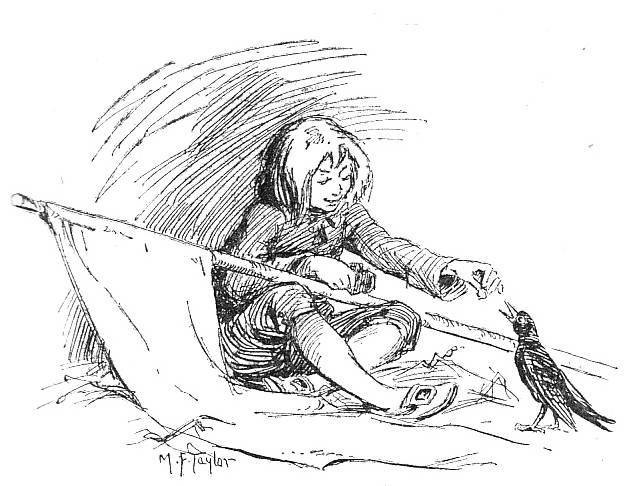
The first time I read Barnaby, also, I had never had a corvid as a hearth companion -- as Dickens had. I was slower to credit how close these relationships can be, than I should have been. Dickens had a couple of pet ravens: Grip is a portrait from life.

Dickens' mythopoeic gifts never fail him. The image of the Fool and the Raven in the foam of the mob is indelible. Grip's meaningless slogans, picked up anywhere, taught to him for any reason or no reason, travel along with Barnaby and inspire him. The extremely slow John Willet likewise picks up a slogan for his son Joe's military career, and the loss of his arm in the British defense of Savannah (Georgia): 

'It's been took off!'

'By George!' said the Black Lion, striking the table with his hand, 'he's got it!'

'Yes, sir,' said Mr Willet, with the look of a man who felt that he had earned a compliment, and deserved it. 'That's where it is. It's been took off.'

'Tell him where it was done,' said the Black Lion to Joe.

'At the defence of the Savannah, father.'

'At the defence of the Salwanners,' repeated Mr Willet, softly; again looking round the table.

'In America, where the war is,' said Joe.

'In America, where the war is,' repeated Mr Willet. 'It was took off in the defence of the Salwanners in America where the war is.' Continuing to repeat these words to himself in a low tone of voice (the same information had been conveyed to him in the same terms, at least fifty times before), Mr Willet arose from table, walked round to Joe, felt his empty sleeve all the way up, from the cuff, to where the stump of his arm remained; shook his hand; lighted his pipe at the fire, took a long whiff, walked to the door, turned round once when he had reached it, wiped his left eye with the back of his forefinger, and said, in a faltering voice: 'My son's arm-- was took off--at the defence of the--Salwanners--in America--where the war is'--with which words he withdrew, and returned no more that night.

I regret, this time around, that by the time Dickens was finishing Barnaby he was anxious to be done with it and go on to other things: I feel (as an at least occasionally bitter old man) that the story of Geoffrey Hareton, if Dickens had turned his full attention on it, could have been made something more than sketch; and I wish he could have thought of something better to do with him than pack him off to a monastery. I suppose in Dickens view it would have been unseemly to leave him walking about on English soil, after committing (technically) murder. But Dickens' inability to scrape up a penny's worth of religious awareness renders Hareton's ending even more perfunctory than the bright "pack them off to Australia!" finishes of Copperfield's lost lambs. Once cloistered in a monastery ("known throughout Europe for the rigour and severity of its discipline") he is officially no longer a person of interest: all good English protestants know that being in a monastery is essentially being dead, and that there can be nothing more to say of him.

But mind, Barnaby Rudge was born into a literary world we can hardly imagine nowadays, before the flowering of the English novel that was marked (and largely formed by) Thackeray's Vanity Fair. Sir Walter Scott was the man to beat, and I would say that Boz beat him, even with this novel. If you haven't read Barnaby Rudge, don't bother, unless you've already read the standards: David Copperfield, Our Mutual Friend, Little Dorrit, Bleak House, Great Expectations. But if you have read those, and are curious to see where they came from, give it a go. Slow John Willet and Grip the Raven are worth the price of admission.

Saturday, September 04, 2021

The Cry of Gulls

The American Civil War was, top-to-bottom and on both sides, a religious war. If you don't understand that, you don't understand anything about America.

When I was young we were taught to sing "The Battle Hymn of the Republic" in school. I imagine that's not done nowadays.

---

A faint yellow cast to the sky this morning, but it's been an extraordinarily easy smoke season here, this year, given that it's been weeks and weeks with no real rain. Everything is as dry as the shriveled sponge you might find on a high shelf in the laundry room. If the rains come soon we may get off lightly. They're still at least ten days away. I check the ten-day forecast every day. Nothing. It's been a lovely late summer: cool mornings and warm afternoons, and golden haze in the distance.

---

I used to wake every morning and spring out of bed: I'd be on my feet before I really knew I was awake, eager for the day, intent on my breakfast and my book and my brief ambitions. Now I wake slowly, even if my bladder is full and urgent. I look at my hands in the morning dark, open them wide and clench them curiously into fists, to see if they'll do it. Still alive: still strong. I'm still here, for some reason. Or for none. I hear the cry of gulls, in my mind's ear. They don't really come this far up from the river: it's some trick of my gimpy auditory processing. I turn on my side, throw off the covers, swing my legs forward into emptiness, freeze my core, and push myself upright with one arm. From there I can stand without any particular stress on my lower back. I sway slightly, reassuring it: see? I can move that much, and no sirens go off. A new day. Thus.

---

Glory, glory hallelujah! His truth is marching on.