Apple Pathways
He lay face down in the grass, with his black wings swept down close to his sides, like a perching falcon's. Martha turned him over tenderly. His eye glittered, too bright for death. At his throat a single white underfeather curled like a bunch of lace.
Not a mark on him. We buried him in the back yard without much ceremony, murmuring a few om manis. There is always the moment, burying an animal, when you have cover its eyes with dirt. That's always the real moment of death, for me. Doing something you could not conceivably do to a living creature. I do it gently and unhappily.
We don't know which crow this was, of the three or four who visit regularly. The brash one who swooped straight down to the back porch rail to pick up his kibbles? The prudent one who hung back on a branch of the apple tree, waiting to see what happened to the first before commiting himself? The one who complained if we were late, going round from window to window to remind us of our duties? No telling. Maybe he wasn't even one of ours.
Yesterday I went through my blogroll from top to bottom. I don't keep it up well. Some of the blogs are gone altogether. Three have become private, asking me for passwords; I always wonder if I should email their owners and ask, but I think I already know the answer. Then there are the ones that simply stop. Six months, nine months, a year ago. Those are the ones that trouble me. I suppose I should just have a cut-off date, and move them to a second tucked away blogroll. Title it "inactive" or "hiatus" or something. But it feels like that moment of covering those bright, glittering eyes with earth. I keep putting it off.
Last night I got a comment on one of my posts from one Nasra Al Adawi, whom I didn't know:
Your web was listed as Gulnaz's friends .
In tribute to her Please spread the message and please visit my blog to see what I wrote
The tribute is here. It's lovely. I suppose lots of us fell a little in love with Gulnaz. If any of you knows, please let us know.
Thursday, June 15, 2006
Wednesday, June 14, 2006
Answer to Dweezila, 4
My mother likes to tell entertaining stories about me. This is one of her favorites.
I read virtually all the time. I used to walk from class to class, reading. One day I walked into gym class, reading, completely absorbed, forgetting to suit up. The gym teacher said, in some exasperation, "if you want to read, Dale, maybe you should go to the library."
I looked up blankly. "Oh." I said. "Okay." And I turned around and walked off, still reading, to go to the library.
This story, she says, was told to her ruefully by the gym teacher, who was dumbfounded to see me walk out of his class. My innocence in taking him at his word was so patent that he just let me go. He didn't know what else to do.
Probably, like most of the stories my mother tells about me, this one is almost true. I have no clear recollection of this incident. If I ever had one, it would have been buried long ago under the repetitions of my mother's version of it. But my horror of gym class was so deep that I would never have gone into it so defenseless. My sensitivity to sarcasm was so fine that I could never have misunderstood him. If I really did trail off to the library, it would have been with full exultant knowledge of what I had pulled off. This is not a story of innocence; it's actually a story of deep duplicity.
I try very hard not to tell stories about my children. Particularly not droll little stories illustrating their charming foibles. Everyone, I believe passionately, should be allowed to tell the stories of his or her own life. No one else ever really knows what these stories mean.
My mother likes to tell entertaining stories about me. This is one of her favorites.
I read virtually all the time. I used to walk from class to class, reading. One day I walked into gym class, reading, completely absorbed, forgetting to suit up. The gym teacher said, in some exasperation, "if you want to read, Dale, maybe you should go to the library."
I looked up blankly. "Oh." I said. "Okay." And I turned around and walked off, still reading, to go to the library.
This story, she says, was told to her ruefully by the gym teacher, who was dumbfounded to see me walk out of his class. My innocence in taking him at his word was so patent that he just let me go. He didn't know what else to do.
Probably, like most of the stories my mother tells about me, this one is almost true. I have no clear recollection of this incident. If I ever had one, it would have been buried long ago under the repetitions of my mother's version of it. But my horror of gym class was so deep that I would never have gone into it so defenseless. My sensitivity to sarcasm was so fine that I could never have misunderstood him. If I really did trail off to the library, it would have been with full exultant knowledge of what I had pulled off. This is not a story of innocence; it's actually a story of deep duplicity.
I try very hard not to tell stories about my children. Particularly not droll little stories illustrating their charming foibles. Everyone, I believe passionately, should be allowed to tell the stories of his or her own life. No one else ever really knows what these stories mean.
Tuesday, June 13, 2006
Answer to Dweezila, 3
I had a set of little blue plastic soldiers, half an inch high. They were supposed to be Foreign Legionairies. Why they were blue, I have no idea. At the time I had not the slightest idea of what the Foreign Legion was, so I saw no reason they shouldn't wear blue clothes, carry blue rifles, and have blue hands and faces.
I had them at the dinner table, that first night in our new house with my new stepfather. I marched them in a circuit around my plate. Set them up in strategic positions on my napkin and silverware. Eventually they spilled onto the plate itself, taking up positions behind green beans, standing sentry over the meatloaf barracks, cautiously climbing the dinner-roll to survey the terrain. I was dimly aware of disappointing the people around me. But I always disappointed the people around me. What was wanted was a good-natured, cheerful, outgoing, mischievous boy. Something in the Tom Sawyer line. A boy with enthusiasm, a boy who made friends, a boy who scorned girls. What was wanted was someone to fill the role of Beaver at the "Leave it to Beaver" dinner table -- brash, impetuous, full of impish ideas; no harm in him.
I was reserved, sullen, and pessimistic. I had no friends. I liked girls. I had no ideas that had to do with actually doing or making anything. My ideas were about how to communicate with alien species. What the consequences of the population explosion would be. Whether infinity admitted of degree. That sort of thing. And there was harm in me. Oh yes, Precious. There was harm in me.
I was intensely visual. As a particularly enterprising legionary scaled my milk glass, and perched uncertainly on the rim, I became enamored of the blue and white. I loved then, as I love still, the intersection of planes and three-dimensional objects. The Legionary slipped and fell into the glass. He floated there, half-submerged, the lines of intersection with the surface making fascinating curves of blue against white. Soon his comrades, a whole lemming Foreign Legion, were dropping into the milk.
"That's it," rumbled my stepfather. I looked up in some surprise. He was standing up. My mother was making half-hearted protests. What was going on?
"He's just trying to see how much he can get away with," said my stepfather, almost kindly. He wasn't especially angry; it was just clear to him that it was time to exert some authority. It took me a few moments to understand what he meant, and when I did I flushed with rage. By that time he had hold of me -- he was a big and very strong man -- and he marched me into my new room, bent me over his knee, and spanked me, hard.
I had been struck exactly once by an adult, before this. One short sharp richly deserved swat. Never this kind of ritual humiliation, deliberate and extended.
When he finally allowed me to stand up, dry-eyed, speechless, and trembling with fury, I said not a word. From that moment till I left his house, I hated him, coldly, implacably, and absolutely. Oh yes. There was harm in me.
I had a set of little blue plastic soldiers, half an inch high. They were supposed to be Foreign Legionairies. Why they were blue, I have no idea. At the time I had not the slightest idea of what the Foreign Legion was, so I saw no reason they shouldn't wear blue clothes, carry blue rifles, and have blue hands and faces.
I had them at the dinner table, that first night in our new house with my new stepfather. I marched them in a circuit around my plate. Set them up in strategic positions on my napkin and silverware. Eventually they spilled onto the plate itself, taking up positions behind green beans, standing sentry over the meatloaf barracks, cautiously climbing the dinner-roll to survey the terrain. I was dimly aware of disappointing the people around me. But I always disappointed the people around me. What was wanted was a good-natured, cheerful, outgoing, mischievous boy. Something in the Tom Sawyer line. A boy with enthusiasm, a boy who made friends, a boy who scorned girls. What was wanted was someone to fill the role of Beaver at the "Leave it to Beaver" dinner table -- brash, impetuous, full of impish ideas; no harm in him.
I was reserved, sullen, and pessimistic. I had no friends. I liked girls. I had no ideas that had to do with actually doing or making anything. My ideas were about how to communicate with alien species. What the consequences of the population explosion would be. Whether infinity admitted of degree. That sort of thing. And there was harm in me. Oh yes, Precious. There was harm in me.
I was intensely visual. As a particularly enterprising legionary scaled my milk glass, and perched uncertainly on the rim, I became enamored of the blue and white. I loved then, as I love still, the intersection of planes and three-dimensional objects. The Legionary slipped and fell into the glass. He floated there, half-submerged, the lines of intersection with the surface making fascinating curves of blue against white. Soon his comrades, a whole lemming Foreign Legion, were dropping into the milk.
"That's it," rumbled my stepfather. I looked up in some surprise. He was standing up. My mother was making half-hearted protests. What was going on?
"He's just trying to see how much he can get away with," said my stepfather, almost kindly. He wasn't especially angry; it was just clear to him that it was time to exert some authority. It took me a few moments to understand what he meant, and when I did I flushed with rage. By that time he had hold of me -- he was a big and very strong man -- and he marched me into my new room, bent me over his knee, and spanked me, hard.
I had been struck exactly once by an adult, before this. One short sharp richly deserved swat. Never this kind of ritual humiliation, deliberate and extended.
When he finally allowed me to stand up, dry-eyed, speechless, and trembling with fury, I said not a word. From that moment till I left his house, I hated him, coldly, implacably, and absolutely. Oh yes. There was harm in me.
Monday, June 12, 2006
Answer to Dweezila, 2
Kids didn't wear backpacks in America in those days. You just carried your books. If you were unpopular, somebody might knock the books out of your hands and into a mud puddle. Dirty water would seep into your algebra book, and soak your homework.
There was a TV show, of excruciating stupidity, called The Man from U.N.C.L.E. Crude Cold War propaganda, but I didn't notice that, of course. What I noticed was the swaggering hero's sidekick. This sidekick was a small, sensitive, reserved Russian defector, played by David MacCallum. I even remember the character's name: Ilya Kuriakin. He wore black turtlenecks. He had no home. He had hopelessly divided loyalties. He carried a black attache case.
Attache cases were fetishes of enormous power, in the years of the Cold War. Do you remember? I talked my mother into buying me one. It wasn't quite the same, somehow. It was plastic. It was too fat -- really it was more a dwarfish suitcase. But at least it was black. I carried my books in it to school, and I'm sure I looked quite ridiculous. It would have served to confirm my dork status, if that had needed any confirmation. I wore black turtlenecks, too. They somehow failed to make my pudgy pink Norwegian face pale, thin, sensitive and slavic like Ilya Kuriakin's, but I persevered.
There were always science fiction books stuffed into this case. I read all the science fiction in my school library. There wasn't much -- science fiction was still marginal in those days. So after school I went to the town library. It had a whole wall-full. I simply started at the A's (Asimov) and read every single one.
Kids didn't wear backpacks in America in those days. You just carried your books. If you were unpopular, somebody might knock the books out of your hands and into a mud puddle. Dirty water would seep into your algebra book, and soak your homework.
There was a TV show, of excruciating stupidity, called The Man from U.N.C.L.E. Crude Cold War propaganda, but I didn't notice that, of course. What I noticed was the swaggering hero's sidekick. This sidekick was a small, sensitive, reserved Russian defector, played by David MacCallum. I even remember the character's name: Ilya Kuriakin. He wore black turtlenecks. He had no home. He had hopelessly divided loyalties. He carried a black attache case.
Attache cases were fetishes of enormous power, in the years of the Cold War. Do you remember? I talked my mother into buying me one. It wasn't quite the same, somehow. It was plastic. It was too fat -- really it was more a dwarfish suitcase. But at least it was black. I carried my books in it to school, and I'm sure I looked quite ridiculous. It would have served to confirm my dork status, if that had needed any confirmation. I wore black turtlenecks, too. They somehow failed to make my pudgy pink Norwegian face pale, thin, sensitive and slavic like Ilya Kuriakin's, but I persevered.
There were always science fiction books stuffed into this case. I read all the science fiction in my school library. There wasn't much -- science fiction was still marginal in those days. So after school I went to the town library. It had a whole wall-full. I simply started at the A's (Asimov) and read every single one.
Sunday, June 11, 2006
Answer to Dweezila
I asked Dweezila where the hell she came from, to write such beautiful harrowing stuff, and she answered with a wonderful letter which explained a lot. But -- I don't know why I didn't see this coming -- she asked me the same question back. I keep writing bits of answers, but nothing holds together. I told her this and she said just do it in bits, then. Why should it hold together? So here's one bit.
Once upon a time, circa 1950, a Midwestern girl went away to college and had sex with a fellow-student, a science nerd there. She had sex with him because science nerds had a faint glamour about them, in the age of Sputnik; and also because he didn't care what anyone thought about him and she thought she would like that. As it turned out she didn't like it as much as she thought she would, but she liked the sex more than she thought she would, which sort of balanced things out and possibly meant they were in love. So, on the quiet, because this was the fifties and not the sixties, they got married.
Then when she went home her parents were distressed at the secret wedding and they convinced her to get married again, to pretend she was getting married for the first time -- a big wedding at the big white congregational church in her home town. Her twice-now husband knew nobody there. There are photos of this wedding. He stands stooped there, forlorn, defeated. All around is a big wedding, with places in it for everyone but him.
They went to California, but they didn't like the cities so they drove north, and eventually they came to Oregon, which they liked. There was the ocean one hundred miles this way and the mountains one hundred miles the other way, and in between an idyllic green valley. In a school administration office in that valley, the man overheard someone say, "I can't for the life of me find a science teacher."
"I teach science," he said.
So he taught highschool science in Pleasant Hill, Oregon. They had three children, neatly spaced at two-and-a-half year intervals. I was the last.
The little house, the sameness, wore on the girl. She wasn't a girl anymore. And all of her specialness seemed to have drained away. She knew now that she didn't actually love this man. But fourteen years went by. She ate a lot of chocolate and became fat. Her life was so small she couldn't stand it. And now it was the sixties, so she started graduate school in psychology, bought a little used car of her own, and filed for divorce.
I asked Dweezila where the hell she came from, to write such beautiful harrowing stuff, and she answered with a wonderful letter which explained a lot. But -- I don't know why I didn't see this coming -- she asked me the same question back. I keep writing bits of answers, but nothing holds together. I told her this and she said just do it in bits, then. Why should it hold together? So here's one bit.
Once upon a time, circa 1950, a Midwestern girl went away to college and had sex with a fellow-student, a science nerd there. She had sex with him because science nerds had a faint glamour about them, in the age of Sputnik; and also because he didn't care what anyone thought about him and she thought she would like that. As it turned out she didn't like it as much as she thought she would, but she liked the sex more than she thought she would, which sort of balanced things out and possibly meant they were in love. So, on the quiet, because this was the fifties and not the sixties, they got married.
Then when she went home her parents were distressed at the secret wedding and they convinced her to get married again, to pretend she was getting married for the first time -- a big wedding at the big white congregational church in her home town. Her twice-now husband knew nobody there. There are photos of this wedding. He stands stooped there, forlorn, defeated. All around is a big wedding, with places in it for everyone but him.
They went to California, but they didn't like the cities so they drove north, and eventually they came to Oregon, which they liked. There was the ocean one hundred miles this way and the mountains one hundred miles the other way, and in between an idyllic green valley. In a school administration office in that valley, the man overheard someone say, "I can't for the life of me find a science teacher."
"I teach science," he said.
So he taught highschool science in Pleasant Hill, Oregon. They had three children, neatly spaced at two-and-a-half year intervals. I was the last.
The little house, the sameness, wore on the girl. She wasn't a girl anymore. And all of her specialness seemed to have drained away. She knew now that she didn't actually love this man. But fourteen years went by. She ate a lot of chocolate and became fat. Her life was so small she couldn't stand it. And now it was the sixties, so she started graduate school in psychology, bought a little used car of her own, and filed for divorce.
Saturday, June 10, 2006
Thank You
Sage Cohen wrote beautifully, a while back, of the decline of thanks:
Are we really living in an age where the only feedback loops of closure are complaints? How did we get to a place where we have mutually agreed that what's worth mentioning is what's wrong?
Mindful of that, as I left my inexpensive hotel in Montreal, I scrawled a note to leave with my tip, thanking whoever it was who had made up my room. And I meant it. I'd run short of clothes -- not having expected to be drenched with sweat periodically, as I was -- so I'd washed a change of clothes in the sink, twisted them in towels, and then draped them over the shower-curtain rod to finish drying. When I came back to the made-up room they were on hangers, and the shirt that would take longest to dry was cleverly hung on the bed-post in front of the air-conditioner. I was touched. The fact that I was washing my own clothes meant, obviously, that I was a poor prospect for tips. Putting the clothes on hangers, I felt, was one thing, possibly just automatic, but thinking about how to make sure the clothes were dry by dinner-time was quite another thing. Gratuitous kindness.
A little thing, of course. But people do that sort of thing all the time -- gratuitously think their way into what other people will need, do their jobs just a little better than they have to. So often we let the fact that these things occur under the auspices of a financial transaction erase the fact of the human kindness, the real connections, they represent. I remember one morning, chatting with a waitress at breakfast in the early morning, she ruefully recounting rushing to get to work. I said earnestly, "we really appreciate it, you know. You hurrying to wake up fast so the rest of us can wake up slow." She colored up and looked away and said "thank you."* I had a feeling neither she nor anyone else had ever put it in that light. But this was a big part of her life, waking up in a frantic scramble, and this was a big part of my life, reading and writing for an hour before work. I meant it.
The thing I most dislike about Capitalism is its tendency to make these human connections invisible, and hence to progressively weaken them, until "cash," as Thomas Carlyle put it, "is the universal sole nexus between man and man." I'm not particularly interested in getting rid of Capitalism.** All economic systems have their own propensities for exploitation, cruelty, and inhumanity. It seems to me that the 20th Century has demonstrated that in agonizing detail. More important than swapping one system for another is recognizing the faults of the one you've got and trying to mitigate them.
On a large scale, in our case, that means recognizing how much of our prosperity derives from poverty and cruelty elsewhere (or here, for that matter.) On a small scale, it means preferring whatever is small and human-scale and face-to-face to whatever is huge and mass-produced and anonymous. And recognizing the small kindnesses without which our lives, all of them, even here in the wealthy first world, would be hell.
* No, I don't think she was pissed off (a legit response, to be sure.) I think she was pleased.
** Anymore. I was passionately interested in it, thirty years ago.
Sage Cohen wrote beautifully, a while back, of the decline of thanks:
Are we really living in an age where the only feedback loops of closure are complaints? How did we get to a place where we have mutually agreed that what's worth mentioning is what's wrong?
Mindful of that, as I left my inexpensive hotel in Montreal, I scrawled a note to leave with my tip, thanking whoever it was who had made up my room. And I meant it. I'd run short of clothes -- not having expected to be drenched with sweat periodically, as I was -- so I'd washed a change of clothes in the sink, twisted them in towels, and then draped them over the shower-curtain rod to finish drying. When I came back to the made-up room they were on hangers, and the shirt that would take longest to dry was cleverly hung on the bed-post in front of the air-conditioner. I was touched. The fact that I was washing my own clothes meant, obviously, that I was a poor prospect for tips. Putting the clothes on hangers, I felt, was one thing, possibly just automatic, but thinking about how to make sure the clothes were dry by dinner-time was quite another thing. Gratuitous kindness.
A little thing, of course. But people do that sort of thing all the time -- gratuitously think their way into what other people will need, do their jobs just a little better than they have to. So often we let the fact that these things occur under the auspices of a financial transaction erase the fact of the human kindness, the real connections, they represent. I remember one morning, chatting with a waitress at breakfast in the early morning, she ruefully recounting rushing to get to work. I said earnestly, "we really appreciate it, you know. You hurrying to wake up fast so the rest of us can wake up slow." She colored up and looked away and said "thank you."* I had a feeling neither she nor anyone else had ever put it in that light. But this was a big part of her life, waking up in a frantic scramble, and this was a big part of my life, reading and writing for an hour before work. I meant it.
The thing I most dislike about Capitalism is its tendency to make these human connections invisible, and hence to progressively weaken them, until "cash," as Thomas Carlyle put it, "is the universal sole nexus between man and man." I'm not particularly interested in getting rid of Capitalism.** All economic systems have their own propensities for exploitation, cruelty, and inhumanity. It seems to me that the 20th Century has demonstrated that in agonizing detail. More important than swapping one system for another is recognizing the faults of the one you've got and trying to mitigate them.
On a large scale, in our case, that means recognizing how much of our prosperity derives from poverty and cruelty elsewhere (or here, for that matter.) On a small scale, it means preferring whatever is small and human-scale and face-to-face to whatever is huge and mass-produced and anonymous. And recognizing the small kindnesses without which our lives, all of them, even here in the wealthy first world, would be hell.
* No, I don't think she was pissed off (a legit response, to be sure.) I think she was pleased.
** Anymore. I was passionately interested in it, thirty years ago.
Friday, June 09, 2006
A High Place
A high place in a dry country. No ghosts live here. No one has ever come here, even to die. Below the mesa, the marbled hills come to a sudden stop, like the toes of lions on a plinth. A pale violet sky kisses into lilac, and then dissolves into ice-blue above the ridge, in this place that has never seen violets or lilacs, and never will.
I say I come here to think, but of course I do what people always do when they set out to think. I remember, and I imagine.
A tumble of rapid images. I could have done this, and I could have done that. I should have known, I should have ignored -- and on it goes, the thin sad piping of a thread of mind that can't realize its irrelevence. If this were to be solved by thinking (remembering, imagining) it would have been solved long ago.
No devil comes to tempt me. No angel brings me tidings.
I crouch and find three stones to set together. A fourth to rest on top. A monument to -- what? You, I suppose.
Is there even anything to solve? To look for a solution is to assume so many things. To assume a problem. To assume progression. To assume agency. Now, now I really am thinking, and I think -- all those assumptions are wrong.
There are none of those things. There is nothing but the burning, nothing but the welding torch of love.
A high place in a dry country. No ghosts live here. No one has ever come here, even to die. Below the mesa, the marbled hills come to a sudden stop, like the toes of lions on a plinth. A pale violet sky kisses into lilac, and then dissolves into ice-blue above the ridge, in this place that has never seen violets or lilacs, and never will.
I say I come here to think, but of course I do what people always do when they set out to think. I remember, and I imagine.
A tumble of rapid images. I could have done this, and I could have done that. I should have known, I should have ignored -- and on it goes, the thin sad piping of a thread of mind that can't realize its irrelevence. If this were to be solved by thinking (remembering, imagining) it would have been solved long ago.
No devil comes to tempt me. No angel brings me tidings.
I crouch and find three stones to set together. A fourth to rest on top. A monument to -- what? You, I suppose.
Is there even anything to solve? To look for a solution is to assume so many things. To assume a problem. To assume progression. To assume agency. Now, now I really am thinking, and I think -- all those assumptions are wrong.
There are none of those things. There is nothing but the burning, nothing but the welding torch of love.
Wednesday, June 07, 2006
Per-Capita Happiness
I saw lots of children in Montreal. Groups of them trailing through the Museum of Contemporary Art; groups of them in the Parc Lafontaine. But I never heard a single child wailing or whining. No children threatening or screaming. None pummeling their mothers or each other.
I do not of course imagine that children in Montreal never do these things. We're talking about another city, not another species.
I said something like this to Beth, and she said simply, "They're happy children."
I think of all the measures of prosperity and well-being and quality of life that you read in the papers. Canada of course tends to come out on the top of those, as well. But I think you could replace them all with a simple scale based on what the children sound like.
I saw lots of children in Montreal. Groups of them trailing through the Museum of Contemporary Art; groups of them in the Parc Lafontaine. But I never heard a single child wailing or whining. No children threatening or screaming. None pummeling their mothers or each other.
I do not of course imagine that children in Montreal never do these things. We're talking about another city, not another species.
I said something like this to Beth, and she said simply, "They're happy children."
I think of all the measures of prosperity and well-being and quality of life that you read in the papers. Canada of course tends to come out on the top of those, as well. But I think you could replace them all with a simple scale based on what the children sound like.

Monday, June 05, 2006
Montreal
So. This morning's idle tears done with, I walked a bit in Montreal, singing softly, as I have a habit of doing, when I walk.
And now I'm sitting by the pond in Parc Lafontaine. Today will be a day of meditation and prayer -- badly needed -- and tomorrow very early I fly back to Oregon.
But first I will have breakfast with Beth, Dave, Tom (the front man for Ben Zen), and the Sylph. This is a beautiful city, and I will miss it. But I'm ready to be home.
Desire
Destroys a man
Twice: once
In the wanting,
Then again
In the not letting go.
-- Ben Zen
So. This morning's idle tears done with, I walked a bit in Montreal, singing softly, as I have a habit of doing, when I walk.
I will buy you a garden
Where your flowers can bloom
I will buy you a new car
Perfect shiny and new
I will buy you that big house
Way up in the West Hills
And now I'm sitting by the pond in Parc Lafontaine. Today will be a day of meditation and prayer -- badly needed -- and tomorrow very early I fly back to Oregon.
But first I will have breakfast with Beth, Dave, Tom (the front man for Ben Zen), and the Sylph. This is a beautiful city, and I will miss it. But I'm ready to be home.
Wednesday, May 31, 2006
Over Montana
Over Montana, I reckon. As always when I fly I remember too late that I want to have a map with me. A wide swash of flat valley-land between two mountain ranges, and I don't have the faintest idea what the mountains were, or what the valley might be. The mountains go on forever, now.
We took off southwest, St Helens out my (righthand) window. Wheeled around over the Columbia, while Hood floated slowly across my field of vision. Then up throught the clouds, and when we came out we were over the Oregon desert.
Mole blinking in the sunlight. It's been a long time, a long time since I remember the world getting wider, more spacious. For almost twenty years it's been narrowing, closing down to just family and work and compulsion. Then I guess seven or eight years ago, the Dharma began opening up space inside -- where it counts, of course -- but outside still the narrow round, work I don't particularly care about, the daily routines of "our little family," as we always refer to the four of us. We've had something of a fortress mentality, really.
So day before yesterday I had lunch with E., and it felt so different. Like when I was in grad school. Everything interesting. Except better, because I don't have anything to prove now. I feel marvellously agenda-less. I'm done with all that. I'm not trying to make anything happen. It's like taking off a seventy-pound backpack after a day's hike; I feel I could float into the air. It's been a long time in the making.
This is not what the Dharma is for, of course. It's the step that means the most to me right now -- it's a measure of freedom from things that have oppressed me all my life, all of this life. But really it's just an incidental side-effect. A minor increment. It feels huge, though. What would real freedom feel like? I can't even begin to imagine.
Over Montana, I reckon. As always when I fly I remember too late that I want to have a map with me. A wide swash of flat valley-land between two mountain ranges, and I don't have the faintest idea what the mountains were, or what the valley might be. The mountains go on forever, now.
We took off southwest, St Helens out my (righthand) window. Wheeled around over the Columbia, while Hood floated slowly across my field of vision. Then up throught the clouds, and when we came out we were over the Oregon desert.
Mole blinking in the sunlight. It's been a long time, a long time since I remember the world getting wider, more spacious. For almost twenty years it's been narrowing, closing down to just family and work and compulsion. Then I guess seven or eight years ago, the Dharma began opening up space inside -- where it counts, of course -- but outside still the narrow round, work I don't particularly care about, the daily routines of "our little family," as we always refer to the four of us. We've had something of a fortress mentality, really.
So day before yesterday I had lunch with E., and it felt so different. Like when I was in grad school. Everything interesting. Except better, because I don't have anything to prove now. I feel marvellously agenda-less. I'm done with all that. I'm not trying to make anything happen. It's like taking off a seventy-pound backpack after a day's hike; I feel I could float into the air. It's been a long time in the making.
This is not what the Dharma is for, of course. It's the step that means the most to me right now -- it's a measure of freedom from things that have oppressed me all my life, all of this life. But really it's just an incidental side-effect. A minor increment. It feels huge, though. What would real freedom feel like? I can't even begin to imagine.
Saturday, May 27, 2006
That Hippie Free School, Again
I see them as if through a tiny window, a teenage boy writing a teenage girl's name in red paint on the wall, the paint trickling down like blood. It can be nothing, in those days, but a reference to the Manson cult murders. The other teenagers in the house profess to think it's funny. What did the adults think? No one knows. The question arises -- as so often, thinking back -- where the hell are the adults? The ruling fiction is that the teenagers are adults. They'll work it out. And they do, of course. They work it out. It costs some of them more than it costs others. They grow up, in some ways, fast. They will take less for granted, all their lives, than those who grew up under authority. They don't assume that anyone else will take care of things, that somebody somewhere has it all under control. It's not under control. That's a lesson worth paying for.
Most of us remember the place with love. Some with intense nostalgia. I and at least one other student I know remain firmly convinced that it saved our lives. We were headed for jail or for one of any number of addictions -- pick one! -- and we found community, of a sort, that made us think a rapprochement with our species might be possible. A shared alienation. It was okay to be smart here, to love art or poetry or philosophy or difficult music -- if you didn't grow up in small-town America you may not understand just how not-okay those things can be. It was okay to think hard about politics, or religion. It was okay to be gay here; in 1970, that counted for a lot. Saved some lives right there. There was a shared body of knowledge about drugs that probably also saved some lives, given that no force on Earth was going to stop these kids from getting stoned repeatedly.
Still, as I read the posts on the Yahoo group, thirty years down the road, I am struck more forcibly by the cost, than by anything else. And what it says about the world these kids were growing up in, that this was a better place than where they came from. The intense, unrelenting sexual pressure on the girls. The violent outbursts of temper. The bad acid trips. The voyages -- scruffy teenagers hitchhiking a thousand miles on a whim, going to Canada, to Mexico, anywhere. You'd get into a car and realize the driver was dead drunk. It's an interesting problem: how do you get out of the car, now, alive? Life skills. You bet.
The leitmotif to me is loneliness. This, I'm sure, isn't the school's fault. Teenagers are all, so far as I can tell, intensely lonely. It goes with the territory. I want to go back and help these kids -- or help the kids, no different from them, right down the street, in 2006 -- or for that matter, the kids playing D & D in my living room -- and I realize, I don't know how. There is no general answer, of course. There's only attending to this child, here, now. They need so much kindness and encouragement, and mostly they don't make it easy to give it to them -- it takes a light touch and a willingness to fail. Sometimes I rise to it and sometimes I don't.
I see them as if through a tiny window, a teenage boy writing a teenage girl's name in red paint on the wall, the paint trickling down like blood. It can be nothing, in those days, but a reference to the Manson cult murders. The other teenagers in the house profess to think it's funny. What did the adults think? No one knows. The question arises -- as so often, thinking back -- where the hell are the adults? The ruling fiction is that the teenagers are adults. They'll work it out. And they do, of course. They work it out. It costs some of them more than it costs others. They grow up, in some ways, fast. They will take less for granted, all their lives, than those who grew up under authority. They don't assume that anyone else will take care of things, that somebody somewhere has it all under control. It's not under control. That's a lesson worth paying for.
Most of us remember the place with love. Some with intense nostalgia. I and at least one other student I know remain firmly convinced that it saved our lives. We were headed for jail or for one of any number of addictions -- pick one! -- and we found community, of a sort, that made us think a rapprochement with our species might be possible. A shared alienation. It was okay to be smart here, to love art or poetry or philosophy or difficult music -- if you didn't grow up in small-town America you may not understand just how not-okay those things can be. It was okay to think hard about politics, or religion. It was okay to be gay here; in 1970, that counted for a lot. Saved some lives right there. There was a shared body of knowledge about drugs that probably also saved some lives, given that no force on Earth was going to stop these kids from getting stoned repeatedly.
Still, as I read the posts on the Yahoo group, thirty years down the road, I am struck more forcibly by the cost, than by anything else. And what it says about the world these kids were growing up in, that this was a better place than where they came from. The intense, unrelenting sexual pressure on the girls. The violent outbursts of temper. The bad acid trips. The voyages -- scruffy teenagers hitchhiking a thousand miles on a whim, going to Canada, to Mexico, anywhere. You'd get into a car and realize the driver was dead drunk. It's an interesting problem: how do you get out of the car, now, alive? Life skills. You bet.
The leitmotif to me is loneliness. This, I'm sure, isn't the school's fault. Teenagers are all, so far as I can tell, intensely lonely. It goes with the territory. I want to go back and help these kids -- or help the kids, no different from them, right down the street, in 2006 -- or for that matter, the kids playing D & D in my living room -- and I realize, I don't know how. There is no general answer, of course. There's only attending to this child, here, now. They need so much kindness and encouragement, and mostly they don't make it easy to give it to them -- it takes a light touch and a willingness to fail. Sometimes I rise to it and sometimes I don't.
Thursday, May 25, 2006
This Brave Bare World
A few days ago, I wrote, of poet Elizabeth Domike:
'Sometime there's going to be a long appreciation of her recent chapbook, "Disenchantment," here. I have to stop being staggered by it, though, which may not happen soon.'
I have since realized that in fact it's not going to happen ever, so I better just get on with it. And my appreciation isn't very long, after all. But herewith, what I scribbled at lunch, today --
The fifteen poems of "Disenchantment" are independent, but together they form a sustained elegy, a celebration of a heterogeny of lost or broken things. Of a mass at Notre Dame:
ind All I ever wanted was to feel
indThe filtered light
indThrough those particular windows
indRain on my upturned face
Of a disastrous connection:
indMy little sociopath. Trouble
indFrom the day you were born.
indAt least that's what your dad said
indwhen he set your crib on fire.
indHe was drunk of course and it was
indan accident, the glass and the cigarette
indslipped from his shaking hand
indYou were tough and moved fast,
indEven then.
There is no narrative here. No movement in time, no-here-to-there -- she is losing these things even as she has them. Loving and losing become the same thing, simultaneous, coterminous. These poems inhabit a world in which "was it worth it?" is a question that makes no sense. There is no before and after.
indWhen the boatman comes I wonder
indif he will carry me in his broad arms down
indthe cracked marble steps,
indor if my body will fall away,
indand I will drift lightly on the wind.
What's extraordinary in this poetry is the quality of attention, the painfully intense watching and listening. The opening lines of maybe the best poem, "In Spite of All the Dreaming" might be describing the world the poems lead us into:
inEverything is visible in this brave bare world
inBirds' nests sit high and shine with frost.
A few days ago, I wrote, of poet Elizabeth Domike:
'Sometime there's going to be a long appreciation of her recent chapbook, "Disenchantment," here. I have to stop being staggered by it, though, which may not happen soon.'
I have since realized that in fact it's not going to happen ever, so I better just get on with it. And my appreciation isn't very long, after all. But herewith, what I scribbled at lunch, today --
The fifteen poems of "Disenchantment" are independent, but together they form a sustained elegy, a celebration of a heterogeny of lost or broken things. Of a mass at Notre Dame:
ind All I ever wanted was to feel
indThe filtered light
indThrough those particular windows
indRain on my upturned face
Of a disastrous connection:
indMy little sociopath. Trouble
indFrom the day you were born.
indAt least that's what your dad said
indwhen he set your crib on fire.
indHe was drunk of course and it was
indan accident, the glass and the cigarette
indslipped from his shaking hand
indYou were tough and moved fast,
indEven then.
There is no narrative here. No movement in time, no-here-to-there -- she is losing these things even as she has them. Loving and losing become the same thing, simultaneous, coterminous. These poems inhabit a world in which "was it worth it?" is a question that makes no sense. There is no before and after.
indWhen the boatman comes I wonder
indif he will carry me in his broad arms down
indthe cracked marble steps,
indor if my body will fall away,
indand I will drift lightly on the wind.
What's extraordinary in this poetry is the quality of attention, the painfully intense watching and listening. The opening lines of maybe the best poem, "In Spite of All the Dreaming" might be describing the world the poems lead us into:
inEverything is visible in this brave bare world
inBirds' nests sit high and shine with frost.
Wednesday, May 24, 2006
Reunion
The curtain stirs. Six burnt matches lie in the bleak ashtray, patterned on the cold glass, the petroglyph of an ancient, unintelligible people -- us, thirty years ago. Us, last night.
When you were seventeen your hair fell across the scimitar curve of your jaw, and I grieved to watch your fingers sift leaf into the papers and twist them closed. You smelled of vanilla and sulfer, cinnamon and tobacco.
Last night you said, "how could we have wasted all that time?"
It would not have been kind to answer, "we are still wasting all that time."
The curtain stirs. Six burnt matches lie in the bleak ashtray, patterned on the cold glass, the petroglyph of an ancient, unintelligible people -- us, thirty years ago. Us, last night.
When you were seventeen your hair fell across the scimitar curve of your jaw, and I grieved to watch your fingers sift leaf into the papers and twist them closed. You smelled of vanilla and sulfer, cinnamon and tobacco.
Last night you said, "how could we have wasted all that time?"
It would not have been kind to answer, "we are still wasting all that time."
Praying a Second-Hand Grief
All the symptoms are there; the sleeplessness, the self-conscious awkwardness, the amorphous sense of betrayal, the longing to go home and the conviction that there is no home to return to. Places in the house that I dare not go. It's too hard.
It's not my grief. I have no right to it. But it's settled in with me, even so. "Om mani padme hum," I mutter, over and over, the way we do in Chenrezig practice. Then, in many voices, it's like the murmur of bees. Now, alone in an empty house, it's a nonsense phrase in a foreign language, somebody else's nursery rhyme.
Behold! the jewel in the lotus. "Behold," who says "behold," anymore? "Lo" is even worse. Translating Beowulf, the very first word is a crux: how do you translate the one-word sentence "Hwaet!"? People say "Behold!" "Hail!" "Lo!" "Listen!" "Hark!" -- even, in desperation, the lineal etymological descendent, "What!" Seamus Heaney took the bull by the horns, dropped the exclamation point, and at least said something that someone who speaks Modern English might say: "So." Take a leaf from him. So. The jewel in the lotus. So. The jewel in the lotus. So. The jewel in the lotus.
What jewel, what lotus? Oh, I know, the translation is a red herring. It's a mantra, not a motto. Each syllable, they say, purifies one of the six realms of samsaric existence. Nevertheless, I can't help forming it into a sentence, and it becomes a more sardonic one, with each repetition. So. The jewel in the lotus. You think so, huh? So. The jewel in the lotus. You think so, huh?
Men ne cunnon
secgan to sothe
sele-raedende
haeleth under heofonum
hwa thaem hlaeste onfeng.
Men do not know,
truth to tell --
talkers in the hall,
heroes under heaven --
who received that cargo.
Training helps. I don't fight with it. I just patiently release it. Like lifting a kitten off my lap, gently freeing its claws from my jeans. Give anything conceptual free rein, and eventually it wanders off.
You know the story, of the learned abbot who heard of a man who lived alone on an island and did nothing but recite om mani padme hum, over and over. An ignorant man, nothing to learn from him, but still it was interesting, so the abbot rowed a boat over to the island. When he found the hermit it turned out, disappointingly, that he wasn't even pronouncing the mantra correctly. The abbot taught the old hermit how it should be said -- at least he could practice it correctly for the few remaining years of his life! And he was rowing back across the lake, when a voice interrupted his thoughts.
"Please, sir," said the hermit, walking on the water alongside the boat, "how was the mantra supposed to go, again? I want to be sure to get it right."
You don't have to get it right. You just have to want to get it right.
It's okay to pray the wrong way, in the wrong measure, at the wrong time, for the wrong person. It's okay to suffer a grief that isn't my own, a grief well-tainted with jealousy. Chenrezig has a thousand arms. He's very good at sorting and arranging. Every prayer will get to its destination. Our job is just to keep on praying, and to keep on trying to get it right. "Just do the practice, and the meaning will reveal itself." Not to do it until we're sure we will do it right can only mean not to do it at all.
All the symptoms are there; the sleeplessness, the self-conscious awkwardness, the amorphous sense of betrayal, the longing to go home and the conviction that there is no home to return to. Places in the house that I dare not go. It's too hard.
It's not my grief. I have no right to it. But it's settled in with me, even so. "Om mani padme hum," I mutter, over and over, the way we do in Chenrezig practice. Then, in many voices, it's like the murmur of bees. Now, alone in an empty house, it's a nonsense phrase in a foreign language, somebody else's nursery rhyme.
Behold! the jewel in the lotus. "Behold," who says "behold," anymore? "Lo" is even worse. Translating Beowulf, the very first word is a crux: how do you translate the one-word sentence "Hwaet!"? People say "Behold!" "Hail!" "Lo!" "Listen!" "Hark!" -- even, in desperation, the lineal etymological descendent, "What!" Seamus Heaney took the bull by the horns, dropped the exclamation point, and at least said something that someone who speaks Modern English might say: "So." Take a leaf from him. So. The jewel in the lotus. So. The jewel in the lotus. So. The jewel in the lotus.
What jewel, what lotus? Oh, I know, the translation is a red herring. It's a mantra, not a motto. Each syllable, they say, purifies one of the six realms of samsaric existence. Nevertheless, I can't help forming it into a sentence, and it becomes a more sardonic one, with each repetition. So. The jewel in the lotus. You think so, huh? So. The jewel in the lotus. You think so, huh?
Men ne cunnon
secgan to sothe
sele-raedende
haeleth under heofonum
hwa thaem hlaeste onfeng.
Men do not know,
truth to tell --
talkers in the hall,
heroes under heaven --
who received that cargo.
Training helps. I don't fight with it. I just patiently release it. Like lifting a kitten off my lap, gently freeing its claws from my jeans. Give anything conceptual free rein, and eventually it wanders off.
You know the story, of the learned abbot who heard of a man who lived alone on an island and did nothing but recite om mani padme hum, over and over. An ignorant man, nothing to learn from him, but still it was interesting, so the abbot rowed a boat over to the island. When he found the hermit it turned out, disappointingly, that he wasn't even pronouncing the mantra correctly. The abbot taught the old hermit how it should be said -- at least he could practice it correctly for the few remaining years of his life! And he was rowing back across the lake, when a voice interrupted his thoughts.
"Please, sir," said the hermit, walking on the water alongside the boat, "how was the mantra supposed to go, again? I want to be sure to get it right."
You don't have to get it right. You just have to want to get it right.
It's okay to pray the wrong way, in the wrong measure, at the wrong time, for the wrong person. It's okay to suffer a grief that isn't my own, a grief well-tainted with jealousy. Chenrezig has a thousand arms. He's very good at sorting and arranging. Every prayer will get to its destination. Our job is just to keep on praying, and to keep on trying to get it right. "Just do the practice, and the meaning will reveal itself." Not to do it until we're sure we will do it right can only mean not to do it at all.
Friday, May 19, 2006
Portrait
I dreamed of you again last night. I explored your face with my fingertips, like a blind man. It is a face I have glimpsed only in worked photographs, but I have touched it many nights now. The furrows where tears would run if you let them; the eyelids that hood a barely-checked ferocity. I tried to understand how such a stern face can be so warm. I brushed your lips with my index finger. A kiss is beyond even the reach of my dreams, I guess; a tolerant irritated moue was all I would get. It was enough. My hands fell. You tossed your head, a gesture I have guessed from photographs is a characteristic one. Throwing your hair impatiently from your face. Better things to do.
No words. What would I say? I would only lie. Better to stay silent.
I have a long tradition, I suppose, of loving photographs. But that was when I mistook my communion with the photographer for communion with his subject. I am warier now.
Under the gaze of those dispassionate eyes, I hesitate. All right. I made up the dreams. I suppose because it wouldn't be willful self-indulgence, if I had dreamed it. And it wouldn't be part of an even longer tradition of nudging the facts to win indulgences from others. It is both. So -- indulge me. It's little enough I want now. Sire, a man without craves audience.
Lying again. How many times can a person lie, in the course of one short essay? I want everything. You knew that from the start, I'm guessing.
I dreamed of you again last night. I explored your face with my fingertips, like a blind man. It is a face I have glimpsed only in worked photographs, but I have touched it many nights now. The furrows where tears would run if you let them; the eyelids that hood a barely-checked ferocity. I tried to understand how such a stern face can be so warm. I brushed your lips with my index finger. A kiss is beyond even the reach of my dreams, I guess; a tolerant irritated moue was all I would get. It was enough. My hands fell. You tossed your head, a gesture I have guessed from photographs is a characteristic one. Throwing your hair impatiently from your face. Better things to do.
No words. What would I say? I would only lie. Better to stay silent.
I have a long tradition, I suppose, of loving photographs. But that was when I mistook my communion with the photographer for communion with his subject. I am warier now.
Under the gaze of those dispassionate eyes, I hesitate. All right. I made up the dreams. I suppose because it wouldn't be willful self-indulgence, if I had dreamed it. And it wouldn't be part of an even longer tradition of nudging the facts to win indulgences from others. It is both. So -- indulge me. It's little enough I want now. Sire, a man without craves audience.
Lying again. How many times can a person lie, in the course of one short essay? I want everything. You knew that from the start, I'm guessing.
Thursday, May 18, 2006
A Note to my Googlers
First of all: you really don't want to consult a computer programmer and erstwhile English teacher about your mole that is red, itchy, growing, or otherwise changing. You want something like this site:
Mole Melanoma Information Site
Second: no. you don't die if you scratch a mole off. Nothing at all spectacular happens. But it's not a treatment, either. See above.
Now, as for Chinese mole reading: so many of you search for it that I suppose there must be such a thing, but I don't know anything about it. You're on your own. I know you're anxious to find out what a mole on your chin (forehead, ring-finger, knee) signifies. Personally, speaking as a computer programmer and an erstwhile English teacher, I think it probably signifies that you have a mole on your chin (forehead, ring-finger, knee). But what do I know?
For those of you who want to find "picture of mole (animal)" or "mole cartoon," what you want to do is click the word "image" above the google bar and then search for "mole." Glad I could help.
For the surprising number of you who want to know "why does bread mole?" -- now you, as an English teacher, I really can help. It's spelled "mold," with a 'd'. Repeat your search with "mold" spelled that way, and you won't end up reading bad buddhist poetry on the internet the night before your science paper is due.
For the rest of you, I will reluctantly admit that yes, I did once write the sentence, "I want to have an affair." But I'll go out on a limb here and guess that what you're looking for is not a happily married, stout, white-bearded, 48-year-old male. Since you've gotten this far, though, I will give you a bit of advice: there's one thing you can always find, if you go looking for it, and that's trouble.
First of all: you really don't want to consult a computer programmer and erstwhile English teacher about your mole that is red, itchy, growing, or otherwise changing. You want something like this site:
Mole Melanoma Information Site
Second: no. you don't die if you scratch a mole off. Nothing at all spectacular happens. But it's not a treatment, either. See above.
Now, as for Chinese mole reading: so many of you search for it that I suppose there must be such a thing, but I don't know anything about it. You're on your own. I know you're anxious to find out what a mole on your chin (forehead, ring-finger, knee) signifies. Personally, speaking as a computer programmer and an erstwhile English teacher, I think it probably signifies that you have a mole on your chin (forehead, ring-finger, knee). But what do I know?
For those of you who want to find "picture of mole (animal)" or "mole cartoon," what you want to do is click the word "image" above the google bar and then search for "mole." Glad I could help.
For the surprising number of you who want to know "why does bread mole?" -- now you, as an English teacher, I really can help. It's spelled "mold," with a 'd'. Repeat your search with "mold" spelled that way, and you won't end up reading bad buddhist poetry on the internet the night before your science paper is due.
For the rest of you, I will reluctantly admit that yes, I did once write the sentence, "I want to have an affair." But I'll go out on a limb here and guess that what you're looking for is not a happily married, stout, white-bearded, 48-year-old male. Since you've gotten this far, though, I will give you a bit of advice: there's one thing you can always find, if you go looking for it, and that's trouble.
Wednesday, May 17, 2006
Unready
Reading maketh a full man, conference a ready man, and writing an exact man.
A neat house in old suburban northeast Portland. I wasn't sure I was in the right place -- there were none of the "alternative" markers that, in varying degrees of subtlety, tend to mark of the houses of people I visit. No prayer flags on the porch. No beans growing in the front yard. No "save Tibet" or "We are Everywhere" or "Live Simply" bumper stickers on the cars parked in the street.
But it was the right place. I entered, and added my shoes to the dozen beside the door. There was lemonade, grainy chips of some kind, fresh-made guacamole and salsa, sliced apples, chunks of dark chocolate. Tea in the kitchen. And more food that we didn't even find out about till afterwards. If you want to eat well, all you need to do is hang out with American Buddhists: three quarters of them are great cooks, and they tend to turn all of their events into potlucks. This was just an evening discussion group, Gender and Dharma, but we could have lived well on the yield for a week.
L. rang a bell, and we sat shamatha for a space. Very still. I could hear the cat washing himself. Someone farted quietly, at intervals. I was amused at how much that filled my mind -- guessing who it was, imagining their embarassment, trying to think of how to lightly banter the embarassment away when we're done -- oh, that's right, back to the breath. Was it farting at all, could it be, at such regular intervals? More amusement, to think of the whole castle I'd built, complete with relationships and strategies, on a sound that might after all just be something mechanical -- oh, that's right, back to the breath. What else could the sound be? Was there any smell to tip me off? No, just the smell of cinnamon and -- what? nutmeg? from the someone's tea -- oh, that's right. Back to the breath.
My vision rested on the glass of lemonade on the glass coffee-table. As my eyes crossed and uncrossed, the gold dakini on the cover of our book travelled slowly across the lemonade. Two yellow tulip shapes exchanging places. The pattern of relections and shadows was entrancing. I wonder if I could photograph something like that? So many bloggers I read are blossoming photographers. Oh. That's right. Back to the breath.
It's always awkward, sitting shamatha on furniture that's not meant for it. I tried to sit up straight, but I was tilting on the couch like a tower of Pisa. Falling onto J. would be decidedly uncool. Though I had to admit that I liked the idea.
Oh. That's right.
L. rang the bell again. What was that, fifteen minutes? Longer than I'd expected, anyway. A moment of awkwardness -- no one knew, were we going to bow? Dedicate the merit? Would Lynn ring the bell three more times, as at a formal sit at the center?
Someone put their hands together and bowed. I did too, to keep them company.
I had felt like I ought to come, since J. and I started this group, and I'd missed two meetings now, having gone only to the first. But I was a little bored. I hadn't much liked the essay and I wasn't much liking the discussion. The emptiness of self, the self that Buddhism denies and the self it doesn't. Ho hum. When I was first learning about Buddhism, I had a large appetite for this kind of talk. Now it strikes me as a bit ludicrous. I wondered why on earth we were talking. We had two hours. We could have sat shamatha the whole time. Much better use of our time.
Though of course, if I hadn't come tonight, I wouldn't be sitting, I'd be playing computer games.
J. a couple times asked me what I thought about things. Was I obviously withdrawn? I tried. As I spoke my voice sounded thick and syrupy to me. I was awkward. There was no flow to what I said. It made no particular sense to me. I've never been a fluent speaker, and without practice, I've gotten worse. "Conference maketh a ready man," said Francis Bacon. Full and exact I may be. Ready I am not.
Finishing up. Establishing the next meeting place, choosing the next essay. Should we switch over to meeting monthly rather than every three weeks? It takes an absurd amount of time to decide.
We put our hands together and dedicate the merit, all murmuring together: "By this virtue may I quickly realize Mahamudra, and establish all beings without exception in that state." Prosy, unbeautiful Sanskrit rhetoric, abstract and prolix. But it makes a difference. No matter how little merit I may feel I've acquired, and God knows it's little enough tonight, there is something about giving it away that changes everything. It's different, if I've been doing it for all sentient beings. I have to think about its successes and failures a little differently.
Unready. An old Anglo-Saxon king was called that, though not, I imagine, to his face. Ethelred the Unready. Ethelred meaning, of course, "Noble Counsel." Damn Sir Francis Bacon. I've always disliked the man.
Reading maketh a full man, conference a ready man, and writing an exact man.
A neat house in old suburban northeast Portland. I wasn't sure I was in the right place -- there were none of the "alternative" markers that, in varying degrees of subtlety, tend to mark of the houses of people I visit. No prayer flags on the porch. No beans growing in the front yard. No "save Tibet" or "We are Everywhere" or "Live Simply" bumper stickers on the cars parked in the street.
But it was the right place. I entered, and added my shoes to the dozen beside the door. There was lemonade, grainy chips of some kind, fresh-made guacamole and salsa, sliced apples, chunks of dark chocolate. Tea in the kitchen. And more food that we didn't even find out about till afterwards. If you want to eat well, all you need to do is hang out with American Buddhists: three quarters of them are great cooks, and they tend to turn all of their events into potlucks. This was just an evening discussion group, Gender and Dharma, but we could have lived well on the yield for a week.
L. rang a bell, and we sat shamatha for a space. Very still. I could hear the cat washing himself. Someone farted quietly, at intervals. I was amused at how much that filled my mind -- guessing who it was, imagining their embarassment, trying to think of how to lightly banter the embarassment away when we're done -- oh, that's right, back to the breath. Was it farting at all, could it be, at such regular intervals? More amusement, to think of the whole castle I'd built, complete with relationships and strategies, on a sound that might after all just be something mechanical -- oh, that's right, back to the breath. What else could the sound be? Was there any smell to tip me off? No, just the smell of cinnamon and -- what? nutmeg? from the someone's tea -- oh, that's right. Back to the breath.
My vision rested on the glass of lemonade on the glass coffee-table. As my eyes crossed and uncrossed, the gold dakini on the cover of our book travelled slowly across the lemonade. Two yellow tulip shapes exchanging places. The pattern of relections and shadows was entrancing. I wonder if I could photograph something like that? So many bloggers I read are blossoming photographers. Oh. That's right. Back to the breath.
It's always awkward, sitting shamatha on furniture that's not meant for it. I tried to sit up straight, but I was tilting on the couch like a tower of Pisa. Falling onto J. would be decidedly uncool. Though I had to admit that I liked the idea.
Oh. That's right.
L. rang the bell again. What was that, fifteen minutes? Longer than I'd expected, anyway. A moment of awkwardness -- no one knew, were we going to bow? Dedicate the merit? Would Lynn ring the bell three more times, as at a formal sit at the center?
Someone put their hands together and bowed. I did too, to keep them company.
I had felt like I ought to come, since J. and I started this group, and I'd missed two meetings now, having gone only to the first. But I was a little bored. I hadn't much liked the essay and I wasn't much liking the discussion. The emptiness of self, the self that Buddhism denies and the self it doesn't. Ho hum. When I was first learning about Buddhism, I had a large appetite for this kind of talk. Now it strikes me as a bit ludicrous. I wondered why on earth we were talking. We had two hours. We could have sat shamatha the whole time. Much better use of our time.
Though of course, if I hadn't come tonight, I wouldn't be sitting, I'd be playing computer games.
J. a couple times asked me what I thought about things. Was I obviously withdrawn? I tried. As I spoke my voice sounded thick and syrupy to me. I was awkward. There was no flow to what I said. It made no particular sense to me. I've never been a fluent speaker, and without practice, I've gotten worse. "Conference maketh a ready man," said Francis Bacon. Full and exact I may be. Ready I am not.
Finishing up. Establishing the next meeting place, choosing the next essay. Should we switch over to meeting monthly rather than every three weeks? It takes an absurd amount of time to decide.
We put our hands together and dedicate the merit, all murmuring together: "By this virtue may I quickly realize Mahamudra, and establish all beings without exception in that state." Prosy, unbeautiful Sanskrit rhetoric, abstract and prolix. But it makes a difference. No matter how little merit I may feel I've acquired, and God knows it's little enough tonight, there is something about giving it away that changes everything. It's different, if I've been doing it for all sentient beings. I have to think about its successes and failures a little differently.
Unready. An old Anglo-Saxon king was called that, though not, I imagine, to his face. Ethelred the Unready. Ethelred meaning, of course, "Noble Counsel." Damn Sir Francis Bacon. I've always disliked the man.
Tuesday, May 16, 2006
That About Covers It
I wanted to set these two Mother's Day posts next to each other.
"Where are your kids?"
My inquisitor is blond and braided. She favors pink, and likes to dance. She turned five last week and is sorry that I missed her party. "It was a princess party," she tells me in conspiratorial tones. "I don't have kids, "I tell her. She will forget, though and ask me again a few hours later. "But why not?" she asks.
-- The Ice Floe
Six in the morning will come quick and still her voice bangs about in my head, her tears sticking to me like guilt.
"I was so hurt by how she spoke to me," the sixty-five year-old mother said, dabbing the folded and refolded tissue to her reddened eyes, her long hair disappearing way beneath the edge of the table. "Why does she do that?"
-- Adriana Bliss
I wanted to set these two Mother's Day posts next to each other.
"Where are your kids?"
My inquisitor is blond and braided. She favors pink, and likes to dance. She turned five last week and is sorry that I missed her party. "It was a princess party," she tells me in conspiratorial tones. "I don't have kids, "I tell her. She will forget, though and ask me again a few hours later. "But why not?" she asks.
-- The Ice Floe
Six in the morning will come quick and still her voice bangs about in my head, her tears sticking to me like guilt.
"I was so hurt by how she spoke to me," the sixty-five year-old mother said, dabbing the folded and refolded tissue to her reddened eyes, her long hair disappearing way beneath the edge of the table. "Why does she do that?"
-- Adriana Bliss
Monday, May 15, 2006
Death
For Death who takes what man would keep,
Leaves what man would lose
On a list I belong to we were talking about death, because the mother of one of our company is dying. One person said suffering is opaque and unredeemable, because we die. But another quoted a story of a wave fearing its death, only because it thought it was a wave; it didn't know it that really it was water. A third, whose father died recently, said simply, and with by far the most authority, "Death sucks."
I wrote a long blowhard response of my own, of course. But while I still do believe what I said -- it too was in the wave-and-water line -- its emotional tenor was all wrong. It sounded like I was saying it was fine that people die. And maybe it should be fine, maybe it is for buddhas. It's not for me.
But. This is what I wanted to say: for me death is not something strange and unexpected erupting in our midst. It's only the most obvious of a series of dissolutions and losses. The friends I no longer have, by circumstance or stupidity. They're dead to me. Every moment of love that passes, every endearment forgotten, is a little death. We're dying to each other every day, becoming inaccessible in a multitude of ways. An acquaintance who was friendly to me yesterday is impatient with me today. Death of an infant friendship. Could be. I don't know yet. I may never know. Hundreds of deaths took place around me today, which won't be revealed as such for weeks, months, years. Lifetimes.
The only thing that's special about real death is that everyone agrees on it. It's an obvious turning in that road. Take the first left, you can't miss it. It's an event with a name, that's all. It's when it's publicly acceptable to grieve for all the accumulated losses of a shared life that has been disappearing into darkness all along.
Or into light. We don't know. I love you now. How strange it is, that we live in this little window of the present, this little glimmer of visible light.
I love you now. The incense-ash falls, all at once, at a breath. Where is the stick of incense, now? In the past? In my mind? The feebleness of the answers tells us that we're asking the wrong question. But it also tells us that our answer to the same question, twenty minutes ago, was just as feeble. We thought we knew then; we think we don't know now. Both wrong.
I love you now. Death is the right question, and that's the right answer. I love you now.
For Death who takes what man would keep,
Leaves what man would lose
On a list I belong to we were talking about death, because the mother of one of our company is dying. One person said suffering is opaque and unredeemable, because we die. But another quoted a story of a wave fearing its death, only because it thought it was a wave; it didn't know it that really it was water. A third, whose father died recently, said simply, and with by far the most authority, "Death sucks."
I wrote a long blowhard response of my own, of course. But while I still do believe what I said -- it too was in the wave-and-water line -- its emotional tenor was all wrong. It sounded like I was saying it was fine that people die. And maybe it should be fine, maybe it is for buddhas. It's not for me.
But. This is what I wanted to say: for me death is not something strange and unexpected erupting in our midst. It's only the most obvious of a series of dissolutions and losses. The friends I no longer have, by circumstance or stupidity. They're dead to me. Every moment of love that passes, every endearment forgotten, is a little death. We're dying to each other every day, becoming inaccessible in a multitude of ways. An acquaintance who was friendly to me yesterday is impatient with me today. Death of an infant friendship. Could be. I don't know yet. I may never know. Hundreds of deaths took place around me today, which won't be revealed as such for weeks, months, years. Lifetimes.
The only thing that's special about real death is that everyone agrees on it. It's an obvious turning in that road. Take the first left, you can't miss it. It's an event with a name, that's all. It's when it's publicly acceptable to grieve for all the accumulated losses of a shared life that has been disappearing into darkness all along.
Or into light. We don't know. I love you now. How strange it is, that we live in this little window of the present, this little glimmer of visible light.
I love you now. The incense-ash falls, all at once, at a breath. Where is the stick of incense, now? In the past? In my mind? The feebleness of the answers tells us that we're asking the wrong question. But it also tells us that our answer to the same question, twenty minutes ago, was just as feeble. We thought we knew then; we think we don't know now. Both wrong.
I love you now. Death is the right question, and that's the right answer. I love you now.
Friday, May 12, 2006
Three Portlanders
Sage Cohen
The weight of the world's diamonds can count on me today to hold everything while carrying nothing. I am that possible.
As of yesterday, when I happened across "Sage Said So," one of my favorite bloggers. She's a gifted poet but at the moment I prefer her prose, which is wilder, & throws runners out every which way.
Tiel Aisha Ansari
Like a lost letter
a lone note goes wandering
looking for a tune.
What she's doing looks simple at first. The longer you look the more complicated it gets. She's got the guts to rhyme, and to stumble in her meter if she has to.
Elizabeth Domike
Who better, I think,
to question the nature of reality
than someone who doesn't exist.
Sometime there's going to be a long appreciation of her recent chapbook, "Disenchantment," here. I have to stop being staggered by it, though, which may not happen soon.
Sage Cohen
The weight of the world's diamonds can count on me today to hold everything while carrying nothing. I am that possible.
As of yesterday, when I happened across "Sage Said So," one of my favorite bloggers. She's a gifted poet but at the moment I prefer her prose, which is wilder, & throws runners out every which way.
Tiel Aisha Ansari
Like a lost letter
a lone note goes wandering
looking for a tune.
What she's doing looks simple at first. The longer you look the more complicated it gets. She's got the guts to rhyme, and to stumble in her meter if she has to.
Elizabeth Domike
Who better, I think,
to question the nature of reality
than someone who doesn't exist.
Sometime there's going to be a long appreciation of her recent chapbook, "Disenchantment," here. I have to stop being staggered by it, though, which may not happen soon.
Wednesday, May 10, 2006
Note
My dearest love. You remember, when we were young, how we went out searching for love, as though the problem was that we couldn't find it? When the problem, of course, was that we couldn't get away from it.
The sunshine has a strange tarnish to it today, a metallic darkness. I'm like a thief who's run from the police for hours, finally letting up, and finding himself in utterly strange streets, walking slowly, wondering how to find my way home.
I know; this is the point at which you worry, "what does he want from me?" But all I want now, really, is to stop wanting things from people. That was always the wrong end of the stick. I'm old enough now to take the gifts given to me and be grateful.
I wish I could go down to the scouring sea, today, hear the mutter of the surf and see its heart beating among the rocks.
Not today, though. But soon. Come with me.
My dearest love. You remember, when we were young, how we went out searching for love, as though the problem was that we couldn't find it? When the problem, of course, was that we couldn't get away from it.
The sunshine has a strange tarnish to it today, a metallic darkness. I'm like a thief who's run from the police for hours, finally letting up, and finding himself in utterly strange streets, walking slowly, wondering how to find my way home.
I know; this is the point at which you worry, "what does he want from me?" But all I want now, really, is to stop wanting things from people. That was always the wrong end of the stick. I'm old enough now to take the gifts given to me and be grateful.
I wish I could go down to the scouring sea, today, hear the mutter of the surf and see its heart beating among the rocks.
Not today, though. But soon. Come with me.
Sunday, May 07, 2006
Koshtra's Retraction
Okay. Time for me to eat crow. I'm as far as Beowulf's arrival at Heorot, in Seamus Heaney's translation. I'm blown away. This is a magnificent translation. Read it. He gets Beowulf. No other translator has ever succeeded so well, particularly in capturing the Beowulf-Poet's tone, his modulations from formality to pathos, his passion and his sly, straight-faced humor.
Read it. But be aware that it does not (as some of the rave reviews imply) reproduce the Old English verse-form. This is not a "modernization" -- as some translations of Chaucer or Shakespeare, for instance, are. The words and syntax and verse form are quite different. Which is as it should be. (At this point I'm going to get technical; if you're not interested in metrics, it's probably time to move on. Just get Heaney's translation and enjoy the ride.)
In Old English manuscripts poetry is not broken into lines: it is usually "pointed," looking something like this:
there at the pier stood . the ringed prow . icy and out-eager . a prince's vessel . they laid . their dear king . giver of rings . on the ship's bosom . famous by the mast . there were many treasures . from far ways . ornaments loaded . I never heard of a comelier . keel furnished . with battle weapons . and war dress . swords and hauberks . on his breast lay . many treasures . to go with him . into the tide's sway .
(I've tried to be very literal here, but I've added a sprinkling of articles -- "a" and "the" -- that already vitiate the strength of the original.)
Some of the very earliest editors of Old English verse treated the "points" as line-breaks, printing it thus:
There at the pier stood
The ringed prow
Icy and out-eager
A prince's vessel
(The lines are bound into "couplets" by alliteration: both heavily stressed syllables in line one would alliterate with the first heavily stressed syllable of line two.)
Others -- whose practice prevailed -- borrowed the lineation of the later Middle English alliterative tradition, which printed both "half-lines" (as they came to be called) as a single line with a space, a caesura, in between, thus:
There at the pier stoodsssthe ringed prow,
Icy and out-eager,sssa prince's vessel.
All of Old English verse is now printed this way, in a form that no Old English poet ever saw. Translators, to a man, ape this format, which saves space and "looks like poetry" to people trained in pentameter. But usually they dump even the caesura, destroying the last remaining indication of half of the line-breaks in the poem. Thus Heaney has:
A ring-whorled prow rode in the harbour,
ice-clad, outbound, a craft for a prince.
Now this is a beautiful rendering, and it alliterates (as my own does not), though on different words than the original. But notice what's happened. The alliteration has stopped being functional. It no longer ties two lines together; it just decorates one line, and it seems like possibly a bit too much of a good thing, even though Heaney sensibly drops one of the alliterations from each first "half-line." The other thing that has happened is that the verse has sped up. It's verse to be spoken, not chanted, now.
Another thing that is injured -- Heaney is sensitive to this, but it can't be helped -- is that the Beowulf-poet alliterates on the words that are most important to him. There is a deep sense to what alliterates. In the first line, or couplet if you like, the words that alliterate in the Old English are "pier" and "ring"; in the second it's "icy," "out-eager," and "prince." Compare that with Heaney's "ring" and "rode," and "clad" and "craft." The Old English alliterations emphasize the meaning of the verse; Heaney's just ornaments it. This example is maybe a little unfair on Heaney, who is very aware of this property of alliteration and tries to reproduce it, often with brilliant success. But even he loses more of this than he manages to save.
The details of Old Germanic metrics are too complicated for me to get into here. It's far more complex and satisfying than "a four-beat line" (or two-beat, depending on how you count.) It simply can't be reproduced in modern English, which usually has only two (not three) degrees of stress and no variation in vowel "quantity" (a "long a" is not a longer version of a "short a," in modern English -- it's just a completely different vowel.) Suffice it to say that Heaney has not, and would never claim to have, reproduced the Old English meter. He's translated it into a variation on its nearest cousin, the Middle English alliterative line, which is simpler and more forgiving.
Okay. Time for me to eat crow. I'm as far as Beowulf's arrival at Heorot, in Seamus Heaney's translation. I'm blown away. This is a magnificent translation. Read it. He gets Beowulf. No other translator has ever succeeded so well, particularly in capturing the Beowulf-Poet's tone, his modulations from formality to pathos, his passion and his sly, straight-faced humor.
Read it. But be aware that it does not (as some of the rave reviews imply) reproduce the Old English verse-form. This is not a "modernization" -- as some translations of Chaucer or Shakespeare, for instance, are. The words and syntax and verse form are quite different. Which is as it should be. (At this point I'm going to get technical; if you're not interested in metrics, it's probably time to move on. Just get Heaney's translation and enjoy the ride.)
In Old English manuscripts poetry is not broken into lines: it is usually "pointed," looking something like this:
there at the pier stood . the ringed prow . icy and out-eager . a prince's vessel . they laid . their dear king . giver of rings . on the ship's bosom . famous by the mast . there were many treasures . from far ways . ornaments loaded . I never heard of a comelier . keel furnished . with battle weapons . and war dress . swords and hauberks . on his breast lay . many treasures . to go with him . into the tide's sway .
(I've tried to be very literal here, but I've added a sprinkling of articles -- "a" and "the" -- that already vitiate the strength of the original.)
Some of the very earliest editors of Old English verse treated the "points" as line-breaks, printing it thus:
There at the pier stood
The ringed prow
Icy and out-eager
A prince's vessel
(The lines are bound into "couplets" by alliteration: both heavily stressed syllables in line one would alliterate with the first heavily stressed syllable of line two.)
Others -- whose practice prevailed -- borrowed the lineation of the later Middle English alliterative tradition, which printed both "half-lines" (as they came to be called) as a single line with a space, a caesura, in between, thus:
There at the pier stoodsssthe ringed prow,
Icy and out-eager,sssa prince's vessel.
All of Old English verse is now printed this way, in a form that no Old English poet ever saw. Translators, to a man, ape this format, which saves space and "looks like poetry" to people trained in pentameter. But usually they dump even the caesura, destroying the last remaining indication of half of the line-breaks in the poem. Thus Heaney has:
A ring-whorled prow rode in the harbour,
ice-clad, outbound, a craft for a prince.
Now this is a beautiful rendering, and it alliterates (as my own does not), though on different words than the original. But notice what's happened. The alliteration has stopped being functional. It no longer ties two lines together; it just decorates one line, and it seems like possibly a bit too much of a good thing, even though Heaney sensibly drops one of the alliterations from each first "half-line." The other thing that has happened is that the verse has sped up. It's verse to be spoken, not chanted, now.
Another thing that is injured -- Heaney is sensitive to this, but it can't be helped -- is that the Beowulf-poet alliterates on the words that are most important to him. There is a deep sense to what alliterates. In the first line, or couplet if you like, the words that alliterate in the Old English are "pier" and "ring"; in the second it's "icy," "out-eager," and "prince." Compare that with Heaney's "ring" and "rode," and "clad" and "craft." The Old English alliterations emphasize the meaning of the verse; Heaney's just ornaments it. This example is maybe a little unfair on Heaney, who is very aware of this property of alliteration and tries to reproduce it, often with brilliant success. But even he loses more of this than he manages to save.
The details of Old Germanic metrics are too complicated for me to get into here. It's far more complex and satisfying than "a four-beat line" (or two-beat, depending on how you count.) It simply can't be reproduced in modern English, which usually has only two (not three) degrees of stress and no variation in vowel "quantity" (a "long a" is not a longer version of a "short a," in modern English -- it's just a completely different vowel.) Suffice it to say that Heaney has not, and would never claim to have, reproduced the Old English meter. He's translated it into a variation on its nearest cousin, the Middle English alliterative line, which is simpler and more forgiving.

Thursday, May 04, 2006
Three Reasons Why You Should Not Read Beowulf
Patry Francis recently listed Beowulf under the heading of Great Books that I Personally Hated. I flinched when I read that, and it immediately launched this diatribe (aimed at the creators of Surveys of English Literature) in my head -- which boils down, basically, to three reasons why you should not read the poem at all.
1. People say you should read it because it is the beginning of English Literature. This is not true. It has nothing to do with the formation of English Literature. Chaucer, Shakespeare, and Milton never heard of it. After its rediscovery and translation in the 19th Century it had some minor influence on English poetry. Not much. There'd be a much better case for reading Virgil at the beginning of an English syllabus than for reading Beowulf.
2. People say you should read it because it tells you about the Old Germanic peoples that the English arose from. Well, sure. So does Old High German. So does Old Frisian. So does Old Norse. Why pick this one difficult, idiosyncratic poem -- which exists in only one manuscript, and is referred to by no other medieval writer -- and pretend it's the national epic of the English? I'll tell you why. Because the English dearly wanted to have a national epic, in the 19th Century, when nationalism was trendy, so they made one up. It will teach you precisely nothing about the English nation (whatever that is.)
3. People say it's a great poem. Well, it is, but it translates horribly. Its metrics are foreign and complicated, its images violently compressed, its stock of metaphors is alien to us. Its literary, legendary, and historical allusions are almost all to things we don't know about. Either you flatten it into dreadful broken-backed prose, or wrench it completely away from its poetic roots and stick it in a pot of blank verse or (even worse!) rhymed quatrains or heroic couplets, where it will die a ghastly death, or you create a brand new modern English verse-form that no one but a few scholars will have any idea how to pronounce.
Actually, of course, these are not reasons not to read Beowulf. They are just reasons not to read Beowulf in translation. If you have the time to learn Old English and find your bearings in Old Germanic culture -- it is one of the most beautiful long poems ever written. You'll be just a hop skip & jump also, then from being able to read Old Norse poetry, which is wonderful stuff too. But don't read it as English Literature. Read it as the most beautiful, intricately-wrought artifact of a dead civilization. Which is what it is. If you don't have time to learn old English, don't insult the poem by reading a translation. Just pick up a recording of it, in Old English, by someone who understands Old English metrics, and listen to the music of the words. It's like listening to the sea.
Patry Francis recently listed Beowulf under the heading of Great Books that I Personally Hated. I flinched when I read that, and it immediately launched this diatribe (aimed at the creators of Surveys of English Literature) in my head -- which boils down, basically, to three reasons why you should not read the poem at all.
1. People say you should read it because it is the beginning of English Literature. This is not true. It has nothing to do with the formation of English Literature. Chaucer, Shakespeare, and Milton never heard of it. After its rediscovery and translation in the 19th Century it had some minor influence on English poetry. Not much. There'd be a much better case for reading Virgil at the beginning of an English syllabus than for reading Beowulf.
2. People say you should read it because it tells you about the Old Germanic peoples that the English arose from. Well, sure. So does Old High German. So does Old Frisian. So does Old Norse. Why pick this one difficult, idiosyncratic poem -- which exists in only one manuscript, and is referred to by no other medieval writer -- and pretend it's the national epic of the English? I'll tell you why. Because the English dearly wanted to have a national epic, in the 19th Century, when nationalism was trendy, so they made one up. It will teach you precisely nothing about the English nation (whatever that is.)
3. People say it's a great poem. Well, it is, but it translates horribly. Its metrics are foreign and complicated, its images violently compressed, its stock of metaphors is alien to us. Its literary, legendary, and historical allusions are almost all to things we don't know about. Either you flatten it into dreadful broken-backed prose, or wrench it completely away from its poetic roots and stick it in a pot of blank verse or (even worse!) rhymed quatrains or heroic couplets, where it will die a ghastly death, or you create a brand new modern English verse-form that no one but a few scholars will have any idea how to pronounce.
Actually, of course, these are not reasons not to read Beowulf. They are just reasons not to read Beowulf in translation. If you have the time to learn Old English and find your bearings in Old Germanic culture -- it is one of the most beautiful long poems ever written. You'll be just a hop skip & jump also, then from being able to read Old Norse poetry, which is wonderful stuff too. But don't read it as English Literature. Read it as the most beautiful, intricately-wrought artifact of a dead civilization. Which is what it is. If you don't have time to learn old English, don't insult the poem by reading a translation. Just pick up a recording of it, in Old English, by someone who understands Old English metrics, and listen to the music of the words. It's like listening to the sea.
Monday, May 01, 2006
A May Day Contemplation, in Seven Easy Steps
(1) Stop. Look around, at every single made thing in your field of vision, and think: who labored to make this?
(2) Stop again. For every person who labored, think: who labored to make their labor possible?
(3) Stop again. For every person who labored to make their labor possible, who labored to make their labor possible?
(4) If you haven't yet reached an uncountable number of people, you're not thinking very hard, but go ahead and do another round. Now you've got an uncountable number.
(5) Now, imagine that every one of those people worked solely out of love for you.
(6) Notice how you immediately balk at incurring such a debt of gratitude, and object that they only did it in pursuit of their own interests.
(7) Ask yourself how you know.
(1) Stop. Look around, at every single made thing in your field of vision, and think: who labored to make this?
(2) Stop again. For every person who labored, think: who labored to make their labor possible?
(3) Stop again. For every person who labored to make their labor possible, who labored to make their labor possible?
(4) If you haven't yet reached an uncountable number of people, you're not thinking very hard, but go ahead and do another round. Now you've got an uncountable number.
(5) Now, imagine that every one of those people worked solely out of love for you.
(6) Notice how you immediately balk at incurring such a debt of gratitude, and object that they only did it in pursuit of their own interests.
(7) Ask yourself how you know.
Friday, April 28, 2006
Shrine
for Beth, with love
This quiet space in the gathering fury of the world,
This philosopher's tower with old lace curtains,
Where words of uncertain meaning but certain significance
Linger on the walls, among the paints and easels --
Pause here. There is the small oak desk
She had when she was a child; she is not one
Who abandons old friends. Moving into exile
She will take the memory of this room with her,
And this room will carry the memory of her.
No doubt the curtains will come down, the heat
Will be updated. New fixtures will appear on the wall
Or on the ceiling. But at day's end, a certain slant of light
Will fall on the face of a puzzling New Englander,
A touch on the hand, a shared joy in the garden, though
No one, supposedly, is there. "It's a calm room,"
She'll say, uncertainly, knowing
There's more to it than that; a pebble dropped
Into the pool of thought, widening circles of light --
No place where God has been made welcome
Ever forgets Her.
for Beth, with love
This quiet space in the gathering fury of the world,
This philosopher's tower with old lace curtains,
Where words of uncertain meaning but certain significance
Linger on the walls, among the paints and easels --
Pause here. There is the small oak desk
She had when she was a child; she is not one
Who abandons old friends. Moving into exile
She will take the memory of this room with her,
And this room will carry the memory of her.
No doubt the curtains will come down, the heat
Will be updated. New fixtures will appear on the wall
Or on the ceiling. But at day's end, a certain slant of light
Will fall on the face of a puzzling New Englander,
A touch on the hand, a shared joy in the garden, though
No one, supposedly, is there. "It's a calm room,"
She'll say, uncertainly, knowing
There's more to it than that; a pebble dropped
Into the pool of thought, widening circles of light --
No place where God has been made welcome
Ever forgets Her.
Wednesday, April 26, 2006
I know there's something I want to say, but my thoughts are a tangled string. I can't find either end, can't begin to make them straight enough to write down. Lisa's hands above my heart, Marcel crying for forty-eight hours, Johnny in Lisbon and Jean in London, Elizabeth's verse, Jonquil at the drug store -- there is no beginning to this thread. It was dark when I sat down here. The morning light is strong now, and still I haven't written anything. Picture me, muddled, in the gift-shop of the soul, trying to find the right present, but shy, unclear on the occasion or the person, only knowing I want to give something. Must give something.
I give water to the Buddhas, in this perplexity. Let this gift stand for the appropriate one, which has yet to be found. Or at least, yet to be understood.
I give water to the Buddhas, in this perplexity. Let this gift stand for the appropriate one, which has yet to be found. Or at least, yet to be understood.
Monday, April 24, 2006
Open Sky
So I was starting to sink into it (starting? I spent the whole morning in it.) But I pushed back from my desk at 1:30. Watch the dread. One long breath. Watch the breath.
So I drove to lunch, and talked to myself, saying, "Look, the point is not to replace this ghost of my self with a more appealing ghost. The point is to exorcize the whole damn lot of them. They're all made up; they're all stories. It doesn't matter. It never mattered. There's nothing to be afraid of.
"I just want to get out under the open sky," I said. The trick is, that the habits run so strong, so strong. Not because the ghosts are real. More because they're not. You really think you want to be out under the open sky? (I was sitting at a formica table at the time. "Sky" was a blue rectangle of light, safely behind plate-glass.)
Blood drummed in my temples. But I drove back and began to work. I'm terrified. Have I always been this afraid?
I think so, really. It comes and goes, of course. There's pride and vanity, which take their turns too. But they're made of the same stuff, woven out of the same terror. It's at times like this I wish I were a Christian. They're cleverer really about terror than we are. The heaven of childhood, a punishing father, a mother who intercedes -- that's the imagery appropriate to my condition. Buddhists pretend to be adults all the time.
Drums. The rattle and moan of huge drums. The thunder of the blue sky. Phantoms in the hills.
"I just want to get out under the open sky," I said, but that was when I was picturing the sky as empty. Now it's full of presences. It's always that way; there's terrors behind the terrors. As in a really clever horror movie. The way out turns into the trap.
But. I've run away long enough. I know where running takes me. Nowhere. It's not that I'm going to take a brave stand. I'm simply out of room to run.
That's one way of putting it, shrill and panicky. I can also shrug, and the waves rush away from my mountainous shoulders and sweep the land clean -- phantoms and spirits go tumbling in the surge; the solid ground shivers; stars are jarred from the sky, and fall like snow. That happens too. It can even happen at the same time.
These are more ghosts, of course. Time to go outside again, under that strange sky. Does it ever end?
So I was starting to sink into it (starting? I spent the whole morning in it.) But I pushed back from my desk at 1:30. Watch the dread. One long breath. Watch the breath.
So I drove to lunch, and talked to myself, saying, "Look, the point is not to replace this ghost of my self with a more appealing ghost. The point is to exorcize the whole damn lot of them. They're all made up; they're all stories. It doesn't matter. It never mattered. There's nothing to be afraid of.
"I just want to get out under the open sky," I said. The trick is, that the habits run so strong, so strong. Not because the ghosts are real. More because they're not. You really think you want to be out under the open sky? (I was sitting at a formica table at the time. "Sky" was a blue rectangle of light, safely behind plate-glass.)
Blood drummed in my temples. But I drove back and began to work. I'm terrified. Have I always been this afraid?
I think so, really. It comes and goes, of course. There's pride and vanity, which take their turns too. But they're made of the same stuff, woven out of the same terror. It's at times like this I wish I were a Christian. They're cleverer really about terror than we are. The heaven of childhood, a punishing father, a mother who intercedes -- that's the imagery appropriate to my condition. Buddhists pretend to be adults all the time.
Drums. The rattle and moan of huge drums. The thunder of the blue sky. Phantoms in the hills.
"I just want to get out under the open sky," I said, but that was when I was picturing the sky as empty. Now it's full of presences. It's always that way; there's terrors behind the terrors. As in a really clever horror movie. The way out turns into the trap.
But. I've run away long enough. I know where running takes me. Nowhere. It's not that I'm going to take a brave stand. I'm simply out of room to run.
That's one way of putting it, shrill and panicky. I can also shrug, and the waves rush away from my mountainous shoulders and sweep the land clean -- phantoms and spirits go tumbling in the surge; the solid ground shivers; stars are jarred from the sky, and fall like snow. That happens too. It can even happen at the same time.
These are more ghosts, of course. Time to go outside again, under that strange sky. Does it ever end?
Sunday, April 23, 2006
Money for Coffee
Lo! swich a lucre is in this lusty game,
A mannes myrthe it wol turne unto grame
-- The Canon's Yeoman's Prologue
Under the wide and starry sky
Dig the grave and let me lie,
Lusting did I live and lusting died
And I laid me down discontent.
Whatever we have told each other
Turns, with the turning of the world, to lies;
Promises slide into habits, habits harden
Into days. God is surely great, but we no longer know
What we mean when we say he is good.
Howl at the moon, grief and rage,
Howl at the sun, it is always the same.
I want in my youth and I want in my age,
Curling and burning with grief and grame.
She wanted to borrow money for coffee.
It is lucky perhaps she doesn't know how little
I could refuse her. But morning runs into night
And night into morning, I go to my room
But my trousers hang in the upstairs bathroom,
Where I left them yesterday, when I went unto woman.
So up the stairs, and back down,
Questing in my wallet. What does coffee cost?
Better give her five. She gives me a brief hug,
Warm but distracted. The youth she has her eye on,
Long-limbed, good-humored, says a careless goodbye.
Lo! swich a lucre is in this lusty game,
A mannes myrthe it wol turne unto grame
-- The Canon's Yeoman's Prologue
Under the wide and starry sky
Dig the grave and let me lie,
Lusting did I live and lusting died
And I laid me down discontent.
Whatever we have told each other
Turns, with the turning of the world, to lies;
Promises slide into habits, habits harden
Into days. God is surely great, but we no longer know
What we mean when we say he is good.
Howl at the moon, grief and rage,
Howl at the sun, it is always the same.
I want in my youth and I want in my age,
Curling and burning with grief and grame.
She wanted to borrow money for coffee.
It is lucky perhaps she doesn't know how little
I could refuse her. But morning runs into night
And night into morning, I go to my room
But my trousers hang in the upstairs bathroom,
Where I left them yesterday, when I went unto woman.
So up the stairs, and back down,
Questing in my wallet. What does coffee cost?
Better give her five. She gives me a brief hug,
Warm but distracted. The youth she has her eye on,
Long-limbed, good-humored, says a careless goodbye.
Thursday, April 20, 2006
Eyen Greye as Glas
Medieval poets loved that phrase -- "eyes as gray as glass." They use it where we might say something like "eyes as blue as the sea."
You have to understand that glass was not the stuff of cheap trinkets and mass-produced perfect windows, then. Glass was expensive stuff, and it was thought to be beautiful. I still think it's beautiful. Not modern glass, which aims to be invisible, and succeeds in being insipid. But the sort of glass that a few of the oldest windows in my old house have -- wavy, ripply glass that catches odd glimmers and offers prismatic refractions of slanting light. It is beautiful stuff. Medieval people didn't think glass was just something to see through. It was also something to be seen.
I found myself standing in six inches of water this morning, water gray as glass. The sky was soft and luminous, the clouds drenched with light. Green grass played in the water. My car was gone. Why? I have no idea. It had broken down. Or just gone away. I walked in the pouring rain, the pouring light. Quite cold, but I didn't mind. just now. I was a little worried about how I would get out of this solitude, but not very worried. Everything was very bright, and the grass rippled and shone. I stepped from high place to high place.
I came to an edge, and there, thirty yards below, was the water again. I was bewildered. How could the water be both up here and down there? Why didn't it run down from here to there? A marsh can't sit up on a headland. Can it?
I wondered if I was dreaming. When that thought comes to me in a dream, it usually comes at the brink of waking. But I didn't wake. I kept walking and puzzling.
Finally I stopped. "I must be asleep," I thought. "There's no other explanation."
I made as if to jump into the sky, and cried "Awake!"
I thought maybe I was going to fly. Maybe this was the turning. Maybe this was the door. Buddhists have an ancient image of enlightenment, a fish jumping up into the air. In those pictures the fish blaze with a dozen colors. I thought of those rainbow fish.
My body jerked. My heart pounded. The light ran away into a sleepy darkness. My arms were wrapped loosely around a pillow. Across the room the numbers on the clock glowed green, but I couldn't read them -- my eyes wouldn't focus yet.
If I thought glass was just to see through, I would have been disappointed in that moment. But I wasn't. Not then, not now. A moment of vertigo and confusion, but that's all. I'm still marvelling at the water. Eyen greye as glas.
Medieval poets loved that phrase -- "eyes as gray as glass." They use it where we might say something like "eyes as blue as the sea."
You have to understand that glass was not the stuff of cheap trinkets and mass-produced perfect windows, then. Glass was expensive stuff, and it was thought to be beautiful. I still think it's beautiful. Not modern glass, which aims to be invisible, and succeeds in being insipid. But the sort of glass that a few of the oldest windows in my old house have -- wavy, ripply glass that catches odd glimmers and offers prismatic refractions of slanting light. It is beautiful stuff. Medieval people didn't think glass was just something to see through. It was also something to be seen.
I found myself standing in six inches of water this morning, water gray as glass. The sky was soft and luminous, the clouds drenched with light. Green grass played in the water. My car was gone. Why? I have no idea. It had broken down. Or just gone away. I walked in the pouring rain, the pouring light. Quite cold, but I didn't mind. just now. I was a little worried about how I would get out of this solitude, but not very worried. Everything was very bright, and the grass rippled and shone. I stepped from high place to high place.
I came to an edge, and there, thirty yards below, was the water again. I was bewildered. How could the water be both up here and down there? Why didn't it run down from here to there? A marsh can't sit up on a headland. Can it?
I wondered if I was dreaming. When that thought comes to me in a dream, it usually comes at the brink of waking. But I didn't wake. I kept walking and puzzling.
Finally I stopped. "I must be asleep," I thought. "There's no other explanation."
I made as if to jump into the sky, and cried "Awake!"
I thought maybe I was going to fly. Maybe this was the turning. Maybe this was the door. Buddhists have an ancient image of enlightenment, a fish jumping up into the air. In those pictures the fish blaze with a dozen colors. I thought of those rainbow fish.
My body jerked. My heart pounded. The light ran away into a sleepy darkness. My arms were wrapped loosely around a pillow. Across the room the numbers on the clock glowed green, but I couldn't read them -- my eyes wouldn't focus yet.
If I thought glass was just to see through, I would have been disappointed in that moment. But I wasn't. Not then, not now. A moment of vertigo and confusion, but that's all. I'm still marvelling at the water. Eyen greye as glas.
Sunday, April 16, 2006
Pilaf
I scooped a little bag of wild rice, and a bigger bag of basmati rice, yesterday. Off-black and off-white, they rest on the kitchen counter, today, quarreling.
"He'll never cook us," says the wild rice. "You wait. He'll put us in the cupboard, and go to Burgerville, and get pizza, and go out for Chinese, and we'll sit there in the dark till the moths or the mildew get us. You wait. You'll see."
"Well, now, we don't know that," says the Basmati, reasonably. "He thought about us yesterday, and imagined the whole thing in detail. Almonds to sliver, olive oil, garlic. He bought another steamer-insert just a few weeks ago. That's the life he really wants -- a life in which he can cook. He thought it all out."
"Yeah, right," says the wild rice. "There's a drawer right underneath us. You want to take bets on how old the brown rice and couscous and quinoa -- quinoa, for Christ's sake! -- how old they are? He doesn't know himself, I bet."
"What are you so anxious to be cooked for, anyway? What difference does it make to us? At least he thinks we're beautiful. 'Off-black and off-white,' that was kind of poetic, wasn't it?"
"Oh, God, spare me. That's what he always does. Goes limp and aesthetic. All he's got to do is pop us into a pot, and what is he doing? He's admiring our looks and composing blog posts. And meanwhile his family lives on fried food and ice cream, and regrets being stout. I mean? Gimme a break. I'd rather be Rice-Crispies. Snap, crackle, pop."
"Oh, come on. You're not a rice really, you know, you're a grass. Too hard to harvest, too pricey to make Rice-Crispies out of. They wouldn't even make Rice-Crispies out of me."
"Well that's what I mean! Seven bucks a pound, I am. For this I pose on the kitchen counter for a couple days? I was meant to be savored! And any sugared bleached wheat-product floozy has a better chance of really getting his attention than I do."
"Well, look, don't talk that way where he can hear you, okay? If he start's feeling guilty, then we're really screwed. That's what that brown rice and couscous and quinoa all have in common, you know. They stared at him reproachfully for a few days, and now they're in that drawer for good, so he doesn't have to look at them. So buck up! Look friendly and inviting! He loves food really, you know. He actually can cook. Make him think of that!"
"What is this, your lovey-dovey Hindu stuff? Look, Basmati, I'm from Montana. We don't do this feel-good, I'm-OK-you're-OK stuff. We say, shit or get off the pot, cowboy. You want to cook, cook! You don't want to cook, don't buy little bags of rice. How hard is that?"
"You're just making it worse, man. Just making it worse."
I think I'll put them in the cupboard. Just for now.
I scooped a little bag of wild rice, and a bigger bag of basmati rice, yesterday. Off-black and off-white, they rest on the kitchen counter, today, quarreling.
"He'll never cook us," says the wild rice. "You wait. He'll put us in the cupboard, and go to Burgerville, and get pizza, and go out for Chinese, and we'll sit there in the dark till the moths or the mildew get us. You wait. You'll see."
"Well, now, we don't know that," says the Basmati, reasonably. "He thought about us yesterday, and imagined the whole thing in detail. Almonds to sliver, olive oil, garlic. He bought another steamer-insert just a few weeks ago. That's the life he really wants -- a life in which he can cook. He thought it all out."
"Yeah, right," says the wild rice. "There's a drawer right underneath us. You want to take bets on how old the brown rice and couscous and quinoa -- quinoa, for Christ's sake! -- how old they are? He doesn't know himself, I bet."
"What are you so anxious to be cooked for, anyway? What difference does it make to us? At least he thinks we're beautiful. 'Off-black and off-white,' that was kind of poetic, wasn't it?"
"Oh, God, spare me. That's what he always does. Goes limp and aesthetic. All he's got to do is pop us into a pot, and what is he doing? He's admiring our looks and composing blog posts. And meanwhile his family lives on fried food and ice cream, and regrets being stout. I mean? Gimme a break. I'd rather be Rice-Crispies. Snap, crackle, pop."
"Oh, come on. You're not a rice really, you know, you're a grass. Too hard to harvest, too pricey to make Rice-Crispies out of. They wouldn't even make Rice-Crispies out of me."
"Well that's what I mean! Seven bucks a pound, I am. For this I pose on the kitchen counter for a couple days? I was meant to be savored! And any sugared bleached wheat-product floozy has a better chance of really getting his attention than I do."
"Well, look, don't talk that way where he can hear you, okay? If he start's feeling guilty, then we're really screwed. That's what that brown rice and couscous and quinoa all have in common, you know. They stared at him reproachfully for a few days, and now they're in that drawer for good, so he doesn't have to look at them. So buck up! Look friendly and inviting! He loves food really, you know. He actually can cook. Make him think of that!"
"What is this, your lovey-dovey Hindu stuff? Look, Basmati, I'm from Montana. We don't do this feel-good, I'm-OK-you're-OK stuff. We say, shit or get off the pot, cowboy. You want to cook, cook! You don't want to cook, don't buy little bags of rice. How hard is that?"
"You're just making it worse, man. Just making it worse."
I think I'll put them in the cupboard. Just for now.
Thursday, April 06, 2006
Tuesday, April 04, 2006
A Battered Homely Thing
A good discussion of the death of languages over on Cassandra Pages. When has a language changed so much that it's ruined?
Languages have souls, I think. Vocabulary isn't much of the core of it -- grammar and syntax are closer to the heart -- but the bedrock couple hundred words may be. If English speakers suddenly started replacing words such as hand, wind, love, or bone, I would be greatly distressed.
In one sense English is already dead. The form of English I love best was destroyed by the Normans nearly a thousand years ago. Half the vocabulary was lost then; a great poetic tradition was forgotten; the spelling was made into the ludicrous mess it remains today. A couple centuries later a strange disease we now call "the great vowel shift" mangled the language still farther, lifting the pitch of all the vowels, making it the most constricted and squeaky of the European languages, and dragging the spelling even farther away from its pronunciation. Onto this mutilated trunk were clumsily grafted branches of French, Latin, and Greek. To someone with a historical linguistic sensitivity Modern English feels inauthentic -- it's a pastiche. My Hero, your Hero, every man's Hero.
But I don't think English has lost its soul, even now. Sky, root, heart, hold. It's had a long hard life; it's a battered, homely thing now, but it's still ours.
A good discussion of the death of languages over on Cassandra Pages. When has a language changed so much that it's ruined?
Languages have souls, I think. Vocabulary isn't much of the core of it -- grammar and syntax are closer to the heart -- but the bedrock couple hundred words may be. If English speakers suddenly started replacing words such as hand, wind, love, or bone, I would be greatly distressed.
In one sense English is already dead. The form of English I love best was destroyed by the Normans nearly a thousand years ago. Half the vocabulary was lost then; a great poetic tradition was forgotten; the spelling was made into the ludicrous mess it remains today. A couple centuries later a strange disease we now call "the great vowel shift" mangled the language still farther, lifting the pitch of all the vowels, making it the most constricted and squeaky of the European languages, and dragging the spelling even farther away from its pronunciation. Onto this mutilated trunk were clumsily grafted branches of French, Latin, and Greek. To someone with a historical linguistic sensitivity Modern English feels inauthentic -- it's a pastiche. My Hero, your Hero, every man's Hero.
But I don't think English has lost its soul, even now. Sky, root, heart, hold. It's had a long hard life; it's a battered, homely thing now, but it's still ours.
Monday, April 03, 2006
Jericho
In the space, he said. In the space between the ripening of karma and our reaction to it, between (as we might say) the arising of an emotion and the construction of a storyline about it, there is a hairsbreadth of space, that's where you have a choice. Too small to see for most people most of the time. Meditate, watch closely, sometimes you can see it.
She said: you call that a choice, but that seems wrong. I'm not aware of any choice there. It seems like the choice must be somewhere else. (Tears, tears etched into the face, but dignity beyond the human -- she frightens me sometimes.)
Choice is the wrong word, he agreed. It carries too much baggage. Call it freedom.
But it is possible to act out of that space, he said.
And I realized just what an impossible wacko cult I belong to. Forget amulets and prophets and reincarnation and glittering deities -- those are sober science and ordinary daily experience, compared to claiming that someone could act out of that stillness. (Later he lifted the bell and the vajra, visual aids, making a simple point about wisdom and skillful means. The world rocked. Was I the only one that noticed?)
It's no wilder than our workaday delusion of a sovereign self, which, unswayed by cicumstances, says I choose this or I choose that. He justly compared that to a man jumping out of an airplane and thinking, "hmm, shall I choose to fall up or fall down?" We are hagridden by our self-conception, mercilessly driven by our sifted, censored image of reality. Never are we less free, never more predictable, never more chained to the past, than when we make what we fondly call "choices."
And yet. Something like freedom must be, or there could be no consciousness at all. We would be frozen solid. There would be no need for awareness and no opportunity for it. Nagarjuna demonstrated many centuries ago that If things had inherent existence, change would be impossible. As a corollary -- if we had no freedom, the question of whether we had freedom would never arise.
What good is freedom, you might say, if it lives in such a narrow space?
But I don't think that anyone who's ever experienced the power of that half-second of liberty could ever ask that question.
This is the beginning of the end. Late or soon, the tower will fall. This is what you see first: a few grains of sand trickling from the stressed foundations. It means though that the whole fortress is collapsing. Maybe not today, maybe not this lifetime, or the next, or the next eon, or the next kalpa, or the next cycle of the big bang. Doesn't matter. The trumpet's been blown. The thing's coming down.
In the space, he said. In the space between the ripening of karma and our reaction to it, between (as we might say) the arising of an emotion and the construction of a storyline about it, there is a hairsbreadth of space, that's where you have a choice. Too small to see for most people most of the time. Meditate, watch closely, sometimes you can see it.
She said: you call that a choice, but that seems wrong. I'm not aware of any choice there. It seems like the choice must be somewhere else. (Tears, tears etched into the face, but dignity beyond the human -- she frightens me sometimes.)
Choice is the wrong word, he agreed. It carries too much baggage. Call it freedom.
But it is possible to act out of that space, he said.
And I realized just what an impossible wacko cult I belong to. Forget amulets and prophets and reincarnation and glittering deities -- those are sober science and ordinary daily experience, compared to claiming that someone could act out of that stillness. (Later he lifted the bell and the vajra, visual aids, making a simple point about wisdom and skillful means. The world rocked. Was I the only one that noticed?)
It's no wilder than our workaday delusion of a sovereign self, which, unswayed by cicumstances, says I choose this or I choose that. He justly compared that to a man jumping out of an airplane and thinking, "hmm, shall I choose to fall up or fall down?" We are hagridden by our self-conception, mercilessly driven by our sifted, censored image of reality. Never are we less free, never more predictable, never more chained to the past, than when we make what we fondly call "choices."
And yet. Something like freedom must be, or there could be no consciousness at all. We would be frozen solid. There would be no need for awareness and no opportunity for it. Nagarjuna demonstrated many centuries ago that If things had inherent existence, change would be impossible. As a corollary -- if we had no freedom, the question of whether we had freedom would never arise.
What good is freedom, you might say, if it lives in such a narrow space?
But I don't think that anyone who's ever experienced the power of that half-second of liberty could ever ask that question.
This is the beginning of the end. Late or soon, the tower will fall. This is what you see first: a few grains of sand trickling from the stressed foundations. It means though that the whole fortress is collapsing. Maybe not today, maybe not this lifetime, or the next, or the next eon, or the next kalpa, or the next cycle of the big bang. Doesn't matter. The trumpet's been blown. The thing's coming down.
Tuesday, March 28, 2006
Forty Questions
For some reason this one really charms me. Udge did one and so did Beth. I'm tagging you, Dear Reader.
1) Who is the last person you high-fived? -- Hmm... I don't know. I'd guess my teenaged friend Jonquil.
2) If you were drafted into a war, would you survive. -- Odds are pretty good. I wouldn't expect my odds to be much different from anyone else's, which I think is what the question is driving at.
3) Do you sleep with the TV on? -- Nope. Only TV in the house receives two channels and is on for two hours Saturday mornings. & it's in my son's room.
4) Have you ever drunk milk straight out of the carton? -- Sure. Last night, in fact.
5) Have you ever won a spelling bee -- I must have, in grade school. I was pretty insufferable that way.
6) Have you ever been stung by a bee -- maybe once. Half a dozen times by yellow-jackets. They get mean, late in the Fall.
7) How fast can you type -- pretty fast, but my accuracy's not all that good. I spend a lot of time backspacing.
8) Are you afraid of the dark? -- I LOVE the dark.
9) Eye color -- sky blue.
10) Have you ever made out at a drive-in? -- Oh. Yes. Yes, definitely. Yes.
11) When is the last time you chose a bath over a shower? -- a couple months ago?
12) Do you knock on wood? -- oh yeah. I have a little piece of wood I brought into the office especially for the purpose, since there's no real wood here in cubicle land. More often though I say "knock on wood!" and rap on my skull.
13) Do you floss daily? -- I seem to do it daily for a month or two, and then forget it for a week or two, and then do it daily for a month or two, and so on.
15) Can you hula hoop? -- Nope. Can't make the things stay up at ALL. Bugs me.
16) Are you good at keeping secrets? -- Yes.
17) What do you want for Christmas? -- I deeply, devoutly, wholeheartedly want the damn holiday to go away. I hate it.
18) Do you know the Muffin Man? -- No, which I think is too bad.
19) Do you talk in your sleep? -- Not often.
20) Who wrote the book of love? -- Emily Bronte wrote one of them. Charlotte wrote the other.
21) Have you ever flown a kite? -- Sure. I even sold them once, on the beach near Astoria.
22) Do you wish on your fallen lashes? -- Never heard of it. Too old to start now.
23) Do you consider yourself successful? -- Huh. I don't know.
24) How many people are on your contact list of your cell? -- You get me a cell, I'll tell you how many contacts I put on it.
25) Have you ever asked for a pony? Nope.
26) Plans for tomorrow? Figure out why my damn tests run on Mr Gates' operating systems in the US, but not in Canada.
27) Can you juggle? -- Yes, but only three objects at a time.
28) Missing someone now? -- Yes.
29) when was the last time you told someone I Love You? -- This morning.
30) And truly meant it? -- Of course!
31) how often do you drink -- Almost never.
32) How are you feeling today? -- Delighted.
33) what do you say too much? -- "Oh, anything's fine with me."
34) Have you ever been suspended or expelled from school? -- Hmm. I don't think so.... but I could have been.
35) What are you looking forward to? -- Visiting Montreal.
36) Have you ever crawled through a window? -- Oh yes, many times. Mostly for fine upstanding reasons like being locked out.
37) Have you ever eaten dog food? -- not that I remember.
38) Can you handle the truth? -- Well, better than I can handle lies, anyway.
39) Do you like green eggs and ham? -- Sure. What's not to like?
40) Any cool scars? -- Oh yeah. I have one shaped like the orange mark on a Black Widow's belly on the back of my left thumb. I think it's really cool.
For some reason this one really charms me. Udge did one and so did Beth. I'm tagging you, Dear Reader.
1) Who is the last person you high-fived? -- Hmm... I don't know. I'd guess my teenaged friend Jonquil.
2) If you were drafted into a war, would you survive. -- Odds are pretty good. I wouldn't expect my odds to be much different from anyone else's, which I think is what the question is driving at.
3) Do you sleep with the TV on? -- Nope. Only TV in the house receives two channels and is on for two hours Saturday mornings. & it's in my son's room.
4) Have you ever drunk milk straight out of the carton? -- Sure. Last night, in fact.
5) Have you ever won a spelling bee -- I must have, in grade school. I was pretty insufferable that way.
6) Have you ever been stung by a bee -- maybe once. Half a dozen times by yellow-jackets. They get mean, late in the Fall.
7) How fast can you type -- pretty fast, but my accuracy's not all that good. I spend a lot of time backspacing.
8) Are you afraid of the dark? -- I LOVE the dark.
9) Eye color -- sky blue.
10) Have you ever made out at a drive-in? -- Oh. Yes. Yes, definitely. Yes.
11) When is the last time you chose a bath over a shower? -- a couple months ago?
12) Do you knock on wood? -- oh yeah. I have a little piece of wood I brought into the office especially for the purpose, since there's no real wood here in cubicle land. More often though I say "knock on wood!" and rap on my skull.
13) Do you floss daily? -- I seem to do it daily for a month or two, and then forget it for a week or two, and then do it daily for a month or two, and so on.
15) Can you hula hoop? -- Nope. Can't make the things stay up at ALL. Bugs me.
16) Are you good at keeping secrets? -- Yes.
17) What do you want for Christmas? -- I deeply, devoutly, wholeheartedly want the damn holiday to go away. I hate it.
18) Do you know the Muffin Man? -- No, which I think is too bad.
19) Do you talk in your sleep? -- Not often.
20) Who wrote the book of love? -- Emily Bronte wrote one of them. Charlotte wrote the other.
21) Have you ever flown a kite? -- Sure. I even sold them once, on the beach near Astoria.
22) Do you wish on your fallen lashes? -- Never heard of it. Too old to start now.
23) Do you consider yourself successful? -- Huh. I don't know.
24) How many people are on your contact list of your cell? -- You get me a cell, I'll tell you how many contacts I put on it.
25) Have you ever asked for a pony? Nope.
26) Plans for tomorrow? Figure out why my damn tests run on Mr Gates' operating systems in the US, but not in Canada.
27) Can you juggle? -- Yes, but only three objects at a time.
28) Missing someone now? -- Yes.
29) when was the last time you told someone I Love You? -- This morning.
30) And truly meant it? -- Of course!
31) how often do you drink -- Almost never.
32) How are you feeling today? -- Delighted.
33) what do you say too much? -- "Oh, anything's fine with me."
34) Have you ever been suspended or expelled from school? -- Hmm. I don't think so.... but I could have been.
35) What are you looking forward to? -- Visiting Montreal.
36) Have you ever crawled through a window? -- Oh yes, many times. Mostly for fine upstanding reasons like being locked out.
37) Have you ever eaten dog food? -- not that I remember.
38) Can you handle the truth? -- Well, better than I can handle lies, anyway.
39) Do you like green eggs and ham? -- Sure. What's not to like?
40) Any cool scars? -- Oh yeah. I have one shaped like the orange mark on a Black Widow's belly on the back of my left thumb. I think it's really cool.
Friday, March 17, 2006
Ordinary
I think this is good. But I'm not sure.
I've been working pretty hard -- putting in five times as much real work, probably, as I had been during my slump. I'm pulling myself out of habitual grooves over and over.
It's exhausting. I keep finding that the question "am I doing this the best and smartest way I can think of?" turns up the answer: "no." Not that it's any easier or more rewarding to do the work in a substandard way. On the contrary, it's harder and less rewarding. But I've habitually chosen the way of least exposure. Do it the laborious way rather than ask somebody's help. Spending half an hour trying to make sense of blurry documentation rather than phoning someone who's sure to know, and could tell me in two minutes.
But every time I ask for help or make a phone call, it takes its toll. And I end the workday completely spent.
It's easy to imagine I"ve transcended something when in fact I haven't risen to it yet. I used to plume myself on how I put my work aside at the end of the day, and came home to be fully with my family. Not like those drones who worked themselves into a stupor and came home unavailable.
But really, I had just solved the problem by hiding out at work. I could come home and be present, because I'd had a whole day of being absent. I hadn't balanced anything.
I'm trusting that at some point this will become less hard. Because I can't keep this up much longer.
Beyond this -- well beyond this -- is the question of whether I actually want to be doing this work. I'm more than ever convinced that I was right when I decided that I would never be able to determine that, unless I knew what it being committed to the work was like.
I feel diminished and ordinary, though. This was what I have been protecting myself against, all these years -- against this sense of myself as just a person like any other person, subject to the same discontents, laboring under the same conditions. And that's exhausting too. I hadn't realized just how heavily I leaned on a sense that I had something special about me, something in reserve that would dazzle people if they only knew -- how much I depended on that. If this is really all I am (and what else could a person be, than what they are? There's a lot of teeth in that; come back to it) -- if this is really all I am, then all the motivation I've drawn from glittering futures has to be replaced. Replaced with ordinary pleasures. And that's not just a morning's work, either; that's another task, as hard for me as lifting the telephone.
I think this is good. But I'm not sure.
I've been working pretty hard -- putting in five times as much real work, probably, as I had been during my slump. I'm pulling myself out of habitual grooves over and over.
It's exhausting. I keep finding that the question "am I doing this the best and smartest way I can think of?" turns up the answer: "no." Not that it's any easier or more rewarding to do the work in a substandard way. On the contrary, it's harder and less rewarding. But I've habitually chosen the way of least exposure. Do it the laborious way rather than ask somebody's help. Spending half an hour trying to make sense of blurry documentation rather than phoning someone who's sure to know, and could tell me in two minutes.
But every time I ask for help or make a phone call, it takes its toll. And I end the workday completely spent.
It's easy to imagine I"ve transcended something when in fact I haven't risen to it yet. I used to plume myself on how I put my work aside at the end of the day, and came home to be fully with my family. Not like those drones who worked themselves into a stupor and came home unavailable.
But really, I had just solved the problem by hiding out at work. I could come home and be present, because I'd had a whole day of being absent. I hadn't balanced anything.
I'm trusting that at some point this will become less hard. Because I can't keep this up much longer.
Beyond this -- well beyond this -- is the question of whether I actually want to be doing this work. I'm more than ever convinced that I was right when I decided that I would never be able to determine that, unless I knew what it being committed to the work was like.
I feel diminished and ordinary, though. This was what I have been protecting myself against, all these years -- against this sense of myself as just a person like any other person, subject to the same discontents, laboring under the same conditions. And that's exhausting too. I hadn't realized just how heavily I leaned on a sense that I had something special about me, something in reserve that would dazzle people if they only knew -- how much I depended on that. If this is really all I am (and what else could a person be, than what they are? There's a lot of teeth in that; come back to it) -- if this is really all I am, then all the motivation I've drawn from glittering futures has to be replaced. Replaced with ordinary pleasures. And that's not just a morning's work, either; that's another task, as hard for me as lifting the telephone.
Tuesday, March 14, 2006
Memory
Yesterday my highschool roommate said he had seen me slap my girlfriend, once. I believe him, but I don't remember it, and there was a cold constriction behind my breastbone all day. This is well over thirty years ago; any connection I have to that overwrought teenager is tenuous, but it distressed me, and it still distresses me.
That I'd done it -- if I could remember it -- would be forgiveable. I was fifteen and terribly unstable. But that I could do it and forget it, that's what frightened me. What else have I forgotten? Just how much editing has gone into making this persona?
I had to ask Martha, last night. "Have I ever hit you?"
Her blank perplexity was reassuring. I told her why I was asking. "No, you've never hit me," she said.
So that was a relief, anyway.
I still don't remember it. But a couple hours after he had said that, a picture formed in my mind: a dark hallway, and she standing a couple yards away, on her high-colored face an expression of mixed anger and triumph. The expression said, "I knew that was what you really were." There's no movement to this picture. Nothing leads up to it or away from it.
My memory works like that. Disconnected pictures, charged with emotion. There are no stories in my memory, no narratives. I'm always astonished by people with narrative memories. Martha has the whole history of our lives in stories. Start her anywhere, with any memory, and she catches the thread of the story, and soon the narrative unfolds, complete with characters and motives. She even remembers other peoples' stories.
But my memory is little vivid pictures framed by a huge darkness. I remember things I've seen and things I've felt. There's M, having just stepped back from me, the stairs tumbling away to my right, an unlighted doorway behind her; and the picture is suffused with dread. But that's all there is.
Yesterday my highschool roommate said he had seen me slap my girlfriend, once. I believe him, but I don't remember it, and there was a cold constriction behind my breastbone all day. This is well over thirty years ago; any connection I have to that overwrought teenager is tenuous, but it distressed me, and it still distresses me.
That I'd done it -- if I could remember it -- would be forgiveable. I was fifteen and terribly unstable. But that I could do it and forget it, that's what frightened me. What else have I forgotten? Just how much editing has gone into making this persona?
I had to ask Martha, last night. "Have I ever hit you?"
Her blank perplexity was reassuring. I told her why I was asking. "No, you've never hit me," she said.
So that was a relief, anyway.
I still don't remember it. But a couple hours after he had said that, a picture formed in my mind: a dark hallway, and she standing a couple yards away, on her high-colored face an expression of mixed anger and triumph. The expression said, "I knew that was what you really were." There's no movement to this picture. Nothing leads up to it or away from it.
My memory works like that. Disconnected pictures, charged with emotion. There are no stories in my memory, no narratives. I'm always astonished by people with narrative memories. Martha has the whole history of our lives in stories. Start her anywhere, with any memory, and she catches the thread of the story, and soon the narrative unfolds, complete with characters and motives. She even remembers other peoples' stories.
But my memory is little vivid pictures framed by a huge darkness. I remember things I've seen and things I've felt. There's M, having just stepped back from me, the stairs tumbling away to my right, an unlighted doorway behind her; and the picture is suffused with dread. But that's all there is.
Sunday, March 12, 2006
Sweet Delight
Down from the Carolina shore
The Yankee sails tonight
Carrying soldiers guns and more
Down below
Down below
The Yankee sails tonight.
The loom of the wind over the shoulder of the hill; Antares wrecked in the surf of Scorpio; late summer, and the grass thick and wet with dew.
An anxious scrabbling underneath the split concrete of the 'S' for Springfield, a teenage hand thrust under the waistband of tight jeans, reaching as far as a soft nest of pubic hair, and then stopping. Further than it had ever got before, and that was enough. No idea what to do beyond that point, anyway. But too tightly wedged in the jeans to withdraw.
Impass, till she abruptly wriggles free, with an unaccustomed mobility of hip, and reaches for the Gallo jug again.
Splintered brown-gold glass, glittering in the far reflected gleam of a streetlight, old cigarette packs, cheap wine. A place where old idols cluster for revenge.
But that's not this story. Except that it's always the same story. "If it's not one damn thing after another, it's the same damn thing over and over."
Oh she sails with the wind it's a bloody end
She has for the rebels' fight
When there's money in the banks there'll be hoodlums in the ranks
Down below
Down below
The Yankee sails tonight.
But no, it's not greed and it's not desire that we have to fear. It's the plowshare of habit, digging one gash of a furrow, over, and over, and over, till all of life is one muddy line. That one Cyclopic tooth. Our one bite, like the sting of a honey-bee.
Hard unaffectionate kisses, the sour taste of Gallo, and a disaster of clouds gathering up the valley. This night will never end. Not till they all end.
Down from the Carolina shore
The Yankee sails tonight
Carrying soldiers guns and more
Down below
Down below
The Yankee sails tonight.
The loom of the wind over the shoulder of the hill; Antares wrecked in the surf of Scorpio; late summer, and the grass thick and wet with dew.
An anxious scrabbling underneath the split concrete of the 'S' for Springfield, a teenage hand thrust under the waistband of tight jeans, reaching as far as a soft nest of pubic hair, and then stopping. Further than it had ever got before, and that was enough. No idea what to do beyond that point, anyway. But too tightly wedged in the jeans to withdraw.
Impass, till she abruptly wriggles free, with an unaccustomed mobility of hip, and reaches for the Gallo jug again.
Splintered brown-gold glass, glittering in the far reflected gleam of a streetlight, old cigarette packs, cheap wine. A place where old idols cluster for revenge.
But that's not this story. Except that it's always the same story. "If it's not one damn thing after another, it's the same damn thing over and over."
Oh she sails with the wind it's a bloody end
She has for the rebels' fight
When there's money in the banks there'll be hoodlums in the ranks
Down below
Down below
The Yankee sails tonight.
But no, it's not greed and it's not desire that we have to fear. It's the plowshare of habit, digging one gash of a furrow, over, and over, and over, till all of life is one muddy line. That one Cyclopic tooth. Our one bite, like the sting of a honey-bee.
Hard unaffectionate kisses, the sour taste of Gallo, and a disaster of clouds gathering up the valley. This night will never end. Not till they all end.
Monday, March 06, 2006
Lake Water
I don't remember what lake it was -- Waldo Lake? Triangle Lake? -- or why we were there. It was not a real lake -- Oregon doesn't run much to natural lakes, being so geologically young -- but a reservoir, a drowned river valley. We didn't ordinarily go to such lakes, my Dad having an aversion to man-meddled landscapes, so I wonder that we were there. Wild rivers and mountains were more in his line.
But I remember just this -- seeing the wrecks of trees below me, dark green shadows, like a dim nightmare of giant pick-up-sticks. Sinking into the cool, hazy water, sunlight filtering through uncertainly. My feet touched the cold water underneath, and recoiled. It was icy down there with the corpses of the trees. "Not yet," I thought.
Today the sadness surrounds me, just like that. The light of the dharma weakly illuminating it. There is a different world up above, and a different one again down below. But for now I'm held up, held down by the sadness. Suspended.
(Love, which made all things -- ah well, it made this, at least.)
The cherries are already blossoming.
Here, where winter never really takes hold, and never really leaves.
"You should believe in reincarnation," my teacher's teacher said to him. "You should believe in reincarnation."
"Why?" he said
"Because believing that will push out all the other stupid things you believe."
Sometimes the loneliness and longing are so intense, that it feels like an intoxication. I am poisoned with it, drunk with it. I become reckless. Sometimes there is a really dangerous moment or two -- but then I just become weak, weak and sick.
But listen, enough of that.
Oh penny, brown penny, brown penny
One cannot begin it too soon.
I don't remember what lake it was -- Waldo Lake? Triangle Lake? -- or why we were there. It was not a real lake -- Oregon doesn't run much to natural lakes, being so geologically young -- but a reservoir, a drowned river valley. We didn't ordinarily go to such lakes, my Dad having an aversion to man-meddled landscapes, so I wonder that we were there. Wild rivers and mountains were more in his line.
But I remember just this -- seeing the wrecks of trees below me, dark green shadows, like a dim nightmare of giant pick-up-sticks. Sinking into the cool, hazy water, sunlight filtering through uncertainly. My feet touched the cold water underneath, and recoiled. It was icy down there with the corpses of the trees. "Not yet," I thought.
Today the sadness surrounds me, just like that. The light of the dharma weakly illuminating it. There is a different world up above, and a different one again down below. But for now I'm held up, held down by the sadness. Suspended.
(Love, which made all things -- ah well, it made this, at least.)
The cherries are already blossoming.
Here, where winter never really takes hold, and never really leaves.
"You should believe in reincarnation," my teacher's teacher said to him. "You should believe in reincarnation."
"Why?" he said
"Because believing that will push out all the other stupid things you believe."
Sometimes the loneliness and longing are so intense, that it feels like an intoxication. I am poisoned with it, drunk with it. I become reckless. Sometimes there is a really dangerous moment or two -- but then I just become weak, weak and sick.
But listen, enough of that.
Oh penny, brown penny, brown penny
One cannot begin it too soon.
Thursday, March 02, 2006
Angel
She was hideous when I first saw her -- head half shaved, criss-crossed with wicked rows of black stitches, one ear in shreds, and half her side shaved and stiched too. She'd apparently lost a fight with a racoon. The stiches looked like zippers against her pink flesh and white fur.
It was Martha, of course, who found her, under a bush. Her owner was away, so Martha took her to the vet. It was a good chunk of money to patch her up. Her owner, when she came back, said "oh -- I would have just had her put her down." So since we were willing to shell out, and to nurse her, we got a cat.
She was a tiny thing, and she'd been living hard even before that -- she weighed only a few pounds.. She lay flat on the bed like a dirty white child's sock. But when I found an undamaged bit of her to pet, she purred.
"She did that at the vet," said Martha, ruefully. "we were looking her over, deciding whether we should even try to put her back together, and I stroked her, and she started purring. I couldn't believe it Well, after that --"
She was embarassed, as she always is about spending money on animals. I always say to think about all the much stupider things people spend much more money on -- luxury automobiles, for example, or fancy clothes, or jewellery. If they're not embarassed about that, why we should be embarassed about spending money patching up cats?
Even patched up, she suffered from heart trouble and asthma. Her purchase on life was tenuous. But she doubled her weight over the next few weeks, and within a couple weeks had blossomed into a beatiful little white cat, with arresting dark eyes, fluffy and dainty, a perfect old lady's cat. With an old lady's cat's name: Angel. I was a little ashamed of the name, and always made a point of telling people we hadn't named her. But in fact it was a good name for her: she was ethereal and light as a feather. A visitor in this world.
That was a year or two ago. After living with us for couple months, she suddenly found her voice. She'd barely made a sound, up till then; we weren't even sure she could meow. But it seemed she'd finally built up enough confidence to ask for dinner. And pretty soon she'd built up enough to insist on dinner, like any other cat.
This morning I heard an odd sound, like a brief moan of overstressed machinery. Couldn't tell where it was coming from. I sat down at the computer & did a bit of work. There was the sound again.
I got up and found her half-under the easy chair, twisted around as if she had been fighting with it, her claws fixed in the upholstery. My first thought was that somehow she had gotten trapped under it. Her eyes were all pupil, staring hard. She was perfectly still.
I gently unhooked her claws. She wasn't trapped. But she wasn't okay either. She writhed in slow motion once, with her forelegs held out stiff in front of her. Made that queer noise again. I think she was trying to stand, but her body wasn't following instructions. I stroked her, looking for injuries, though I didn't really expect to find any. I know neurological damage when I see it. Poison, or a stroke, was my guess.
She calmed a little as I stroked her. Closed her eyes, and began to purr.
I woke Martha, and she took Angel to the veterinary clinic, while I took Alan to school and went on to work. She called me here at work, not long ago. Angel had purred while she was holding her after the final injection, too. "I cried and cried," admitted Martha.
She was hideous when I first saw her -- head half shaved, criss-crossed with wicked rows of black stitches, one ear in shreds, and half her side shaved and stiched too. She'd apparently lost a fight with a racoon. The stiches looked like zippers against her pink flesh and white fur.
It was Martha, of course, who found her, under a bush. Her owner was away, so Martha took her to the vet. It was a good chunk of money to patch her up. Her owner, when she came back, said "oh -- I would have just had her put her down." So since we were willing to shell out, and to nurse her, we got a cat.
She was a tiny thing, and she'd been living hard even before that -- she weighed only a few pounds.. She lay flat on the bed like a dirty white child's sock. But when I found an undamaged bit of her to pet, she purred.
"She did that at the vet," said Martha, ruefully. "we were looking her over, deciding whether we should even try to put her back together, and I stroked her, and she started purring. I couldn't believe it Well, after that --"
She was embarassed, as she always is about spending money on animals. I always say to think about all the much stupider things people spend much more money on -- luxury automobiles, for example, or fancy clothes, or jewellery. If they're not embarassed about that, why we should be embarassed about spending money patching up cats?
Even patched up, she suffered from heart trouble and asthma. Her purchase on life was tenuous. But she doubled her weight over the next few weeks, and within a couple weeks had blossomed into a beatiful little white cat, with arresting dark eyes, fluffy and dainty, a perfect old lady's cat. With an old lady's cat's name: Angel. I was a little ashamed of the name, and always made a point of telling people we hadn't named her. But in fact it was a good name for her: she was ethereal and light as a feather. A visitor in this world.
That was a year or two ago. After living with us for couple months, she suddenly found her voice. She'd barely made a sound, up till then; we weren't even sure she could meow. But it seemed she'd finally built up enough confidence to ask for dinner. And pretty soon she'd built up enough to insist on dinner, like any other cat.
This morning I heard an odd sound, like a brief moan of overstressed machinery. Couldn't tell where it was coming from. I sat down at the computer & did a bit of work. There was the sound again.
I got up and found her half-under the easy chair, twisted around as if she had been fighting with it, her claws fixed in the upholstery. My first thought was that somehow she had gotten trapped under it. Her eyes were all pupil, staring hard. She was perfectly still.
I gently unhooked her claws. She wasn't trapped. But she wasn't okay either. She writhed in slow motion once, with her forelegs held out stiff in front of her. Made that queer noise again. I think she was trying to stand, but her body wasn't following instructions. I stroked her, looking for injuries, though I didn't really expect to find any. I know neurological damage when I see it. Poison, or a stroke, was my guess.
She calmed a little as I stroked her. Closed her eyes, and began to purr.
I woke Martha, and she took Angel to the veterinary clinic, while I took Alan to school and went on to work. She called me here at work, not long ago. Angel had purred while she was holding her after the final injection, too. "I cried and cried," admitted Martha.
Tuesday, February 28, 2006
Clutch
I loved the swings, when I was in grade school. I was slow, as a rule -- one of those pudgy kids who always trailed at the back of the pack when running laps in gym class. My big athletic ambitions then were a) not to be the very last, and b) not to get "lapped" -- overtaken from behind by the boys in the lead. That was humiliating.
But slow as I was, I always got to the swings in time to claim one. I don't remember, but I suspect I somehow crept out of class a minute or two early in order to do so. (I wasn't fast, but I was good at getting places unseen and unheard.) I loved everything about the swings. The tall steel A-frame of cold steel posts, rock-solid and well-made, standing out as sharp-focused objects in that vague haze of shoddy public property. The flexible black seats, made of some mysterious material I've never been able to identify, half canvas, half tire-rubber, corded with strong fibers. The big-linked chains by which those seats hung from the crosspieces.
I would pump and pump, higher and higher, diving and swooping and diving and swooping. I often did this for the full recess period. I did it for so long that when it was time to go back inside, it was difficult to release my clutch; I had held so tight and so long that my hands had frozen onto the chains. I had to pull them loose, and I would walk back to class gingerly prying my fingers open. It was deliciously painful. The prints of the chain links, a pattern in red and white, were vivid on my finger and palms.
I was reading Noko's diary yesterday, She wrote of finally giving up on "the two things that were the most important, the driving force and cause of so much suffering over the last ten years or so" -- the hopes for an ideal love and the hope for poetic recognition.
-- and I thought of that sensation, the painful but, deeply gratifying sensation of loosening a long-held clutch. You don't know how hard you were holding till you let go.
I loved the swings, when I was in grade school. I was slow, as a rule -- one of those pudgy kids who always trailed at the back of the pack when running laps in gym class. My big athletic ambitions then were a) not to be the very last, and b) not to get "lapped" -- overtaken from behind by the boys in the lead. That was humiliating.
But slow as I was, I always got to the swings in time to claim one. I don't remember, but I suspect I somehow crept out of class a minute or two early in order to do so. (I wasn't fast, but I was good at getting places unseen and unheard.) I loved everything about the swings. The tall steel A-frame of cold steel posts, rock-solid and well-made, standing out as sharp-focused objects in that vague haze of shoddy public property. The flexible black seats, made of some mysterious material I've never been able to identify, half canvas, half tire-rubber, corded with strong fibers. The big-linked chains by which those seats hung from the crosspieces.
I would pump and pump, higher and higher, diving and swooping and diving and swooping. I often did this for the full recess period. I did it for so long that when it was time to go back inside, it was difficult to release my clutch; I had held so tight and so long that my hands had frozen onto the chains. I had to pull them loose, and I would walk back to class gingerly prying my fingers open. It was deliciously painful. The prints of the chain links, a pattern in red and white, were vivid on my finger and palms.
I was reading Noko's diary yesterday, She wrote of finally giving up on "the two things that were the most important, the driving force and cause of so much suffering over the last ten years or so" -- the hopes for an ideal love and the hope for poetic recognition.
-- and I thought of that sensation, the painful but, deeply gratifying sensation of loosening a long-held clutch. You don't know how hard you were holding till you let go.
Thursday, February 23, 2006
Passport
I dug out my old passport, circa 1980, a few days ago. The photo showed a strapping clean-shaven blond youth with large blunt scandinavian features, my hair in a ponytail, a cheerful, eager-to-please smile on my face. I was startled to see that I still signed my name in cursive then -- a jerky back-and-forth scrawl with a few awkward swoops. Not long after that I took to signing my name, as I still do, in flowing printed capitals. The whole thing used to be legible. Nowadays there's just "DALE A. ~~~~~~~~" -- it tails off into a wavy line. I signed my county taxes that way, this morning.
I lingered over the picture. I was not happy then. It was in fact one of the low points of my life. I was grinding out an uninspired novel by sheer will power, well-intentioned people having assured me that real writers just crank away regardless of inspiration. I knew what I was writing was worthless, but my ego was clamped desperately onto Being a Writer. It was a miserable time. So why did I look at the picture with nostalgia? I'm much happier now.
Nostalgia is a queer emotion, a collection of emotions really, I guess. There's always dramatic irony in looking at old photographs. I know how the story's going to turn out, but that pony-tailed young man doesn't. I catch the backwash of his anxious hope. The one thing I could tell him that would really appall him, is that I won't be much different in twenty-five years. I'll still be fretting mostly about the same things -- trying to figure out if there's a place for me in the world, falling in love with unattainable people, imagining utopias, squandering time on compulsive pattern-filling. I could tell him that the only thing he's begun that will really have any lasting impact on anyone is his relationship with Martha. I don't think he'd want to hear any of those things. And then of course there's the premonition that twenty-five years from now, I may be pausing again over a twenty-five-year-old passport. The dramatic irony doesn't stop here.
I dug out my old passport, circa 1980, a few days ago. The photo showed a strapping clean-shaven blond youth with large blunt scandinavian features, my hair in a ponytail, a cheerful, eager-to-please smile on my face. I was startled to see that I still signed my name in cursive then -- a jerky back-and-forth scrawl with a few awkward swoops. Not long after that I took to signing my name, as I still do, in flowing printed capitals. The whole thing used to be legible. Nowadays there's just "DALE A. ~~~~~~~~" -- it tails off into a wavy line. I signed my county taxes that way, this morning.
I lingered over the picture. I was not happy then. It was in fact one of the low points of my life. I was grinding out an uninspired novel by sheer will power, well-intentioned people having assured me that real writers just crank away regardless of inspiration. I knew what I was writing was worthless, but my ego was clamped desperately onto Being a Writer. It was a miserable time. So why did I look at the picture with nostalgia? I'm much happier now.
Nostalgia is a queer emotion, a collection of emotions really, I guess. There's always dramatic irony in looking at old photographs. I know how the story's going to turn out, but that pony-tailed young man doesn't. I catch the backwash of his anxious hope. The one thing I could tell him that would really appall him, is that I won't be much different in twenty-five years. I'll still be fretting mostly about the same things -- trying to figure out if there's a place for me in the world, falling in love with unattainable people, imagining utopias, squandering time on compulsive pattern-filling. I could tell him that the only thing he's begun that will really have any lasting impact on anyone is his relationship with Martha. I don't think he'd want to hear any of those things. And then of course there's the premonition that twenty-five years from now, I may be pausing again over a twenty-five-year-old passport. The dramatic irony doesn't stop here.
Sunday, February 19, 2006
Hakluyt's Voyages
Ships of green wood, ill-carpentered, a velvet scum uncovered
By broaching the water barrels, and men of uncertain alliegance.
Six weeks since sight of land. A birdless sky, and rebellious winds,
Old wounds opening and teeth coming out of young men's jaws,
The telltale pause before following orders, the flicker of mutinous eyes,
We have seen all this before. We know what all this means.
Clouds chasing clouds out of a creaking shuddering unquiet sea;
A kiss from the cold wave, a splatter from its breast.
Holding by a withered linen tape, muttering, I go
And sailors scramble to avoid my eye. One bloody star
In the darkening gloom, Mars rising from our wake and burning
Like a reflection of the sunset in the Goddess's stern eye.
If she will not speak to me, then I must split my mouth to her.
"Lady," I say, "I did not think that you would serve me so,
After all I have done for you." Thunder moans astern, the sky
Shatters along a jagged blazing line.
She reminds me of her gifts. Two days the black-skinned people
Feasted us, and danced with us. On the third we took them slaves,
Sold them to the king of skulls. That was a fortunate start.
Then the Portuguese hoard of silver betrayed into our hands;
We nailed them to their doors, enemies and judases alike,
And fired the town. The Lady was kind to us that day, it's true,
The smoke of men burning, oily and thick, is in my nostrils yet.
"Shall I say more?" She whispers. The taffrail heaves.
"You promised me more," I say. "You know you promised me more."
Another levenflash. The men behind me groan, unless
It is the bones of this rotting ship. "You promised me happiness!"
I shriek, and she laughs, and drapes her hair across my beard,
And murmurs in my ear, "My precious fool, my little toy,
You're thinking of some other god. Happiness? What's that?
I promised you your heart's desire, that's all." A blackness opens.
Her leg is cold on my thigh. Her tongue is cold in my mouth.
Ships of green wood, ill-carpentered, a velvet scum uncovered
By broaching the water barrels, and men of uncertain alliegance.
Six weeks since sight of land. A birdless sky, and rebellious winds,
Old wounds opening and teeth coming out of young men's jaws,
The telltale pause before following orders, the flicker of mutinous eyes,
We have seen all this before. We know what all this means.
Clouds chasing clouds out of a creaking shuddering unquiet sea;
A kiss from the cold wave, a splatter from its breast.
Holding by a withered linen tape, muttering, I go
And sailors scramble to avoid my eye. One bloody star
In the darkening gloom, Mars rising from our wake and burning
Like a reflection of the sunset in the Goddess's stern eye.
If she will not speak to me, then I must split my mouth to her.
"Lady," I say, "I did not think that you would serve me so,
After all I have done for you." Thunder moans astern, the sky
Shatters along a jagged blazing line.
She reminds me of her gifts. Two days the black-skinned people
Feasted us, and danced with us. On the third we took them slaves,
Sold them to the king of skulls. That was a fortunate start.
Then the Portuguese hoard of silver betrayed into our hands;
We nailed them to their doors, enemies and judases alike,
And fired the town. The Lady was kind to us that day, it's true,
The smoke of men burning, oily and thick, is in my nostrils yet.
"Shall I say more?" She whispers. The taffrail heaves.
"You promised me more," I say. "You know you promised me more."
Another levenflash. The men behind me groan, unless
It is the bones of this rotting ship. "You promised me happiness!"
I shriek, and she laughs, and drapes her hair across my beard,
And murmurs in my ear, "My precious fool, my little toy,
You're thinking of some other god. Happiness? What's that?
I promised you your heart's desire, that's all." A blackness opens.
Her leg is cold on my thigh. Her tongue is cold in my mouth.
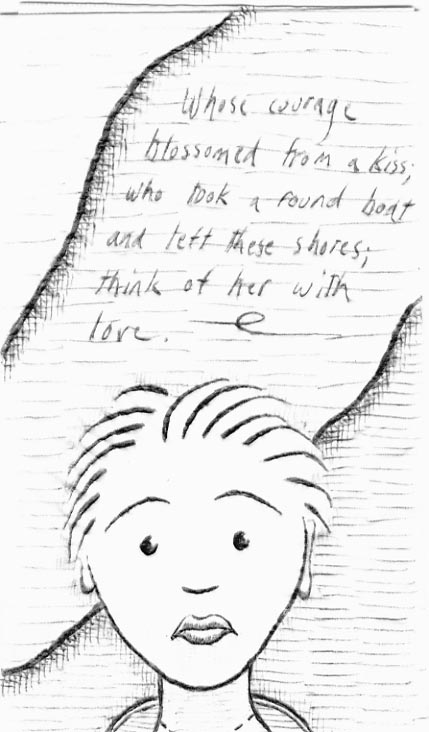
Monday, February 13, 2006
A Quiet Generation
Still I can hear your heartbeat when you lean over my shoulder.
The former owners of this house, they say, died in it. After living here a quiet generation, their kids all grown and moved out, one year much like the next. And now we are moving toward being the old couple in the old house. Moss grows on the roof. An old carousel-horse is so buried under long matted grass, by the back-yard fence, that it can be neither seen nor easily removed. Once our kids played on it.
Your breasts rest lightly against my shoulder and the nape of my neck, as you reach past me to lift a bowl from the table.
The neighbors' youngest son -- the one who visits home occasionally from college now -- asked you, not long after we moved in, with wide eight-year-old eyes, if it wasn't spooky to live in a house someone had died in. You laughed and said no. Most old houses, you said, someone has died in, at some point. You grew up in the house your grandparents died in.
You didn't say, but you could have, that what's spooky is a house that no one's died in, no proper house but a campsite. What's spooky is a people who can't hold still long enough to bury their dead.
I lean my head back against the softness, and listen. The distant, resonant beat.
Still I can hear your heartbeat when you lean over my shoulder.
The former owners of this house, they say, died in it. After living here a quiet generation, their kids all grown and moved out, one year much like the next. And now we are moving toward being the old couple in the old house. Moss grows on the roof. An old carousel-horse is so buried under long matted grass, by the back-yard fence, that it can be neither seen nor easily removed. Once our kids played on it.
Your breasts rest lightly against my shoulder and the nape of my neck, as you reach past me to lift a bowl from the table.
The neighbors' youngest son -- the one who visits home occasionally from college now -- asked you, not long after we moved in, with wide eight-year-old eyes, if it wasn't spooky to live in a house someone had died in. You laughed and said no. Most old houses, you said, someone has died in, at some point. You grew up in the house your grandparents died in.
You didn't say, but you could have, that what's spooky is a house that no one's died in, no proper house but a campsite. What's spooky is a people who can't hold still long enough to bury their dead.
I lean my head back against the softness, and listen. The distant, resonant beat.

Monday, February 06, 2006
Resolution
So an odd thing has happened. For over a week I have been full of resolution and combativeness, determined to retrieve my reputation at work, and wholly free from defeatism.
I can identify some reasons. A couple weeks ago I doubled my dose of antidepressants, back up to the middling dosage prescribed for me a few years ago. I got a frankly bad performance review at work. I've been reading books that showcase resolution and gallantry. And I resumed my Ngondro practice. I'm inclined to give that, sporadic as it's been, most of the credit.
With this change, some things have come into focus. How much the psychological center of my life has been a desire for approval in the real world, and a conviction that it's unavailable. I've grown very skeptical about the existence of this world, over the years, let alone its claims to superior reality, but that hasn't stopped it from cowing me. I have fled from it at every opportunity, seeking distinction in all sorts of alternative worlds, but hoping only to avert disaster in the real one. Now that a minor disaster -- that of losing a job I have not much liked for the past five years -- looms, it has suddenly lost its terrors. I don't really care. What I do care about is freeing myself of this incubus of self-doubt. I am determined to fail honestly, if I do fail -- to fail because the work is beyond my capacity, and not because of procrastination and diffidence. Failing that way would be a victory anyway.
I don't for a moment suppose that my struggle with self-doubt is over, any more than my struggle with my eating habits was ended by my apparent triumph over them last year (the last time, incidentally, that I was regularly doing my Ngondro practice.) But -- as with the eating habits -- knowing that this self-doubt can be defeated makes a great difference.
Blogdom being one of those alternative worlds in which I've sought distinction in order to avoid struggling for what I want, and believe I can't obtain, in the real world, I will probably be reading and posting less often. But when I'm here it will be because I want to be here, and not because I'm escaping from somewhere else.
So an odd thing has happened. For over a week I have been full of resolution and combativeness, determined to retrieve my reputation at work, and wholly free from defeatism.
I can identify some reasons. A couple weeks ago I doubled my dose of antidepressants, back up to the middling dosage prescribed for me a few years ago. I got a frankly bad performance review at work. I've been reading books that showcase resolution and gallantry. And I resumed my Ngondro practice. I'm inclined to give that, sporadic as it's been, most of the credit.
With this change, some things have come into focus. How much the psychological center of my life has been a desire for approval in the real world, and a conviction that it's unavailable. I've grown very skeptical about the existence of this world, over the years, let alone its claims to superior reality, but that hasn't stopped it from cowing me. I have fled from it at every opportunity, seeking distinction in all sorts of alternative worlds, but hoping only to avert disaster in the real one. Now that a minor disaster -- that of losing a job I have not much liked for the past five years -- looms, it has suddenly lost its terrors. I don't really care. What I do care about is freeing myself of this incubus of self-doubt. I am determined to fail honestly, if I do fail -- to fail because the work is beyond my capacity, and not because of procrastination and diffidence. Failing that way would be a victory anyway.
I don't for a moment suppose that my struggle with self-doubt is over, any more than my struggle with my eating habits was ended by my apparent triumph over them last year (the last time, incidentally, that I was regularly doing my Ngondro practice.) But -- as with the eating habits -- knowing that this self-doubt can be defeated makes a great difference.
Blogdom being one of those alternative worlds in which I've sought distinction in order to avoid struggling for what I want, and believe I can't obtain, in the real world, I will probably be reading and posting less often. But when I'm here it will be because I want to be here, and not because I'm escaping from somewhere else.
Wednesday, February 01, 2006
Qarrtsiluni
Things have been a bit quiet here, but you should all go read Maria Benet's new poem at Qarrtsiluni. It's terrific.
...Again you write:
nothing to declare,
nothing worth currency.
Things have been a bit quiet here, but you should all go read Maria Benet's new poem at Qarrtsiluni. It's terrific.
...Again you write:
nothing to declare,
nothing worth currency.
Subscribe to:
Posts (Atom)