Showing posts with label Whupping the Food Thing. Show all posts

Saturday, January 28, 2023

Annual Report for 2022, part 2

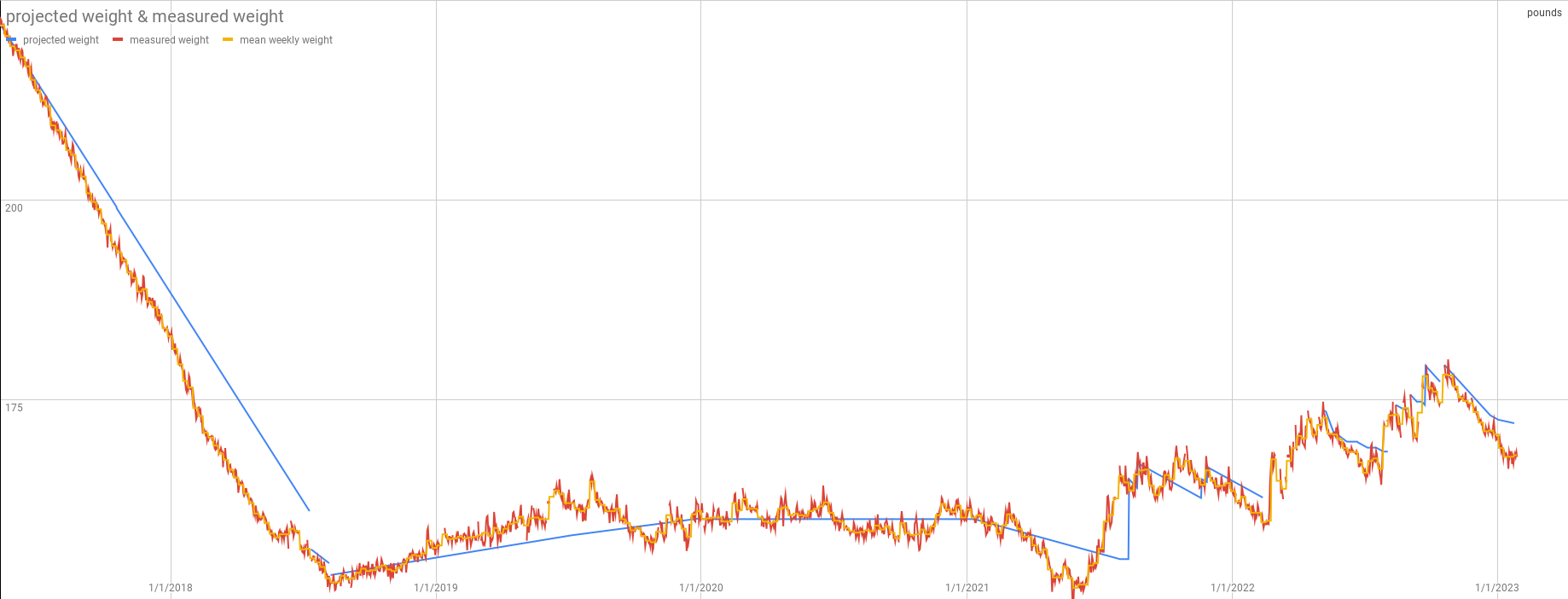
First, the grand overview, using the most familiar measure. Here's my weight in pounds, measured daily since May 2017. My discipline was very good for the first year and a half. I got down near 150 lbs, and decided I was skinnier than I liked, so I deliberately gained back 10 lbs or so. I stayed around 160 lbs for a couple of years. Then, in Spring 2021, I started experimenting with fasting. That brought my weight down rapidly, but my discipline deteriorated. Other things were going on: I was worried about my father's health. So I can't be sure, but it's hard to look at this graph and not to suspect that in Spring 2021 I disturbed my hormonal equilibrium. A pattern emerges of losing control for a few months, getting it back for a few months, and losing it again. With an overall trendline going steadily up. I didn't like the looks of this chart at all.


There were other ways to view the data that were more encouraging. I was putting on a lot of muscle through these ups and downs: I was training consistently, and I had inadvertently taken up the bodybuilder's typical bulk-and-cut method. I don't, unfortunately, have hip measurements clear back to the start of the project, but you can see that the graph of my waist/hip ratio, over those last ups and downs, makes the situation look a lot better. I was veering wildly from 90% to 95% and back again, but the overall trendline didn't look so bad. So I was alarmed, and determined to do something, but I wasn't panicked.

I had started tracking binge behavior a couple years ago -- just marking every day as "binge" or "no binge," where "binge" simply means "didn't eat exactly what I planned to." The graph of that looked, towards the end of 2022, like this:

That trendline was very alarming indeed. he whole project was threatened, if that went on. I would simply lose control entirely. I realized I needed to change my focus. A dozen pounds of weight, an inch or two around the waist, was not nearly so important as getting on top of the binge behavior. That trendline really needed to be reversed. 

So. I am back at at 90% waist/hip ratio now, and my project is to keep it there -- to hold that line horizontal -- for at least four months, and to do it without any bingeing at all. At that point I may try to steer down a little bit more; I would really rather have a slightly smaller waist; but getting the upper hand of the bingeing is obviously much more important. The binge graph now looks like this:


A better trendline, but not the one I want, yet. I'm not out of the woods.

So the 2023 project is to end the binges once and for all, and to have nice steady, stable, horizontal lines.

Tuesday, January 03, 2023

Feast Days (annual report part 1)

I have four designated feast days during the year, days on which I deliberately go off my regimen and eat whatever I want: Thanksgiving, Christmas, my birthday in March, and (in theory, because my sense of symmetry demands it) some unspecified day in high summer. I suppose this is a variant of the "cheat days" advocated by some diet gurus: the idea being to take some of the pressure of constant self-regulation off, and deal with binge behavior by getting ahead of it a little. But the term "cheat day" seems excessively negative, and possibly self-defeating, to me. The whole point is that I'm not cheating. Also, "cheat days" seem to happen oftener, in some versions once per week: my discipline would go to pieces if I were going off regimen that often. But there are days of celebration when it feels mean and antisocial to measure my oatmeal and weigh my potatoes. They're typically days of stress, for those of us who are trying to self-regulate: so it seems better to just roll with the holiday, have fun, eat too much, and go on with life.

It sets me back. It takes a week or even two to lose the weight I can pack on effortlessly in a single day of unregulated eating. But on the larger scale that I now think and plan in -- who cares? I'm not looking forward to some utopian liberation day. I will always need to "watch what I eat."

2022 was a hard year for me. I don't have time yet for my annual report, but the summary version is that 2022 was the first year I felt like my achievements were seriously under threat: I gained about fifteen pounds, and then lost ten, and gained fifteen more pounds, and lost ten again. That isn't as bad as it sounds, because I was packing on muscle at the same time: bodybuilders are quite right when they observe that it's a lot easier to build muscle when you're in a large calorie surplus. But if I gain ten pounds every year, in a few years I'll end up fat again. Not what I want: not what I'm going to do. It's been 70 days since I last had to record a binge day, which is the longest period since I began recording them, two years ago. Trendlines on my binge graphs are already looking less ominous, and I have (in the stock-market parlance) "broken out of the box." 

The challenge for 2023 is not to lose weight -- though I do expect to drift very slowly down another five pounds or so, and to lose another inch off my waist, still -- but to hold my graph lines more horizontal than I ever have. I know how to lose weight now, and I'm confident that if, in times of stress, I overeat, I know exactly how to to undo the damage. But what I have still never done is really hold a steady body composition, without having periods of bingeing and binge-repair. That's my ambition now. I want a nice steady horizontal graph.

(I seem to have drifted into delivering the beginning of my annual report anyway. Oh well. Graphs, with commentary, to follow :->)

Sunday, December 18, 2022

Because I Think I'm Making Progress

I know it's tiresome, the way I yatter on about my attempts to control my eating, and I know that the project seems endless. I'm well into its sixth year, and rolling out an elaborate "maintenance" plan, complete with graphs and algorithms, and I think it would be reasonable for a reader to say, "why don't you just get the hell over it and think about something different, and more interesting, for a change? Nobody else gives a damn about this"

Which is quite true: there's really nobody anymore who cares that much whether I weigh 150 or 250 pounds. And it doesn't even matter to me that much: I'm close enough to the end of my life that moving life expectancies around by 5% or 10% doesn't, in absolute terms, amount to much. Who cares?

There's three reasons I do care. One psychological: it's that this bears crucially on the narrative of my life. I grew up believing that under challenge I would always collapse, and that being fat was the outward sign of my cowardice and lack of fortitude. I believed also, like my mother, that this doomed me to being perpetually, and essentially, unlovable. So psychologically, it's as fraught as it can be. Is it my fate to become ever fatter and ever less loved? 

That reason is nonsense and always has been. It was nonsense of my mother as well, who grew ever fatter and had three devoted husbands. The fat wasn't particularly a problem, even to her longevity: she made it into her early 80s. The Doom of our House was always a stupid fiction.

So if this was only a psychological problem, it would make sense to simply drop it. Who cares how much I eat? Nobody. It's of compelling interest to no one at all.

However. The second reason has to do, not with longevity or lovability, but with physical well-being. Being fat renders me sulky, pimply, smelly, and impotent. It makes me susceptible to joint pain and back problems. Very little of that has to do with subcutaneous fat, which is pretty harmless: I think it has to do with visceral fat and chronic systemic inflammation. When I have a big belly my baseline is feeling really pretty crappy.

I used to think that people were exaggerating all these things, in the interests of the diet industry and so forth. Now that I have direct experience of it, I no longer think so. The differences are large, unmistakable, and unmistakably tied to a very particular threshold of belly fat. My body hates being fat.

The third reason though is much more important, and it has to do with -- I know a lot of you dislike this way of talking about it -- cultivating virtue. 

The opposite of gluttony is supposedly temperance, but in my case the virtue I'm cultivating is actually fortitude. It is the virtue I have always missed most. It has to do with keeping resolutions, and remaining steadfast in the face of adversity: it has to do keeping commitments. It has to do with not letting passing whims and glittery little distractions drive your life. The reason I keep practicing "whupping the food thing" is that I keep benefitting from it. Fortitude generalizes, in all sorts of ways. It keeps making me a better person: it keeps making my life better. Pablo Casals, when asked why he continued practicing the cello at age 96, answered simply, "because I think I'm making progress." And that's my answer too.

The difference in how I work, now, is striking: I used often to hit a wall -- if I was lucky, not till mid-afternoon -- beyond which I was utterly unable to push myself to do anything more. This happened daily; and there were days when I never managed to work at all. That just doesn't happen to me now. I get tired, sure, but if I look at a stack of work that will just take an hour more, and make tomorrow much easier -- I just do the work. No fuss, no bucking or shying of the mind. This is intimately related to restraining my eating: it's subjectively obvious that the virtue that enables me to proceed with work is the same one that enables me to refrain from eating what I've decided not to eat. I'd call it fortitude. Psychologists call it self-regulation. The general public calls it will power. 

I really think fortitude is a better name. Because it's not a matter of one part of me dominating the other parts: it's a matter of holding fast to a larger understanding of what's going on, and a matter of the various constituents of my spirit being better aligned. Self-regulation and will power suffer all the ills of despotism: blindness and caprice and grandiosity. And they're prone to sudden catastrophic failure. Fortitude is the opposite of that. I don't try to not to be tired, or not to be hungry. I just do what needs to be done anyway.

There is not much glory to this progress. I am well aware that this is remedial work. Many people were trained up in fortitude, as children, or at least discovered it early. I came to it late: so I'm celebrating triumphs more appropriate to a nine-year-old than a sixty-four-year-old. But it was the obvious, first thing that I needed to do, and I'm doing it.

Thursday, December 01, 2022

Smite the Vices

Here I am in the sixth year of my weight-loss project, and it is still the project that consumes most of my disposable will-power. Humiliating, but there’s nothing to be gained by trying to ignore or conceal it. It gains a certain shabby philosophical dignity if I call it “cultivating temperance,” I guess. It has the advantage of being easily and precisely calculable. If my waist/hip ratio is over 91%, then I’m not temperate enough. Hardly a full account of the virtue, but as a heuristic it works fine. Some virtues are difficult to evaluate. Not this one.

Looming behind this is the project of cultivating chastity. Lest this one should seem interesting – it amounts to not squandering precious work time on stupid, repetitive, commercial pornography. This also is humiliating, but there it is. But until I have the temperance habits fully in place, and have freed up some self-regulatory oomph, I may not make much progress on it. Although I think the temperance skills have already been transferring to this realm. (But possibly that’s just age-related decline of libido. Here again, the nuts and bolts of cultivating virtue contribute all too generously to the prime virtue of humility.)

There is the danger of sinking into a sort of mindless video game of smite the vices, and forgetting what all this is in aid of. The vices and virtues are not the point. Unbearable, dazzling beauty: being overwhelmed by the infinite fractal elaboration of the worlds, visible and hidden – that is the point. I could win the game and lose the life. This is necessary, but it’s not sufficient. Remember that.

Wednesday, June 22, 2022

Desperate Entitlement

Starting a two-week cut, today, after two weeks of maintenance. This was very first time that I've tried to simply hold my weight steady. A skill that, hopefully, I'll need to make much use of. But I'm still not down to the green zone yet, so chopping some 300 calories out of the daily regimen: expecting to drop maybe two pounds and maybe a percent from the waist-hip ratio. The green zone -- between 90% and 91.5% -- is a place I've been a couple times before: but the challenge is to stabilize that.

The main problem, psychologically speaking, is that I'm so accustomed to motivating myself with "getting to goal." I love tracking numbers, and watching them form patterns, and fluctuate. They have a compelling life of their own: and they blow through your soul like the wind, if you let them. So there's a certain amount of reconceptualizing that needs to be done. Nothing alive is actually static, of course: what I'm aiming at is... more like an eddy than a stasis. That's the right way to think of it: a swirl between the upper and the lower green lines. Dark water with glimmering curves in it: for a while. For a little while.

I was chatting with Tori about classical philosophers and eating. I associate controlling my eating with a bunch of (suspiciously gendered and denigrating) stereotypes of housewives fussing about their appearance. But, I told her, I can totally transfer over to the image of philosophers taking control of their lives: all the philosophers seem to have been notably abstemious about food. Tori asked about the hows and whys of that, and I said I guessed it was different in every case. Epicurus because the pleasure of food should take second place to other higher pleasures, such as philosophical friendship and conversation; Diogenes because, as a sort of classical Mr. Money Mustache, he thought that devotion to luxury was a form of slavery; Plotinus because the body was an embarrassment and impediment to the divine. Pythagoras because eating souls, including the souls of beans, was obviously wrong. (A diversion on Fava beans threatens there, and on the story of the ox that Pythagoras convinced to forgo beans, and which lived long beyond an ox's ordinary span. Whatever that may be. You know, right, that my name means "farmer of fava beans"? Much could be made of that.) Anyway. The point is that the unexamined diet is not worth eating. Or something like that.

But to be marginally more serious: I have been making an effort to think of this five-plus-year project as a spiritual enterprise, both because it's more motivating and because it's more true. Gluttony was simply the vice that was directly in my way. The obvious obstacle, smack in the fairway. Addressing it addresses more than my waistline. It addresses the surges of desperate entitlement, instilled I suppose as an American child: I deserve a treat, I deserve all the treats... which of course is an unsustainable train-wreck, and the basic driver of the present ruination of the environment. If I deserve anything, it's probably a kick in the pants; but surely the real project here is to become an adult, not a child, and to stop thinking of the world as a gallery of treats and punishments. I was not gaining a happier life by obstinately accumulating treats: I was making myself, and my world, sick. There are other ways to be.

This project has entailed planning ahead and shopping. It's entailed prepping my breakfast and cleaning the kitchen every night. And there's been a generalized effect from those disciplines to other parts of my life. Folding the wash as soon as it's dry. Planning my workdays so as to avoid bottlenecks. Sticking to irksome tasks, large or small, until they're done. Procrastination has quietly vanished out of my life: it's just not something I do any more. When I become aware of something that needs to be done, I do it, or plan it, and there's an end of it. 

Do I exaggerate, here? Possibly. But let it stand. It's truer than not.

Tuesday, May 17, 2022

Five Years Later

Five years ago today I undertook my last weight loss attempt. I had failed so many ways so many times: I promised myself this is the last time. No more.

That was the deal I made with myself: if this didn't work, I was going to stop, and just accept being fat, and get on with my life. I had already sunk an extraordinary amount of time and effort and anguish into the project. I needed to either succeed or fail. Whatever life was for, it couldn't be for struggling endlessly with this ultimately trivial issue. Who cares if I'm fat? What difference does it make?

The date I picked for the decisive day, the day I'd decide if I succeeded, was five years in the future: May 17th, 2022. I didn't just have to lose the weight -- I'd pulled off significant weight losses before, that wasn't the problem -- I had to get it off and keep it off. My target was 180 lbs. After five years, I reckoned, you could reasonably claim victory.

Today I weighed in at 170.2 lbs. So I succeeded! Kind of. But that's twelve pounds more than it was three months ago. As I succeeded in losing weight, and dropped all the way down past 180, down into the 150s, I revised my target, as one does: my target now was to have my waist measurement be 90% of my hip measurement. I'm at 94% now. Which isn't bad: but it's not the target. And the larger fact, it seems to me, is that after all this time and work, my weight is still not stable. The whole idea of the win-or-lose showdown was to be done with the damn issue, one way or the other. The real outcome, it becomes clear, is this: I will never be done with it.

It was realizing this, perhaps, along with other stressors, that sent my on my latest series of binges. When I was really faced with doing this forever -- eating the same thing every day, tracking meticulously, weighing and measuring -- a large part of me rebelled. Screw that. What is it for? said the rebels, and for a few weeks they had the upper hand, and binge-eating was the order of the day. (Or the order of the evening, actually: the evenings are generally when these collapses occur.)

What drove all this was the idea that my daily life might look different, at my goal weight: that I might be able to indulge occasionally, as normal people do, without getting fat. This is clearly untrue (For myself as I am now. There may be future selves that have wider options, who knows?) As I am now, I have only two paths open to me.

So this is clarifying. And which path I take is obvious. Onerous and discouraging as the path of restriction is, it is less onerous and discouraging than the path of bingeing. The thing about the bingeing is that it's intrinsically deluded. My mind is inflamed with the idea that there's satisfaction somewhere, on the far side of that bowl of ice cream. But on the far side of that bowl of ice cream is... the craving for another bowl of ice cream. And beyond that again, another. What stops the binge is not being satisfied: what stops it is the sheer discomfort of having eaten a week's worth of calories in a couple of hours, and the glut of a certain crooked longing for... humiliation? Breaking the lares? Dunno. I get gleams of pleasure -- especially early on -- but they're extinguished by the anxiety of the craving really rapidly. Very soon, only the anxiety is left. The whole thing is a chump's game. The reward never really comes. I catch certain of the rebel forces trying to convince the populace that we have in fact experienced satisfaction. My populace is not quite that dim. We have not experienced satisfaction, and they know it.

So -- there is no far side. There is no resolution. There is no being done with it.

And that actually is the resolution. What I'm faced with here is not a trivial issue, after all. What I'm faced with is life: my relationship with food is just the part that's been under the bright lights lately. If I want to be my own master -- to have agency in the world -- this is the price: exercising control. Setting limits. Planning ahead. Being an ordinary creature subject to the ordinary rules of life.

So does this mean I never get treats? Well, it does and it doesn't. Of course I will get treats. Of course my self-regulation will collapse from time to time, and I will binge: that has remained true all through this process, and presumably it remains true all my life. There will be birthday dinners and Thanksgivings. What there will not be is a magical exit from the rules of causation. Which I think is what the eagerness for treats actually amounts to: to stubbornly clinging to the hope that the structure of the universe will change. That the adults will let us stay up late and we won't get tired and we'll be able to have fun forever.

That's not the way this works. And it's not even -- to drop to the most prosaic level -- it's not even the way that maximizing pleasure works. Epicurus, who believed that the point of life was maximizing pleasure, ate simply and sparingly: not from a suspicion of pleasure, but from a wholehearted commitment to it.

Much more important than how I manage my eating is this: I am gradually learning -- this is remedial learning, something I should have learned in childhood -- to get ahead of myself a little, to plan and execute in my own person for my own ends. And that is not trivial. That's the project of inhabiting my own life, as I've written many times. I want to live in my life, not camp out in it. I don't want to be a tourist here. I want to be a local. And there is no time I feel more like a local than when I am following my own regimen: when I get up in the morning to the ritual of making the breakfast I prepped last night, or when I wash the week's apples as the finishing touch of putting away the week's shopping. Every time I follow through on a commitment to myself, there's a moment of relief, of rightness.

So call it a success, or call it a failure. It's both: but it ain't over.

Wednesday, February 16, 2022

Inside the Box: the Maintenance Plan

I did not have a very well-thought-out maintenance plan, the last couple times I got to my goal: just a fairly vague idea that I would "level out" by adding some calories back in. Exactly how many calories, and how I would pace myself on them, I didn't specify, so naturally what happened was that I just eased the restraints a bit, and what naturally happened after that was a period of binge-eating. Just as revolutions tend to break out when conditions are getting better, bingeing tends to happen when my calorie allowances are increased. The urge to break out of restraints is stronger when those restraints are loosened.

It didn't help that my graphs were all weight-loss graphs, not weight-maintenance graphs. They weren't  well adapted to visualizing what I wanted to visualize. These things matter, for me.

So the new graph is this one here:


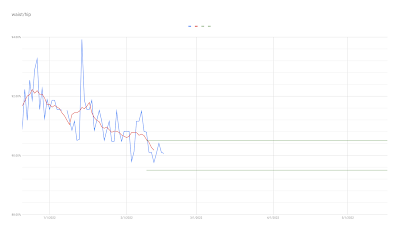
The thing being measured here is my waist measurement divided by my hip measurement, expressed as a percentage. The blue line is a three-day rolling average, and the red line is an eight-day rolling average; and the object of the game is to keep the red line "inside the box," that is, in between the two green lines, which mark out 89.5% and 90.5%. The plan is to keep my current regimen until the red line bashes into the bottom of the box, probably in about a month, and then to add a daily hundred calories, so as to spend a month wandering back up until it bashes into the top. Then reduce calories again, and repeat, indefinitely. (One of the things to be discovered is roughly how many calories it takes to "change direction.")

I mulled over other plans, but I think I like this best. I don't want to be "changing direction" daily or even weekly. Plus I suspect that it will be easier to build and retain muscle if I have weeks-long periods of mild calorie- and protein-surplus, alternating with weeks-long periods of mild calorie- and protein-deficit. I used to envision a steady state, a stable weight that stayed within a couple pounds of some number or other. I no longer think that would be necessarily desirable -- or an easy state to attain. Things shift too much: demands and stresses alter. I need a dynamic system that accommodates them. I hope this plan will be easier, and more flexible without entailing more decision fatigue. 

Thursday, July 01, 2021

Eat and Reading

 The story is told of an American Buddhist teacher -- I can't remember which one -- that a student, finding him eating lunch with a book before him, asked if this multi-tasking didn't run counter to his mindfulness principles. Shouldn't he be doing just one thing at once, with all his attention?

The teacher fixed the student with a baleful stare. "When I eat and read," he replied, "I eat and read."

---

This story passed into the idiolect of my marriage, so that "eat and read" was understood, and sometimes conjugated, as a single verb: "I was eat and reading yesterday when the phone rang..." 

I was binge-eating the other day, after a visit with my father -- those visits reliably precipitate binges -- and I noted that suddenly that as I ate, I was reading as I used to read: cruising through a hundred or a couple hundred pages per day. The penny dropped: so that's why I got through so little reading these days! I've been reading The Old Curiosity Shop for nearly a month, and I'm only two thirds through it: time was I would have dispatched it easily in a week. The reason I do so little reading now is that I no longer eat and read. I just read when I read, and reading by itself is a different activity, one that doesn't keep me bound so tightly into its orbit.

---

Not sure what to do with that realization. Maybe I'm not a reader: maybe I was never a reader: maybe I was just an eat and reader. Being the sort of person who reads a Dickens novel in a week has been part of my identity for so long that I have difficulty even bringing the notion that I might not be that sort of reader into focus. It's taken me four years to notice that there has been a change.

My knee-jerk response is, well, I must simply make myself read more. Or take up gum, or something. I can't actually read less. That would mean I was no longer me.

---

Or I could just not read as much. I don't need to be me, after all. Often I wish I weren't me. Why defend this identity? What do I really stand to lose?

---

Meanwhile, I got Eric Foner's classic history of the Reconstruction out of the library. (I have a couple more recent books on the same topic on hold, but they're taking forever to come in.) I realized at some point that much of my history reading was undershooting the target. Long ago I decided since that wars change things, I should read about the wars. It's useful to understand these things -- I often wish lefties understood more about military matters -- but for understanding the changes, what you really want to know is what happened after the shooting stopped. So rather than reading yet another history of World War II last year, I read Tony Judt's Postwar Europe. And now I'm reading about the Reconstruction. I've always shied away from it, knowing it would be grim reading, and that it's largely (from my perspective) the story of how the bad guys won after all. But all the more reason to dig in.

---

But I think one thing I am doing wrong -- if I want to read as I did back in the old eat and read days -- is that I am reading too many books at once, and taking my books as medicine, rather than as psychedelics. The whole point is opening the doors of perception, nicht? Washing the windows. Instead I've been primly reading improving books. No wonder my attention flags. I should take my reading in heroic doses.

---

As I walked this morning, before dawn, there was actually a little rain, or a least a heavy dewfall. It felt miraculous. A post-apocalyptic blessing.

Thursday, May 27, 2021

4th Fast

 This one was 48 hours. Much more challenging than 36, because the second night I got only two or three hours' real sleep; I dozed a couple more, but it wasn't near enough. My body clearly thought this was no time for sleeping: I should be out tracking an elk or gathering a yam. Maybe next time I'll cut my caffeine in half; that might help.

It will be interesting to see where my numbers rebound to, as I re-feed. In previous fasts they've bounced back surprisingly little. I give myself permission to eat the food I missed, the day after my fast -- i.e. if I want to double the portions on my next three meals, I can -- but so far I seem to want only one make-up meal, and then I'm back to my usual routine. I actually expected a lot more bounce-back in the numbers than I'm seeing. If it turns out that losing weight was as simple as fasting occasionally, I'm going to be pissed. All those elaborate meal plans and finicking about macros! 

I'm joking (mostly). I had to learn how to eat way differently. I had to give up processed foods. I had to learn to plan. I had to learn to maintain a kitchen. I had to give up spontaneous eating, except on three or four special occasions per year. It wasn't going to work without that.

But still, compared to the misery of continuous calorie restriction, this is just absurdly easy. Sure, I get hungry from time to time, but I was hungrier -- way hungrier -- when I was fat. When I was fat I was ferociously hungry several times a day. I think people who have never had a disordered appetite do not have any conception of how desperate that hunger is. Compared to it a 48-hour fast is a walk in the park. Who cares? I get to eat day after tomorrow. It's not like I'm going to starve.

It's downright comical to see the graph of my weight drop like a stone, off the bottom of the chart, after so many years of grimly driving it downwards, pixel by pixel. 148.5. But we have still to see the bounce-back, and to see if cravings arise. So far, nada.

I finished the fast at 2:00 yesterday, which is more or less dinnertime in my current routine. I ate "breakfast," and then a couple hours later I ate "lunch," and I was done. Now I'm back to the usual.

Tuesday, May 11, 2021

Anabolic / Catabolic Switch


This is possibly the most information-rich of the graphs I keep. The blue line is my hip measurement and red line is my waist measurement. I was not tracking the hip measurements until my big weight loss was nearly complete, unfortunately: it would be interesting to see what that looked like. But there's two and half years of daily measurements, here. To me there's one really striking fact that jumps out at me: my visceral fat is always either rising or falling. It's really striking given that my muscle (as represented by the hip line) was doing pretty much exactly what I was aiming at: a slow steady increase. But my visceral fat (as represented by the waist line), despite my best efforts at a slow steady decline, never did that. Not even for a couple weeks at a time. It was always either rising or falling, and always at about the same slope, either way. When you back off and just get the gestalt of the chart, it's obvious. This despite a very rigorous discipline in the number of calories consumed: I did change things, occasionally, but always in a controlled manner, and never by more than 100 daily calories. Yet, between those changes and the very occasional binges, the chart shows this very strong pattern.

It could be sheer happenstance, but I suspect I'm seeing an important physiological truth here: that for me there's an master anabolic/catabolic switch that has only two settings. It's either on or off.

I have always held, as an article of faith, that what I wanted was a slow steady loss of fat, until I hit the desired level (i.e. where I am now), whereupon I would ease up on the calorie restriction slightly and level off, and live happily forever in the perfect steady-state. But I realize now that I have no particular reason to believe such a thing is possible. I mean, clearly a steady state is possible for people whose appetites have never been broken: but it may not be possible for me. I may have to settle for a consciously-imposed version of homeostasis, flipping this switch back and forth every few weeks. Or maybe, with fasting as a new tool in my kit, it's will be a matter of generally leaving the switch on, but fasting for a few days every time I hit a tripwire, to jolt the line back down.

The steeper slope of the last visceral fat loss, by the way, coincides with taking up a ten or eleven hour feeding window. I'm playing with making that window smaller, and being done with eating for the day by 2:30. (This sounds quite stern and draconian if you don't take into account that my first meal of the day is often before 6:00 a.m. It's just a slightly early supper: the equivalent, for someone who's less of a morning person, of knocking off eating by 5:30 p.m.) I find, to my great astonishment, that I really don't like going to bed on a full stomach, now: it feels weird and impairs my sleep. 

The time-restricted feeding and the general calorie restriction don't coexist entirely comfortably: I'm still thinking about that. In general, I'm sort of doing both, since I generally don't want to cram any more eating into the feeding window than I'd be allowed under my usual calorie-restriction anyway. But on the rare occasions that I do, maybe I should let myself, so long as it's just a matter of more of my usual food.

Saturday, May 08, 2021

Four Years


On May 11th, 2017 -- four years ago next Tuesday -- I undertook a diet, for the last time. I weighed 222 pounds, and my goal was to get down to 180. If I failed -- or if I succeeded and then gained the weight back -- I was done for good and all. No more diets ever again.

I didn't really understand the scale of the enterprise, back then: that the project would take up the lion's share of my intellectual, spiritual, and physical energy for four years. I succeeded. I weigh 152 pounds today. If I maintain the success for another year, I grant myself permission to declare the success official, and probably permanent; but the cost was proportional to the benefit. I would do it again, but not entirely for the reasons I started. Everything looks a little different, from this vantage. I am, for one thing, much more charitable toward my previous failures. I was navigating with crappy information, and shockingly bad advice, and I was working full time. There was no way I was going to succeed back then.

Why would a person devote this much of their life to a silly project like losing weight? In theory I buy back the four years by having won back as many years and a healthier life: but that's statistical and speculative. If I die in a car crash tomorrow, the joke's on me.

Well, some of the story is personal and rather sad. My earliest memories are of my mother collapsed in an armchair, her sky-blue eyes wide and blank, slowly and inexorably eating a container of store-bought chocolate fudge frosting with a spoon. She would eat it to the bottom and swipe every bit of it clean with her finger. She fought with her weight all her life, and lost. She warned me that I too would ruin my life if I kept eating as I did. I kept eating as I did. She was clinically depressed, and the depression was so inwoven with the eating behavior that there was no untangling them. I loved to eat too, and we would often binge together, united in defying the world's determination to take our one pleasure away from us. I learned early the phase-shift between obedience and defiance, between fighting oneself and giving way. It dominated my life for a long, long time, and not just in the domain of food.

There were two of me: one who meant to eat well and one who did not. They would struggle for motor control. At times it was so finely balanced I could watch my hand slowly reaching for the freezer door, and then jerking back, and reaching again, and jerking back, as the different selves struggled for mastery. Sometimes one would win and sometimes the other. Even as one won motor control, the other would be planning and scheming: I could binge on ice cream while planning my next diet. I could also force myself to eat a salad while planning my next binge. Only one self at a time ordinarily had motor control, but they were both thinking all the time. It was an exhausting way to live, and it did not leave me with a high opinion of myself.

It did, however, teach me a lot about being a human being. I understood early a truth that many people never learn: that I could not control myself. In a knock-down drag-out fight between my will and my hormones, my hormones would win. Not every time, sure. but the self determined to eat all the food only has to win every once in a while, to win the war. You can win a dozen battles a day for six days, and eleven on Sunday morning, and still, there you are: eating enough on Sunday evening to make a comfortable week's surplus of calories. Your 83 straight victories mean exactly nothing. You're a glutton, and everyone can see that you're a glutton, no matter how baggy your shirts are. 

So I learned some compassion for people, the hard way: I learned early, and believe to this day, that no one can actually control their appetites. "Those who control their desires," said William Blake, "do so because theirs are weak enough to be restrained." I could count myself lucky -- and it was sheer luck -- that my desires were no more destructive and unacceptable than they were.

I have not mastered myself. I have learned, at great cost and with sustained efforts, to maneuver myself and arrange my life such that the self that doesn't give a damn about eating well gets control seldom, and has limited access to food when he does get control. I have not beaten him, and I never will. 

We do, however, jog along more comfortably together than we used to. I still binge from time to time, under certain kinds of stress, and I imagine I always will. But I waste far less energy fighting with him, and far less being ashamed of him. I watch him go to work now with mild interest. Huh! I failed, and a binge is coming on. I don't particularly try to stop it, or even to limit it. It will wear itself out. All I require of myself is that the next day I spend some time analyzing exactly where and how I could have planned ahead or intervened so as to head it off, so I can prevent the next one. Occasionally there is no answer: nothing on God's green earth could have prevented this binge under these circumstances. Fair enough: you do what you can. No one can do more.

For the first three years of my "success" you will find two- or three-day holes in my spreadsheets where the binges happened. When the binge guy was in control, I could not muster the wherewithal to record my food consumption, my weight, or my measurements: I only started recording again when my disciplined self was in the saddle. Now there are no holes in the spreadsheets. I record binges as meticulously as I record everything else. They are just information, and I need all the information I can get. 

So, there's some of the "why": putting this Manichean struggle somewhat to rest opens up some space, at least in theory, to live in a different way. To escape the depressive atmosphere of my childhood, and that blank, blue-eyed gaze into nothingness. It's fun to be lighter-weight. It's fun to be able to do pull-ups, and to imagine living to be eighty years old. But I don't know if it would have been worth four years of sustained effort, if that had been all I gained. Maybe: maybe not.

But this, this measure of peace with myself: yes. This was worth the four years.
Thursday, April 29, 2021

Chimeras


The numbers you get at the end of a fast are chimeras, of course: they're mostly about lost water, not about lost fat. I knew they would bounce back, and they have; and they may not yet be done rebounding. Still, it was agreeable to see two long-awaited numbers heave in sight: the 32" waist, and the waist-hip ratio of 0.900. 

The 32" waist is not a serious goal: I don't really care what my standalone waist measurement is, so long as it's under 34". But it has long been the purely theoretic number that lodged in my head as the size my waist ought to be: I think it may have been my waist measurement when I was a teenager. Or I may have thought it was: possibly it was the size of my Levis, which would have been total non-information. Who knows. I didn't learn to measure and record with real discipline until decades later. So it's not really what I'm aiming at -- just as 160 lbs wasn't ever really what I was aiming at -- but it eases my adolescent heart to see it.

My weight dropped to 150.9, and bounced back to 152.5 today. This is the least I have weighed in my adult life. When I did my initial big weight loss, I got down to 152 for a few days. I deliberately gained back to 160. At that point I felt like I was too damn little. But I've had a few years to adjust my mind to the fact that I'm actually an average-sized guy: no longer "beefy," or "husky," or "stocky." Maybe 150 or so is where I land: I can live with that. But weight, while it's easy to measure with (spurious) accuracy, is not a serious measure of what I'm really driving at, which is metabolic health. My best number for that is my waist-hip ratio: that is, my waist measurement divided by my hip measurement. I've been aiming at getting that number down to 0.900, and keeping it there.

I got there at the end of the fast yesterday: 0.889. I'm still there today, at 0.896. Since I have a nice data set now, four years of numbers, I know exactly how this graph behaves, so I know that keeping a 7-day rolling average around 0.900 means having that average wander back and forth in the region between 0.890 to 0.910. So it's business as usual until the 7-day average falls to 0.890: it's currently at 0.901. At that point I will cautiously lift my foot from the pedal.

So -- God willing and the creek don't rise -- I'm in the end game, now. It's been a long savage fight, but I think I'm winning this thing.

Wednesday, April 28, 2021

3rd Fast

3rd fast: the 36-hour one. This continues to be absurdly easy. You just don't eat. Nothing bad happens to you. You get hungry, and you tell yourself, "so this is what burning fat stores feels like!" and you get on with your life, except that you don't have to fuss about food prep. I feel something of a chucklehead: I tried so many difficult and convoluted methods, and I finally worked my large weight loss with a huge expenditure of energy and attention -- and all the while I could have just not eaten, from time to time. Sheesh.

Early days, early days, of course: I'm sure there's more to learn. And maybe the fasting wouldn't have worked without having established such ingrained habits of eating good food in reasonable amounts. We'll see. I keep tracking the numbers and observing the behavior. I have a considerable bank of actual data, now. It's not easy to fool me about what's going on. If my hunger hormones go "sproing!" and drive me to eating wildly, I'll calmly note it down, and lay my course accordingly. 

The back continues fairly borked. If it isn't much improved in a week's time, I'm going to escalate more resources towards it: do some more reading and see if I can get some physical therapy. This episode is a little different than my former ones -- less of the panic-seizing-up and more of just plain old pain. The paraspinals are remarkably sore from sacrum to mid-thorax. There is a faint possibility that this last ten pounds of weight loss has shifted loads or movement patterns somehow: but I'm more inclined to think that I just pushed too hard on the sprints, and stretched a little too much, and then asked my back on top of that to do a couple things it hadn't done in a year -- viz., a massage, and a drive to Eugene and back. That's still my working hypothesis. If that's so, then it really ought to resolve in the next week or two. Again: we'll see. I am managing to get a fair amount of exercise in now, even though walking more than ten minutes is out of the question. 

At the moment, with a full belly and a spreadsheet full of lovely numbers, my cup overflows with benevolence, regardless of the silly rituals I have to go through every time I transition from sitting to standing. The lark's on the wing, the snail's on the thorn, & etc. 

Tuesday, April 13, 2021

Physics: Biology

 The ridiculous ease with which I'm losing weight on my new regimen makes me think I may have made this whole process much harder than it needed to be, by casting a biological problem (how do you get fat to leave fat cells faster than it comes in?) as a physics-and-will-power problem (how do you reduce calorie intake without overwhelming your will power?)

The physics-and-will-power solution worked, but it worked by main force, and it wouldn't have worked if a) I weren't already a guy who liked measuring things and keeping spreadsheets and b) if I hadn't been extremely canny about managing hunger hormones and c) if I hadn't had a nice calm stretch of water in my life that allowed me to devote the lion's share of my exertions of will to managing my eating. I suspect now I could have done the big weight loss with considerably less effort. But who knows? I still had to go through weaning myself from processed foods, from flour and sugar and seed oils, and that was never going to be easy. This (very mild) intermittent fasting regimen would not have worked if I had been eating as I was four years ago: four years ago fitting more than a day's calories into a ten-hour window was child's play. Now it's quite difficult.

But of course, we're only a month in, and we have novelty going for us, and we also have the nearness of the goal going for us: a .90 waist-hip ratio is very close. My 7-day rolling average stands at .905. I want to take it to .89 before even thinking of taking my foot off the pedal, because there's bound to be random fluctuation of .01 or .02. But it's very close, in the range of weeks, if not days, by now. And that's even without reckoning in prolonged fasts. I am (by my old way of reckoning things) within a couple pounds of my realio trulio end-goal.

The biology of weight loss boils down to having the time that the insulin is low and the glucagon is high -- and hence the entrance to the fat cells is closed and the exit is open -- being longer than the time that it's the other way around. Yes, accomplishing that will generally translate to being in an overall hypocaloric state, but that's accidental, not essential. 

That's my best understanding now. The proof is in the pudding, of course. I should know whether I'm right within a few weeks. 

Monday, March 29, 2021

Belated End of Year Check-In

 I neglected my end-of-year check-in this year. So here it is, three months late. Here's the chart for the weight. Weight is a crummy metric for Metabolic Syndrome: it's analogous to cholesterol -- we rely on it because it's easy, and gives us a spurious but scientific-feeling accuracy. You can see the major contours below, though: I lost weight steadily from May 2017 to August 2018, going from 220 to 150; then I gained back ten pounds; for the two years thereafter I've held pretty steady at 160.


Below is the graph of my waist measurement over the same time (sorry, I don't know enough about the charts and PNG formats to get the scales to look the same: but they really are over the same period of time)


From this you get a better picture of what the changes in weight meant, and what I was trying to do. The year I gained ten pounds, I did it deliberately, and I did it without increasing my waist measurement, which I've been able to hold pretty steady in the 33" to 34" range. Waist measurement is fussy and inaccurate and frustrating, but it's actually a direct measurement of what I was most eager to do: reduce my visceral fat. So the ten pounds I gained was mostly muscle mass: something devoutly to be wished. Not because it's decorative, but because muscle means you can get up off the floor and carry groceries, etc.; and because it provides an excellent glucose sink for people (like me, like at least half the American population) that have difficulty managing glucose in a healthy way. The glucose that doesn't end up in your muscles lands in your liver, and the liver has to flail about trying to store it in various generally unhealthy ways.

The attentive reader will see that over the past year and a half I've tried repeatedly to bring my waist down another inch or two, with no success whatever. (That's where the blue line, which describes my intention, goes jagged, as I revise it over and over.) I had thought the same strategy I used for my original weight loss would work again: why wouldn't it?

Well, it wouldn't because within a week or two of cutting down my calorie intake, I would find myself binge-eating, just like the bad old days. God knows I don't want to start that up again. It was during one of these binge-prone periods that I had my blood lipids done, which showed a mild deterioration, and inspired my doctor to urge statins, and made me take the project of further reducing my visceral fat, and improving my metabolic health, more seriously. (Yes, yes, I know that cholesterol is a crappy metric for metabolic health, but it's not totally irrelevant, either. A happy liver just doesn't crank out that much cholesterol.) Hence the reduction of saturated fat -- the switch from the nightly hamburger and ice cream to herring and turkey (which is going fine!) Hence also the time-restricted feeding, also going fine, with a quite roomy ten- or eleven-hour feeding window: the idea of that is making sure that my insulin actually has time to fall for a reasonable amount of time. (Calling thirteen or fourteen hours a "fast" seems a bit overblown to me. "Not snacking" seems nearer the mark. But it makes sense that if you want to burn fat you'll have to stop flashing the "don't burn any fat! we've got sugar to burn!" signal at some point; i.e. let your insulin levels fall.)

And also I'm interested in real fasting, fasting for a day or two or three -- partly because of the the autophagy and senescent-cell-clearance speculation, which is fascinating but not really settled health science yet, and partly because it seems at least possible that it works for burning fat without lowering metabolism, which in real-life terms, may mean without kicking off binge-eating.

I'm interested too for what you might loosely call spiritual, or psychological, reasons: I've been hagridden by obsessive attention to food all my life, and I long to shake loose of it. I have never, in 63 years on the planet, gone a full 24 hours without food. This seems rather immature to me: not because I think I should have the will power -- I don't believe I will ever have any more will power than I have right now, or that I have, or should have, particularly more or less than anyone else -- but because I'd like to practice managing my endocrine reactions better. I would be a better person if I didn't get cranky and unreasonable at missing a meal, or at even the prospect of missing a meal. And I think with practice I might get a handle on that.

So that's the current project. Still pushing to get that waist/hip ratio down to 90%. And tomorrow is the next fast: 24 hours this time. (Or put another way, skipping lunch and dinner.) Wish me luck!

Tuesday, February 25, 2020

Fragilities

So. Today we regroup. So there’s another big fuck-up, and the temptation is to go catastrophic. But really, dude. You are still under 165 lbs, which is a miracle. You are not suffering a breakdown, you're suffering a denial-of-service attack from your lizard brain. You wanted and needed a break that you didn’t really contrive to give yourself during your “vacation,” which turned mostly into “re-upping your massage license week,” so now you’re taking it as you can. That’s fine.


This has revealed fragilities in the system. Now you address them: 
  1. You need to have some frozen soup, so when you run out -- as with the burger -- you’re not really out. Build some resilience into the system. Figure out how to freeze some soup. It’s not rocket science. All over America people are freezing soup. You can do it too.
  2. When the girls invite you over for dinner, what you do is consider whatever the hell you eat to be the equivalent of your burger and potatoes. You may miss your ordinary meal, but you tough it out. You’ve actually eaten more calories, probably. Enlist Martha to help you get through the rest of the evening. You can do this thing. Yeah, it’s hard, it’s place where it’s easy to break down. Maybe sometimes you will. But it’s not a system failure. Even if you binge every time, all that means is that you need to compensate with less consumption in your daily regimen, and you can do that. Seriously, dude: get real. This is not system failure.
  3. Every Wednesday and every Saturday is a soup-making day, unless you have a quart per day on hand to get you through to the next one. You can’t rely on yourself to make soup on a work day. That’s fine. But it does mean that the Wednesday-and-Saturday expectation is non-negotiable.* Nothing has higher priority than making the soup, on those days. 


*Duh moment: what has actually changed is that my biweekly visit to my Dad has become a Wednesday thing, not a Monday thing. Which means every other Wednesday is rather overloaded. Making soup *and* making the Eugene run is a lot to ask, maybe too much to ask. On the other hand it leaves the *Monday* free for cooking… so think and plan. You’ve learned to plan a couple days ahead, which is a huge triumph. Now you learn to plan a whole week ahead. Again, this is a thing all your ancestors pulled off. You can learn to pull it off too.

Wednesday, January 29, 2020

Vanishment

During my forty-five years or so of trying to lose weight, with varying intensities of effort, crowned with failure after failure, I gradually formed my expectations for what would happen if I succeeded. If I finally really lost weight, I would be celebrated and praised; people would be fascinated; I would be cornered at parties and asked for the secret of my success. I would modestly plume myself: admired by all, and anxiously consulted by would-be followers. What I didn't really expect was that I would disappear. 

But in fact I vanished. I was littler, of course: a continual wonderment to myself, a small lithe creature made of bone and hard muscle, that could wriggle through small spaces like a boy. My body in fact is a delight to me. This is the boyhood I never had. Even though I was only pudgy, and not yet fat, when I was a boy, I was intensely shy, and intensely aware of being weaker and slower than my peers. (I skipped a grade early in elementary school, so this was simple fact, not damaged self-image.) Only now am I having the experience of being physically competitive, full of energy, light on my feet: my vigor astonishes me. But I am smaller, and I have disappeared.

I should have expected this. There are two kinds of people: people who have never had much trouble with their weight, and people who have struggled with it all their lives. Neither kind wants to hear about my success. In crossing over, I have become suspect, unreliable, a traitor of sorts. The first sort are not interested, because -- why would they be? They know why people are fat: it's because they stuff their faces and have no will power. A previously fat person may have reformed, but there still is a whiff of bad character about them. Someone who let that happen to them? Ugh.

To the second sort, I am a standing reproach. I don't want to be. I do not in fact think that it is the fault of fat people that they are fat: I think that I have been extraordinarily fortunate in having had the resources to address a problem that ordinarily is insoluble. My solution is not portable. In a sense, I have nothing to say to fat people. My advice would run: "Establish a life essentially free of social, psychological, and financial stress; free up two hours per day to deal exclusively with preparing food, and line up a perfectly supportive household with no dependents. Then, here's what you do: ..." Who is still listening, by then? Who should be? Almost no one. 

Still, I'm a little sad sometimes, a little wistful. I had friends I valued, who have dropped away. A life of being jerked around by one's own hormones, dragged about against one's will, leaves marks. I will always be a fat person, as an alcoholic will always be an alcoholic; and in losing weight I have lost one of my communities.

Hard to know, hard to know. I was disappearing anyway, for other reasons and in other ways. I have always had a deep longing to disappear: that operates as well. To turn sideways and vanish into the air, light as bubble, a fleeting arc of iridescence floating on the wind: it may be the deepest desire of my heart. So it may be that I was due to depart anyway. I'm less and less present in the online world, as well as in such incarnate worlds as I ever inhabited. But on occasion I miss some of my former friends, and some of my former life.

Saturday, January 04, 2020

End of Year Check-In, 2019

Here's the charts for 2019:


Weight in 2019
Waist in 2019

The project for 2019 was to increase my weight by ten pounds, while losing half an inch off my waist. The weight-increase worked fine. But things went off the rails twice -- there were two periods in which I had a week or two of not eating according to program, and some binges -- not on the scale of binges as I used to know them, but bad enough. Things may or may not be under control again: it's too soon to know. I ended the year with my waist an inch and a half larger: not at all what I was aiming for. 

The unevenness itself is telling. My eating is not "fixed," and I doubt it ever will be: I think the safest assumption is that my appetite is permanently broken, and I will always have to monitor and deliberately control my eating. So that's discouraging, although I expected it: most people who have maintained weight loss over years report the same thing. The other thing to note is that going off the rails corresponds exactly with stress: it's not difficult to locate my parents' health troubles in the summer, or the onset of the holidays, on either graph. That's the decisive factor, and it's largely out of my control. This probably runs into the ditch any time my family has serious worries.

But backing off a bit, it's worth pulling up the full charts, back to the beginning of this project in May 2017:


Weight Since May 2017


Waist since May 2017

On this scale, the failures of this year look less important. Basically I lost the weight in the course of 15 months, and have kept it off for a subsequent 16 months.

I decided from the start that "success" in this project meant still being on track and in control five years later -- to wit, in May 2022. And in fact, my goal at the start was to get down to 180 lbs and stay there -- my present 160 is way beyond what I had thought possible. I need to remind myself -- since I tend to forget -- that this has still been, according to my original goals, wildly successful.

Other notes. The experiment in quitting red meat, and substituting bean salad for my nightly hamburger, was a resounding failure, and is involved in the end-of-year collapse. I've backtracked on that one. Maybe someday. Maybe not. 

The other thing to note here is that now, in maintenance mode, exercise actually matters. I attribute part of my success in losing my weight to totally ignoring exercise as a contributor to weight loss: it's a trivial factor, not worth taking into account, if you're trying to lose a pound a week. Calorie intake totally swamps calorie output ("you can't outrun your fork," as they say.) But when you're talking half a pound a month, or half an inch a year, the exercise is an important factor. I had cold viruses twice in December, and basically stopped lifting for that month, and even stopped walking for a week or two, which had a lot to do with how bad the numbers look there. I'm lifting again now, and have done some thinking and planning about how to get back on track after exercise setbacks: hopefully I won't be so derailed again. Not exercising at all feels really crappy and depressing. I need to get back to it as quickly as possible, even if it's just "ghost workouts": going through the motions with light weights (or none.)

So that's the year: 2019 is a wrap.

Tuesday, January 01, 2019

End of Year Check-In, 2018

2018 saw the end of the weight loss project. But I've changed nothing about how I regulate my eating: I just slightly increased the quantities of a few of my daily foods. I doubt I will ever be able to eat ad libitum, like a person whose appetite has never become disordered. I am on a diet for life, you might say. Which takes fair amount of tedious planning and effort, but I actually find it psychologically easier than the ceaseless fret of "what do I get to eat next?" -- which feels to me now, at the rare times when I entertain the possibility of returning to it, like a worse confinement than just restricting my eating. I know exactly what I'm eating next, in what quantity, so I don't have to think about it. I don't have much of a yen to go back to those cycles of craving and fleeting gratification and self-contempt. It was not much fun and a lot of ickiness.

Here's the charts:

Red line: weight in 2018. The blue lines were projected weights I was steering by.


Waist measurements in 2018

(You can see the 2017 charts here). I levelled off my weight at about 155 pounds (70 kg), with a plan to gradually bring it up to 160 pounds (72.5 kg) while either keeping my waist where it is, at 33 inches (84 cm), or bringing it down to 32 (81 cm). Changes at this point are slow and will be mostly invisible to the casual viewer. Lots of resistance training.

The other thing I'm undertaking in 2019 is trying to figure out my salt intake, and probably reducing it. I find the science on sodium intake confusing so far. And like the science on diet, founded on a lot of very dubious self-reported data. I don't think most people have any idea how much sodium they're consuming, just as they don't have any idea how many calories they're consuming. I'll keep reading, and in the meantime, I'll undertake to describe how much salt I'm eating with an actual reliable number. 

If there's one firm conclusion I've drawn about weight loss, it's that the primary difficulty has nothing to do with will power or psychology, and everything to do with accurate measurement. It's an engineering problem with fairly fine tolerances, and we approach it with laughably inaccurate measurement tools: what we end up doing is wildly oversteering until we capsize. I expect the salt problem -- if there is one -- will look a lot the same.

Anyway, happy new year to you all! The sun is shining, and melting the ice on the skylights: squares of pure pale blue are appearing there. As we say in the Buddha hood, may all beings have happiness, and the causes of happiness; may all beings be free of suffering, and the causes of suffering

xoxo

Friday, August 10, 2018

Obsession

A while back, in an online forum, someone wrote about having once been obsessed with their weight, in a bad way. They went on to give in evidence -- well, everything that I'm doing. Tracking everything. Carefully measuring weight and girth daily. Planning food intake carefully and following the plan exactly. This, she said, was her unhealthy obsession. She didn't want to do that again. She just wanted to lose weight.

So I mulled that over for a while. I suppose one person's unhealthy obsession is another person's due diligence. I feel less obsessed -- less hagridden -- by food than I have ever felt. It's true that I plan and track. But when I'm not shopping, cooking, eating, recording -- I'm not thinking about it. I used to fret about food a lot, and I spent a surprising amount of time "deciding what to eat." Mealtimes nevertheless came upon me suddenly, causing chaos and dismay. What should I eat? What did Martha want to eat? What should we do, at that tangled intersection of spending and indulgence and health risk and consumerism and HOW CAN WE SOLVE IT RIGHT NOW BECAUSE OH MY GOD I'M STARVING?

I used to eat so much more, and yet I was starving so often. The hunger was brutal. People with unbroken appetites have no idea how hungry we get.

I only get that hungry now if I've missed a meal by a couple hours. The uncertainty itself was a big contributor. If I didn't know what I was going to eat -- and knowing there was a part of myself that would try to stop me from eating what I wanted to -- there was a mounting anxiety as the hunger sharpened, and it all came to a crisis, and something had to be done immediately. There was no way to satisfy all the contending, contradictory demands, and the way of sheer indulgence glowed brighter and brighter and easier and easier before me. There was no way to do it right; but by God I could do it wrong in style! And not much later, I'd be eating epic quantities of takeout pork fried twice, followed by ice cream, followed by wheat thins. Eating my way through the evening. Maybe eating right would start tomorrow.

I have a hard time seeing my present way of eating as more obsessive than that. Yes, I plan it all. Yes, I write it all down (which takes about twenty seconds, with standard abbreviations. A typical food day's diary entry looks like this: "8/6/18 hb, al+b, chili, salad, hd, orange.")

And it's just food. It's not self-worth, or appreciation of art; it's not a moral triumph or a collapse into self-indulgence. It's just food. I like it. I eat it up. When I'm done I forget about till my next meal -- also planned, also ready to go. If this is obsession, so be it. I'll take it over my former experience, gladly.