So I'm laptopped again: an HP mini 110, at a total cost of $290. I'll probably regret this, but I'm keeping the Windows 7 "Starter" OS. I uninstalled the Norton teaser and installed free Avira instead. Downloaded Open Office (I'm damned if I ever again will submit to the highway robbery of Microsoft desktop tools!) and trying out Zumo. I am now officially ready to rock and roll again.
My aim is to keep my laptop cost down to $15 per month, and my strategy for doing that is going the dirt-cheap route. The big downside is that really cheap laptops don't last long at all. To meet my goal I'm going to have to keep this running for twenty months. Since all three of my last laptops have died of power jack contusions, I'm going to try to be very tender with this one's power jack. No more working on it while it's plugged in: no more getting tangled up with the cord when I get up off the couch.
It's a pain to go the low end route, since you have to replace the laptops so often, but it also keeps you disciplined about storing *nothing* that you really want to keep locally. That's been my goal for years. The local drive is there as a backup, of course, but anything I really want I keep pushed out to the net, one way or another, where professionals tend the data and back it up. Every time one of these laptops goes south, I do discover stuff that I was keeping only locally. But less and less. I handle each succeeding calamity with greater aplomb.
One could also go high end. But the thing is, if I bought myself a really nice Mac, say, I'd be looking at keeping it running for ten to fifteen *years* before it would work out to being as cheap. And unless the technology races slow way down, any machine looks to be useless ten years from now, no matter how high end it may be right now. I have a settled preference for taking my lumps up front.
I had a bad, bad hour with this machine when I first took it out of the box, and it would not power up for me. The power switch is a little spring-loaded slider that masquerades as a two-notch switch, and there was nothing on keyboard or screen that acknowledged powering on: I apparently turned it on and off so rapidly that I never saw even a flicker. I called India in high dudgeon, and spent half an hour learning, painfully, that there are alpha-bravo systems for confirming alphabetical serial numbers that I have never heard of (was he really saying "a as in aardvark," or was I having auditory hallucinations?) and that a circular saw going in the kitchen moves me easily from "hard of hearing" to "stone deaf." Eventually the screen started doing something, and I hung up on my friend in Bangalore -- who was by this time nearly as frustrated with me as I with him -- and life became one long sweet song.
So I'm back! And now I can get seriously to work on my poetry MS. O happy day!
Sunday, May 15, 2011
Tuesday, May 10, 2011
Hygiene
Are sun, moon, or stars by law forbidden
To smile where they list, or lend away their light?
I wonder where Donne really comes down? He loved to tease, of course, and I suppose his real conviction was that the whole game of love was a house of worldly cards. This poem, like others, is a reductio ad absurdum. Take love seriously, and it leads you to conclusions like these: therefore love is not to be taken seriously.
Donne himself indulged regularly in that bizarre 17th Century habit of alternating (at least in poetry) between attempting to seduce women, and vilifying their inconstancy. But he could at least see that the two projects made nonsense of each other.
I think of myself these days as only vaguely Buddhist. Not apostate, but certainly careless. But I am brought up short by a Facebook friend, scorning merciful thoughts towards Osama bin Laden, and expressing the wish that his corpse should be hanged from the Statue of Liberty till he rots, and then that his bones should be scattered in the gutters for passing New Yorkers to piss on.
I deliberately did not notice Osama's death: I do not choose to regard him as an important man. I'm not shocked on his account. The karma of his life and death is as obvious as karma ever gets. Osama's great misfortune is that he found people to take him seriously: I won't add to his troubles by joining the crowd.
No, I'm shocked on my friend's account. He has no habit of introspection, no religious tradition to help him, and he has no idea what he's doing to his mind by cultivating this hatred, what marks that kind of thinking leaves, what impotence it causes. And there's no way even to begin to tell him. It would be like trying to explain calculus to someone with no algebra or trigonometry: the conceptual building blocks are just not there. So again, I come to silence.
But I also come to realizing that, impatient of ritual and skeptical of authority as I may be -- dismissive of such fundamental doctrines of reincarnation and enlightenment -- I am a Buddhist now down to the bones, and will be till I die. I would not sink my hands in a tub of human shit and then walk around all day without washing them: with precisely the same urgency, and for precisely the same reasons, if I found my mind sunk in thoughts like these, I would clean up immediately with meditation and prayer. It's ordinary hygiene: I'd do it for my friends and family as much as for myself.
To smile where they list, or lend away their light?
I wonder where Donne really comes down? He loved to tease, of course, and I suppose his real conviction was that the whole game of love was a house of worldly cards. This poem, like others, is a reductio ad absurdum. Take love seriously, and it leads you to conclusions like these: therefore love is not to be taken seriously.
Donne himself indulged regularly in that bizarre 17th Century habit of alternating (at least in poetry) between attempting to seduce women, and vilifying their inconstancy. But he could at least see that the two projects made nonsense of each other.
I think of myself these days as only vaguely Buddhist. Not apostate, but certainly careless. But I am brought up short by a Facebook friend, scorning merciful thoughts towards Osama bin Laden, and expressing the wish that his corpse should be hanged from the Statue of Liberty till he rots, and then that his bones should be scattered in the gutters for passing New Yorkers to piss on.
I deliberately did not notice Osama's death: I do not choose to regard him as an important man. I'm not shocked on his account. The karma of his life and death is as obvious as karma ever gets. Osama's great misfortune is that he found people to take him seriously: I won't add to his troubles by joining the crowd.
No, I'm shocked on my friend's account. He has no habit of introspection, no religious tradition to help him, and he has no idea what he's doing to his mind by cultivating this hatred, what marks that kind of thinking leaves, what impotence it causes. And there's no way even to begin to tell him. It would be like trying to explain calculus to someone with no algebra or trigonometry: the conceptual building blocks are just not there. So again, I come to silence.
But I also come to realizing that, impatient of ritual and skeptical of authority as I may be -- dismissive of such fundamental doctrines of reincarnation and enlightenment -- I am a Buddhist now down to the bones, and will be till I die. I would not sink my hands in a tub of human shit and then walk around all day without washing them: with precisely the same urgency, and for precisely the same reasons, if I found my mind sunk in thoughts like these, I would clean up immediately with meditation and prayer. It's ordinary hygiene: I'd do it for my friends and family as much as for myself.
Sunday, May 08, 2011
Lighted Windows
The waitress, seeing me lost in thought, paused to wave a hand in front of my eyes. Not because she'd asked me anything. Gratuitously: simply because she'd seen that I was thinking. At once the old anger was ignited, and suffused me like a blush. I fixed a cold unsmiling gaze on her face, rocked with a rage so deep that I could do nothing but what I did in childhood: cut off my voice and my face, and present a perfect blank to the world, until I had control of myself again.
All my life people have done this. Seeing that I'm thinking something out, or exploring some emotion or experience with deep attention, they deliberately come and interrupt me. It's supposed to be funny. They've caught me, they seem to think, in a lapse.
If they knew the deep hatred their interruption lights in my heart, they'd back up even faster than this waitress did. In all the years I've suffered this persecution, I've never yet killed one of my tormentors. But there's always a first time, my pretties.
It's incomprehensible to me. If you see someone painting, do you step up to snatch the brush out of their hand? If you see someone working with power tools, do you go find the fusebox to switch off the electricity? If you see someone singing, do you take the opportunity to pitch a balled-up kleenex in their mouth? Why is thinking the one act of creative attention that it's supposed to be a harmless joke to ruin?
I have a horror of imprisonment, because I picture prison as a place where this happens all the time, where nobody ever leaves you alone to think.
Nowadays this sort of interruption happens so seldom that I can afford to hold no grudge; sometimes I don't even get angry. When I was in school it happened all the time, and I'm sure it still happens all the time to thoughtful children. I wish I could do something to protect them. I wish, at the very least, I could tell that that the day will come when they can surround themselves with people who would no more interrupt them because they are thinking than they would break a window because it was lighted. Someday, it will be rare enough to be worthy of a blog post. Hang in there, kids.
All my life people have done this. Seeing that I'm thinking something out, or exploring some emotion or experience with deep attention, they deliberately come and interrupt me. It's supposed to be funny. They've caught me, they seem to think, in a lapse.
If they knew the deep hatred their interruption lights in my heart, they'd back up even faster than this waitress did. In all the years I've suffered this persecution, I've never yet killed one of my tormentors. But there's always a first time, my pretties.
It's incomprehensible to me. If you see someone painting, do you step up to snatch the brush out of their hand? If you see someone working with power tools, do you go find the fusebox to switch off the electricity? If you see someone singing, do you take the opportunity to pitch a balled-up kleenex in their mouth? Why is thinking the one act of creative attention that it's supposed to be a harmless joke to ruin?
I have a horror of imprisonment, because I picture prison as a place where this happens all the time, where nobody ever leaves you alone to think.
Nowadays this sort of interruption happens so seldom that I can afford to hold no grudge; sometimes I don't even get angry. When I was in school it happened all the time, and I'm sure it still happens all the time to thoughtful children. I wish I could do something to protect them. I wish, at the very least, I could tell that that the day will come when they can surround themselves with people who would no more interrupt them because they are thinking than they would break a window because it was lighted. Someday, it will be rare enough to be worthy of a blog post. Hang in there, kids.
Saturday, May 07, 2011
Counting from the Middle
Oh, but maybe it’s you after all who’s right, to count
the costs of lingering. I have grown white with blossom,
wrinkled with lichen, confused with kisses that came
after the peace was declared. And still the roots push deeper
and the flare is brighter, and the copper-green pulls gold
tighter to the finger. How to reckon now, with the end
and the beginning both lost in the half-leaved trees?
In response to Luisa Igloria's Letter to Ardor at Via Negativa.
the costs of lingering. I have grown white with blossom,
wrinkled with lichen, confused with kisses that came
after the peace was declared. And still the roots push deeper
and the flare is brighter, and the copper-green pulls gold
tighter to the finger. How to reckon now, with the end
and the beginning both lost in the half-leaved trees?
In response to Luisa Igloria's Letter to Ardor at Via Negativa.
Tuesday, May 03, 2011
Customer Survey
At some point, five years ago or so, some application or other asked me to supply an avatar, and the nearest image belonging to me was the scan of this napkin-drawing:
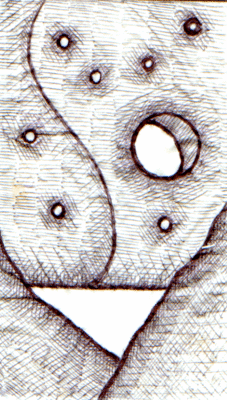
So I cropped it a bit and stuck the image in there, and the image sort of hitchhiked around until it became my image in the Google-Yahoo industrial complex, like this --

If you know me online at all, you've probably seen it beside my comments and so forth. So after five years of this, it suddenly occurred to me that this more or less randomly snipped thing has become part of my "brand," and that I should think about whether it actually presents me as I want to be presented. (I love, by the way, the fact that we use the word "brand" about human beings, since human beings have indeed been branded, throughout history, with hot iron. If they're slaves. Now we cheerfully do it to ourselves, happy to be our own slavemasters and peddle ourselves in the market.)
The hitch is that I have no idea how it lands for people. I took a certain pleasure in the fact that it was a) homemade, b) had moon, stars, hills and water in it, and c) hinted at something possibly, in an off-center way, erotic. As a Buddhist (not to mention as someone tending to morbid self-consciousness) I always have an uneasy relationship with this sort of self-reification, so having once come up with something, I just kept it.
But now it occurs to me that I should do a customer survey of the consumers of my brand. What do you think of it? Does it represent me? Should I substitute something else? Have you always hated it and been too polite to say so? Now's the time to be rude.

So I cropped it a bit and stuck the image in there, and the image sort of hitchhiked around until it became my image in the Google-Yahoo industrial complex, like this --

If you know me online at all, you've probably seen it beside my comments and so forth. So after five years of this, it suddenly occurred to me that this more or less randomly snipped thing has become part of my "brand," and that I should think about whether it actually presents me as I want to be presented. (I love, by the way, the fact that we use the word "brand" about human beings, since human beings have indeed been branded, throughout history, with hot iron. If they're slaves. Now we cheerfully do it to ourselves, happy to be our own slavemasters and peddle ourselves in the market.)
The hitch is that I have no idea how it lands for people. I took a certain pleasure in the fact that it was a) homemade, b) had moon, stars, hills and water in it, and c) hinted at something possibly, in an off-center way, erotic. As a Buddhist (not to mention as someone tending to morbid self-consciousness) I always have an uneasy relationship with this sort of self-reification, so having once come up with something, I just kept it.
But now it occurs to me that I should do a customer survey of the consumers of my brand. What do you think of it? Does it represent me? Should I substitute something else? Have you always hated it and been too polite to say so? Now's the time to be rude.
Saturday, April 30, 2011
The Shadow of its Flight
One last poem, one thick smudge
across the page, one smeared fingerprint,
one more prisoner to be shoved
across the broken ground.
Somewhere a clear green sky rises;
somewhere the rain has stopped.
Somewhere bare feet step on naked wood.
"Tell them," said Jefferson Davis,
long after it was all over,
trying hopelessly to explain, "tell them
I only loved America."
A disillusioned follower, well aware
of the poisonings and absurdities,
the fifty-three Rolls Royces, told me too
that to be in the room with Bagwan Rajneesh
was to be in the presence of someone
greater than a human being.
"I still think that, it's still true," he said,
a mournful apostate, broken at the root.
A swift and skillful bird plays on the wind,
turns, rolls, and with a flourish, lands on the wire:
revealing, this close, the imbecile profile
and depthless eye of a pigeon.
The blue pulse at your temple
is the shadow of its flight.
across the page, one smeared fingerprint,
one more prisoner to be shoved
across the broken ground.
Somewhere a clear green sky rises;
somewhere the rain has stopped.
Somewhere bare feet step on naked wood.
"Tell them," said Jefferson Davis,
long after it was all over,
trying hopelessly to explain, "tell them
I only loved America."
A disillusioned follower, well aware
of the poisonings and absurdities,
the fifty-three Rolls Royces, told me too
that to be in the room with Bagwan Rajneesh
was to be in the presence of someone
greater than a human being.
"I still think that, it's still true," he said,
a mournful apostate, broken at the root.
A swift and skillful bird plays on the wind,
turns, rolls, and with a flourish, lands on the wire:
revealing, this close, the imbecile profile
and depthless eye of a pigeon.
The blue pulse at your temple
is the shadow of its flight.
Friday, April 29, 2011
The Pebbles of the Wrist
And what to make of that pile of rubble,
the carpals tumbled at the fingers' roots?
What storm washed them there? What mender
set to work with glue and ligament
and tethered each to each?
My fathers carried their fathers'
in leather bags for luck, rattling
like dice in a Yahtzee cup. You can cast them
like the guts of birds: you can read them
like the I Ching or the Tarot.
Where finger thumb and arm come to parley,
time tries its combinations,
the tumblers shift and click,
until finally the guess is right, the hand unfolds,
and the pebbles of the wrist lie open to the sky.
the carpals tumbled at the fingers' roots?
What storm washed them there? What mender
set to work with glue and ligament
and tethered each to each?
My fathers carried their fathers'
in leather bags for luck, rattling
like dice in a Yahtzee cup. You can cast them
like the guts of birds: you can read them
like the I Ching or the Tarot.
Where finger thumb and arm come to parley,
time tries its combinations,
the tumblers shift and click,
until finally the guess is right, the hand unfolds,
and the pebbles of the wrist lie open to the sky.
Thursday, April 28, 2011
Massage Noir
A second session, and the headaches are as obscure as ever
hovering in the midrange, come-and-go, not thunderclap,
not migraines, not disabling, reassuringly bilateral. They ought
to be muscular in origin; the ill-named “tension headaches.”
But all the usual suspects have alibis. The lower traps have
confessed their petty crimes: they're going straight.
One of the wickeder, more inward scalenes, maybe. A strand
of lev scap cunningly twisted, hard to pin. Maybe
one of those outlandish muscles that only five percent
of people have? My mind roams among the more
freakish possibilities. Calf muscles. Wrist extensors.
Well. Next time I'm going to put her on her side
and see if something opens up. Interrogate
the lev scaps one at a time, where they can't
hear each other's stories. Let the SCM imagine
it's free of suspicion. Back the subscap
up against the ribcage and rough it up a little.
Sooner or later, someone's going to talk:
and when he does, these headaches
are going out of business.
hovering in the midrange, come-and-go, not thunderclap,
not migraines, not disabling, reassuringly bilateral. They ought
to be muscular in origin; the ill-named “tension headaches.”
But all the usual suspects have alibis. The lower traps have
confessed their petty crimes: they're going straight.
One of the wickeder, more inward scalenes, maybe. A strand
of lev scap cunningly twisted, hard to pin. Maybe
one of those outlandish muscles that only five percent
of people have? My mind roams among the more
freakish possibilities. Calf muscles. Wrist extensors.
Well. Next time I'm going to put her on her side
and see if something opens up. Interrogate
the lev scaps one at a time, where they can't
hear each other's stories. Let the SCM imagine
it's free of suspicion. Back the subscap
up against the ribcage and rough it up a little.
Sooner or later, someone's going to talk:
and when he does, these headaches
are going out of business.
Wednesday, April 27, 2011
Come, Tell Me How You Live
So, having no reply to give
To what the old man said,
I cried "Come, tell me how you live!"
And thumped him on the head.
Is it a faint smell of burnt toast, or a tang of citrus
that would rise from warm sheets in the morning?
Premonitory sadness draws me from
speculation: either would break a heart
that no repairman would touch. “You just
need a new one, man.”
No. On to the brisk day. The silver casque
settles onto my white head, and my U-lock
is couched in its rest. Laptop in my pack,
reading glasses in its pocket -- all wrapped
in proof: the yellow water-shedding stuff
given me by my daughter's partner long ago
to shield my basket's contents from the rain.
I'm ready to ride on my slightly ridiculous errantry.
Only that song, so familiar that at first
I don't realize I haven't heard it since the Fall --
the stirring of small warmths in the thicket --
the call of à l'arme! à l'arme! -- the danger
that I might take myself seriously, at last,
after all this time.
In response to this Morning Porch post.
To what the old man said,
I cried "Come, tell me how you live!"
And thumped him on the head.
Is it a faint smell of burnt toast, or a tang of citrus
that would rise from warm sheets in the morning?
Premonitory sadness draws me from
speculation: either would break a heart
that no repairman would touch. “You just
need a new one, man.”
No. On to the brisk day. The silver casque
settles onto my white head, and my U-lock
is couched in its rest. Laptop in my pack,
reading glasses in its pocket -- all wrapped
in proof: the yellow water-shedding stuff
given me by my daughter's partner long ago
to shield my basket's contents from the rain.
I'm ready to ride on my slightly ridiculous errantry.
Only that song, so familiar that at first
I don't realize I haven't heard it since the Fall --
the stirring of small warmths in the thicket --
the call of à l'arme! à l'arme! -- the danger
that I might take myself seriously, at last,
after all this time.
In response to this Morning Porch post.
Tuesday, April 26, 2011
Doppler Bird
I don't know much about birds.
I call her the doppler bird:
she begins a pure, liquid whistle,
not a bubble or a flaw in it anywhere,
and then its pitch drops, and drops,
as though she were falling, falling away from you.
Almost the comic sound
given to anvils falling in old cartoons.
But she's not going anywhere.
Right to the end, it's as loud and pure
as ever, and she reminds me
of Grace Slick, finding
somebody to love,
holding the note impossibly,
increasing the volume at the end
till you think her lungs will collapse.
And almost immediately she starts again
high on the cliff, stalked by
an immemorially frustrated coyote:
A sweet high whistle. A flute with a slider.
I hold an oiled foot in both my hands.
Hands fit with feet in dozens of ways:
they are just foreign enough
to be mutually fascinated.
Palm to sole, and fingers between toes,
heels cradled in a basket of fingers,
ankles held in thumb-straps:
everything the same and not the same.
There is a sweet spot on the sole
before the metatarsals knuckle out,
where you can nudge a thumb
as though it had lived there all its life,
and with your other hand, your mortar hand,
you push the foot down on the pestle thumb.
That's where the doppler bird begins to sing,
just there. And every thumbswidth heelward
you go, the note drops, sweet and pure,
rocking lower, flooding your ears.
No hesitation, no vibrato.
Something does collapse, then.
The toast-crusts of the spirit,
the rind of the heart, the table
of the soul's contents. What was
hard and edged softens, what was closed
opens. What happens in that
tiny space of silence? No one knows.
You might guess the doppler bird
is filling its lungs again,
returning to the top of the cliff,
but guesses miss their mark here.
No one knows what pours quietly
into that opened darkness.
I call her the doppler bird:
she begins a pure, liquid whistle,
not a bubble or a flaw in it anywhere,
and then its pitch drops, and drops,
as though she were falling, falling away from you.
Almost the comic sound
given to anvils falling in old cartoons.
But she's not going anywhere.
Right to the end, it's as loud and pure
as ever, and she reminds me
of Grace Slick, finding
somebody to love,
holding the note impossibly,
increasing the volume at the end
till you think her lungs will collapse.
And almost immediately she starts again
high on the cliff, stalked by
an immemorially frustrated coyote:
A sweet high whistle. A flute with a slider.
I hold an oiled foot in both my hands.
Hands fit with feet in dozens of ways:
they are just foreign enough
to be mutually fascinated.
Palm to sole, and fingers between toes,
heels cradled in a basket of fingers,
ankles held in thumb-straps:
everything the same and not the same.
There is a sweet spot on the sole
before the metatarsals knuckle out,
where you can nudge a thumb
as though it had lived there all its life,
and with your other hand, your mortar hand,
you push the foot down on the pestle thumb.
That's where the doppler bird begins to sing,
just there. And every thumbswidth heelward
you go, the note drops, sweet and pure,
rocking lower, flooding your ears.
No hesitation, no vibrato.
Something does collapse, then.
The toast-crusts of the spirit,
the rind of the heart, the table
of the soul's contents. What was
hard and edged softens, what was closed
opens. What happens in that
tiny space of silence? No one knows.
You might guess the doppler bird
is filling its lungs again,
returning to the top of the cliff,
but guesses miss their mark here.
No one knows what pours quietly
into that opened darkness.
Monday, April 25, 2011
Everything Twice
Rain thrashes tattered blossoms;
sparrow says everything twice.
Water sheets in the parking lot,
lens of a windshield; gutters
rush for the river,
stuttering eagerly;
crow crawls under
a pole switchbox and glares.
Indian plum
gone, serviceberry going --
rain thrashes tattered blossoms,
sparrow says everything twice.
In response to this Morning Porch post.
sparrow says everything twice.
Water sheets in the parking lot,
lens of a windshield; gutters
rush for the river,
stuttering eagerly;
crow crawls under
a pole switchbox and glares.
Indian plum
gone, serviceberry going --
rain thrashes tattered blossoms,
sparrow says everything twice.
In response to this Morning Porch post.
Sunday, April 24, 2011
Easter Falls on ANZAC Day
The criss cross leaves, against
the dark but paler sky
seen through the waving leaded glass
(installed in nineteen thirteen,
before those ANZACs had heard
the name Gallipoli)
A wind comes through them
and they come to a boil all at once,
the leaves, bubbling like a ramen pot;
and behind them the clouds are breaking,
and pools of light collect like the
ovals of olive oil
my son (just that age)
pours in to make the noodles
heartier. Tell me
that just this once
it doesn't have to happen again.
the dark but paler sky
seen through the waving leaded glass
(installed in nineteen thirteen,
before those ANZACs had heard
the name Gallipoli)
A wind comes through them
and they come to a boil all at once,
the leaves, bubbling like a ramen pot;
and behind them the clouds are breaking,
and pools of light collect like the
ovals of olive oil
my son (just that age)
pours in to make the noodles
heartier. Tell me
that just this once
it doesn't have to happen again.
Saturday, April 23, 2011
Matching Grant
The sun glows faintly through the clouds like a coin at the bottom of a fountain.
-- Dave Bonta, Morning Porch
. . . the color of plums, of Bordeaux,
of things that have lain a while in the clarifying
dark.
-- Luisa Igloria, “Mandorla”
It seems that Spring won't come
until I find forgiveness,
that the God of Cartwheels and Extravagance
is withholding his bounty:
that Spring is a sort of matching grant.
I'm the one responsible for the morning frosts,
the endless rains. The homeless man
who's lain on his side for forty days without food
is in no mood
to make me pretty prophecies. Not while the rain goes on.
Roll up the stinking blankets and begin again. Say the prayers
until you mean them. Take some comfort in knowing
that nothing comes clear, water or wine, without
having “lain a while in the clarifying dark.”
Forgiving injury is hard enough, but harder still
is to forgive the people we have injured
for being injured by us.
So fill the dusty offering bowls.
Stumble through the liturgy. Fumble
through the flyspecked pecha. Give us this day --
No, that's not right. Wrong God. Or is it?
Give us this day --
And finally the sun appears, wavering,
like a coin at the bottom of a fountain.
I think today we'll fill the bowls with wine
even if their cheap alloys dissolve. Why
call them offerings if you're not willing to give them?
Give us this day --
That can't be right. Until the summit
of enlightenment is reached I take refuge
in the Buddha, the Dharma, and in
something unintelligible.
I drop a sun, a bright penny,
into each bowl of wine.
Please forgive me.
Please give us this day.
Friday, April 22, 2011
Posterity

I don't really know why this itch
to listen to the dead, and speak to the unborn.
I could come up with reasons, but I think
they'd float away on the first stiff breeze.
Imagine our horror when Praxiteles
shows up one day with his studio crew
and sets them painting Adonis and Aphrodite
with floozy lips and baby blues.
I have been so long with the dead that the living
seem over-colored and fake: Marmaduke doggies
overturning end tables in the sickroom.
They're a breeding nuisance, and the unborn
don't promise better. Some professor,
inked all over with tattoos, will explain
the occult meaning of our poems.
“You're not to imagine,”
she'll say, “that they're really, like,
having crushes on each other.”
Nope. Not us. Hold still: I've got some lipstick
and a tube of cobalt somewhere in my coat.
Thursday, April 21, 2011
Invasives
Stark Street goes feral for a few moments.
East from 60th Avenue she climbs
up the shoulder of Mt Tabor,
curving up in a cutting, shimmying north,
and then bucking south, before becoming
prim again, a straight Gresham thoroughfare,
smoothing her skirts: butter
wouldn't melt in her mouth.
But when she goes wild on the hill, all bets are off.
Thickets of invasives everywhere. The slopes too steep
for proper lawns: blackberry strangles the shrubbery;
ivy throttles the trees.
Martha points out to me
the massive stems of dead clematis,
dangling like Richard of York's head
from the city gate.
Are they left there for a warning? I ask
She answers no, when they're that big
it's too dangerous to pull the vines down. You don't know
what's up there that will come down with them.
So you cut them at the roots and leave them there,
more like thick and stranded rope than branches,
gray as the sinews of an ox
freeze-dried on the Oregon trail. They sway
and shiver and twist, and do little grisly dances
in the Spring rain. The war goes on: York roses,
Lancaster roses, lickspittle playwrights, virgin queens,
white skeletons twined with the living wood.
in response to this Morning Porch post.
East from 60th Avenue she climbs
up the shoulder of Mt Tabor,
curving up in a cutting, shimmying north,
and then bucking south, before becoming
prim again, a straight Gresham thoroughfare,
smoothing her skirts: butter
wouldn't melt in her mouth.
But when she goes wild on the hill, all bets are off.
Thickets of invasives everywhere. The slopes too steep
for proper lawns: blackberry strangles the shrubbery;
ivy throttles the trees.
Martha points out to me
the massive stems of dead clematis,
dangling like Richard of York's head
from the city gate.
Are they left there for a warning? I ask
She answers no, when they're that big
it's too dangerous to pull the vines down. You don't know
what's up there that will come down with them.
So you cut them at the roots and leave them there,
more like thick and stranded rope than branches,
gray as the sinews of an ox
freeze-dried on the Oregon trail. They sway
and shiver and twist, and do little grisly dances
in the Spring rain. The war goes on: York roses,
Lancaster roses, lickspittle playwrights, virgin queens,
white skeletons twined with the living wood.
in response to this Morning Porch post.
Wednesday, April 20, 2011
Seasons (More on Trill & Mordent)
In the Woodrat podcast, Dave put his finger on it, the thing possibly I like best about Luisa Igloria's poetry: you don't know what's going to happen next. And again, it's not because of any legerdemain, any withholding. You never think, “Oh, I see, she kept this back so it would come as a surprise at the end.” It's just that the poems keep thinking, right up to the end.
“The Four Seasons of Life,” a meditation on a series of old lithographs, has these marvelous lines: “I was eighteen. I did not know what -- or even that -- / I could become.” But it's the Middle Age section I come back to, again and again. It worries me. “I am trying to learn how to leave my body,” she says, and I don't know why. And, you know, my life work is to bring people back to their bodies.
She goes on, immediately, “Much more difficult, to manage each / return.” Well, yeah. That I could have told her. We climb in a little more painfully, each time. A little more disquietude, a little stronger sense of loss.
Then suddenly -- you never know, with Luisa, when she's suddenly going to stomp on the accelerator like this:
That's simply gorgeous poetry, no matter how you take it. There isn't poetry better than that. I don't even notice at first that my Buddhist sensibilities ought to be outraged. All about seeing the self? -- worse, a representation of the self?
I can get around it, of course, I'm a clever boy, I can get around anything. I could say, it's not necessarily her face, it's just a face, it's intelligibility itself she's talking about. But I know better. It's Luisa's face we're talking about here, it's her becoming, the becoming she didn't even know could happen. And here again the word humane is the first word that comes to my mind. A kind of humanity and tenderness toward herself, as both vessel and burden. It's beguiling, of course, but it's also right, and whatever I think that pulls me away from understanding its rightness is, necessarily, wrong.
The poem ends by suggesting, wishing, mulling over the possibility that “there might be more than this world, / stenciled by the window-frame.” And of course there is, because she's describing a picture, but the description itself is a picture and the Luisa picturing it is a picture (rising to proof) and that's the world that there might be more than. But not yet. “Lord, take away my sins, but not yet.”
“The Four Seasons of Life,” a meditation on a series of old lithographs, has these marvelous lines: “I was eighteen. I did not know what -- or even that -- / I could become.” But it's the Middle Age section I come back to, again and again. It worries me. “I am trying to learn how to leave my body,” she says, and I don't know why. And, you know, my life work is to bring people back to their bodies.
She goes on, immediately, “Much more difficult, to manage each / return.” Well, yeah. That I could have told her. We climb in a little more painfully, each time. A little more disquietude, a little stronger sense of loss.
Then suddenly -- you never know, with Luisa, when she's suddenly going to stomp on the accelerator like this:
. . . I don't wish to desert the world,
not yet. Fear and desire, because I want to see
what face, what image, etched in reverse
on a metal plate and lowered into the acid bath,
rises to proof on paper.
That's simply gorgeous poetry, no matter how you take it. There isn't poetry better than that. I don't even notice at first that my Buddhist sensibilities ought to be outraged. All about seeing the self? -- worse, a representation of the self?
I can get around it, of course, I'm a clever boy, I can get around anything. I could say, it's not necessarily her face, it's just a face, it's intelligibility itself she's talking about. But I know better. It's Luisa's face we're talking about here, it's her becoming, the becoming she didn't even know could happen. And here again the word humane is the first word that comes to my mind. A kind of humanity and tenderness toward herself, as both vessel and burden. It's beguiling, of course, but it's also right, and whatever I think that pulls me away from understanding its rightness is, necessarily, wrong.
The poem ends by suggesting, wishing, mulling over the possibility that “there might be more than this world, / stenciled by the window-frame.” And of course there is, because she's describing a picture, but the description itself is a picture and the Luisa picturing it is a picture (rising to proof) and that's the world that there might be more than. But not yet. “Lord, take away my sins, but not yet.”
Anger
. . . God in my mouth
As if I did but only chew his name,
And in my heart the strong and swelling evil
Of my conception. -- Measure for Measure
I have been thinking about rancor.
About the petulant anger of
those of us, used to having, once denied.
I have been thinking of
the turning points of my life:
all of them a stumbling through
a white sheet of flame,
an opacity of anger, to come to
unexpected places beyond.
I am unused to anger, I began
and realized the lie as soon as spoken.
I am old in anger, old in resentment.
What then? What next? I sift through
a scanty toolbox: plastic screwdrivers,
hammers made of chalk,
Chalklines of sugar floss.
Shantideva says the same thing
your grandmother did:
count to ten. And Thich Nhat Hanh
advised a method of confession
that I can't bring to mind.
I tried to write, to inquire,
to apologize, and found myself
iterating my grievances again,
like Thomas Jefferson ticking off the sins
of George the Third, uglifying
what ought to be the most beautiful poem
of democracy. “A decent respect
to the opinions of mankind...”
Maybe that's the problem.
If you are the water ouzel
swim now. Catch the sun, carry it underwater,
wrap it in cold weeds.
Strip off your skin and turn it
inside out, make it a bag for holding
memories. Think.
Now cross, skinless and shivering.
Cross that scrawl of charcoal
on the coarse cement.
Vomit this morning's breakfast,
yesterday's dinner. Let the bile
in your sinuses kiss the coming tears.
It is always something simple, in the end.
Kneel, and press your forehead
against the sand-flecked concrete.
To desire and not to have:
that's all it ever is. That's all it ever is.
Put your skin back on, boy.
Swim back and bring out the sun.
Shake the water out of your wings;
say the shortest prayer you know.
Now we can begin.
As if I did but only chew his name,
And in my heart the strong and swelling evil
Of my conception. -- Measure for Measure
I have been thinking about rancor.
About the petulant anger of
those of us, used to having, once denied.
I have been thinking of
the turning points of my life:
all of them a stumbling through
a white sheet of flame,
an opacity of anger, to come to
unexpected places beyond.
I am unused to anger, I began
and realized the lie as soon as spoken.
I am old in anger, old in resentment.
What then? What next? I sift through
a scanty toolbox: plastic screwdrivers,
hammers made of chalk,
Chalklines of sugar floss.
Shantideva says the same thing
your grandmother did:
count to ten. And Thich Nhat Hanh
advised a method of confession
that I can't bring to mind.
I tried to write, to inquire,
to apologize, and found myself
iterating my grievances again,
like Thomas Jefferson ticking off the sins
of George the Third, uglifying
what ought to be the most beautiful poem
of democracy. “A decent respect
to the opinions of mankind...”
Maybe that's the problem.
If you are the water ouzel
swim now. Catch the sun, carry it underwater,
wrap it in cold weeds.
Strip off your skin and turn it
inside out, make it a bag for holding
memories. Think.
Now cross, skinless and shivering.
Cross that scrawl of charcoal
on the coarse cement.
Vomit this morning's breakfast,
yesterday's dinner. Let the bile
in your sinuses kiss the coming tears.
It is always something simple, in the end.
Kneel, and press your forehead
against the sand-flecked concrete.
To desire and not to have:
that's all it ever is. That's all it ever is.
Put your skin back on, boy.
Swim back and bring out the sun.
Shake the water out of your wings;
say the shortest prayer you know.
Now we can begin.
Tuesday, April 19, 2011
Outside the Walls
That's what I want to be. One fish
in the numberless fish of the snow. -- Chase Twichell
Easter is the resurrection: the renewal
of the blood sacrifice, the enshrinement
of killing the innocent to protect the guilty.
Oh yes, we're all on board. Wash while
you sing the alphabet song: wash while
you sing the cathedral program.
You'll never be clean. Not if you strip
the flesh from your fingers: the stain
is in the marrow bone. And in spite of that
we call this Friday good.
This is my last visit to the church,
my dears. Thank you for letting me in.
Thank you for letting me gaze
at your strange and bloody pictures.
I will never tell the truth again. You've won.
I am going to live outside the walls:
I always have, I always will. Still, thank you:
thank you for letting me sit in an alien pew;
thank you for letting me pretend, a while.
in the numberless fish of the snow. -- Chase Twichell
Easter is the resurrection: the renewal
of the blood sacrifice, the enshrinement
of killing the innocent to protect the guilty.
Oh yes, we're all on board. Wash while
you sing the alphabet song: wash while
you sing the cathedral program.
You'll never be clean. Not if you strip
the flesh from your fingers: the stain
is in the marrow bone. And in spite of that
we call this Friday good.
This is my last visit to the church,
my dears. Thank you for letting me in.
Thank you for letting me gaze
at your strange and bloody pictures.
I will never tell the truth again. You've won.
I am going to live outside the walls:
I always have, I always will. Still, thank you:
thank you for letting me sit in an alien pew;
thank you for letting me pretend, a while.
Monday, April 18, 2011
What To Tell Her
She came to me
diffident but insistent,
as the dead do,
filled with the urgency to speak.
Would you please
she said, but then worked silently,
internally, like a modern dishwasher
on some fancy setting
for a while.
The last time I saw you,
I said, lest things grow awkward,
was bad times. Goblins
sorting organs in the basement.
I'm glad we're done with that.
Would you tell her,
she finally said. It's always words.
It's funny, the dead
don't care about things anymore.
It's only the words, the words
they're desperate to get right.
Would you tell her I'm sorry, I'm sorry
that I loved her so much.
It was the only thing I could do.
I could tell her that,
I said. But it's only
what any of us would tell our kids,
if we could,
if they could hear it.
I don't think you came
all this way to say just that.
She laughed, suddenly,
so that the curtain stirred.
Ah, you're like her father:
she said, not nearly
so soft and drifty as you seem.
I know what I think
you should tell her, I said.
Tell her you could only protect her
from the things
you could protect yourself from.
She was silent a while.
You don't quite understand yet,
she said, and neither does she.
But say that for now, say that for now.
It's difficult working from this side,
you know: everything's backwards.
It's like trying to back up a U-Haul trailer.
But tell her -- and suddenly
she was fierce -- tell her I love her.
She backed away, as they do, without moving.
Not the messenger you would have chosen,
I know, I said, and we both laughed.
You take what you can get, she said,
and vanished.
diffident but insistent,
as the dead do,
filled with the urgency to speak.
Would you please
she said, but then worked silently,
internally, like a modern dishwasher
on some fancy setting
for a while.
The last time I saw you,
I said, lest things grow awkward,
was bad times. Goblins
sorting organs in the basement.
I'm glad we're done with that.
Would you tell her,
she finally said. It's always words.
It's funny, the dead
don't care about things anymore.
It's only the words, the words
they're desperate to get right.
Would you tell her I'm sorry, I'm sorry
that I loved her so much.
It was the only thing I could do.
I could tell her that,
I said. But it's only
what any of us would tell our kids,
if we could,
if they could hear it.
I don't think you came
all this way to say just that.
She laughed, suddenly,
so that the curtain stirred.
Ah, you're like her father:
she said, not nearly
so soft and drifty as you seem.
I know what I think
you should tell her, I said.
Tell her you could only protect her
from the things
you could protect yourself from.
She was silent a while.
You don't quite understand yet,
she said, and neither does she.
But say that for now, say that for now.
It's difficult working from this side,
you know: everything's backwards.
It's like trying to back up a U-Haul trailer.
But tell her -- and suddenly
she was fierce -- tell her I love her.
She backed away, as they do, without moving.
Not the messenger you would have chosen,
I know, I said, and we both laughed.
You take what you can get, she said,
and vanished.
Sunday, April 17, 2011
Infusion of Red
Your scissors work their way around my ears,
munching my hair like lettuce: thin crunches
that, when the cold steel lays flat
to the temporal bone, sound exactly like
the crackling cartilage under my thumbs
when I work on a difficult shoulder.
You would think a cottonwood tree in Spring,
throwing down wisps of white and gray.
I sweep it up afterwards. Barely enough
to line a mouse's nest. My son's thick brown stuff
fills the dustpan: he could fit out
opulently
every bird and rodent in Portland. Or
you might think
of the frayed cuffs of a gray silk shirt
useless now for going out, but still
sweet enough to toy with absently
when the afternoon sun is vanishing
behind laid courses of cloud. Or --
listen, the truth is
no one's going to think of it all.
Get a shower, man. Wipe down your table.
Think of all you ever knew or dreamed
about working a guarded sacrum:
How with one hand on the ribs,
and one palm cradling the iliac crest,
you will gently, gently begin to rock
the whole frame. Casting off at last.
The same wind that takes
the cottonwood floss over the fence
and that builds Marpa's tower of cloud
to hide the sun, the same wind that
fills the sails of that bloody stubborn bark
easing slowly down the skids into the water:
the very same wind is carrying
in sly hidden packets of transparent air
the crimson, the scarlet, the ruby
screaming red into your blood.
Breathe deep. Be an old man: be a
wicked impossible infusion of red
into the pale world.
In response to this Morning Porch post.
munching my hair like lettuce: thin crunches
that, when the cold steel lays flat
to the temporal bone, sound exactly like
the crackling cartilage under my thumbs
when I work on a difficult shoulder.
You would think a cottonwood tree in Spring,
throwing down wisps of white and gray.
I sweep it up afterwards. Barely enough
to line a mouse's nest. My son's thick brown stuff
fills the dustpan: he could fit out
opulently
every bird and rodent in Portland. Or
you might think
of the frayed cuffs of a gray silk shirt
useless now for going out, but still
sweet enough to toy with absently
when the afternoon sun is vanishing
behind laid courses of cloud. Or --
listen, the truth is
no one's going to think of it all.
Get a shower, man. Wipe down your table.
Think of all you ever knew or dreamed
about working a guarded sacrum:
How with one hand on the ribs,
and one palm cradling the iliac crest,
you will gently, gently begin to rock
the whole frame. Casting off at last.
The same wind that takes
the cottonwood floss over the fence
and that builds Marpa's tower of cloud
to hide the sun, the same wind that
fills the sails of that bloody stubborn bark
easing slowly down the skids into the water:
the very same wind is carrying
in sly hidden packets of transparent air
the crimson, the scarlet, the ruby
screaming red into your blood.
Breathe deep. Be an old man: be a
wicked impossible infusion of red
into the pale world.
In response to this Morning Porch post.
Saturday, April 16, 2011
Sometimes Nothing Happens
Sometimes life comes softly to rest
against the pilings, like gleaming
bronze leaf litter, nudging with
the spent wakes of outing boats,
the whole slough a teapot open to the sky
steeping last year's alder leaves.
Sometimes the herons pause, and
turn their slow reptilian heads,
actors with huge presence,
about to roll out their lines:
but they think better of it,
and take one deliberate step instead.
Sometimes the sky breaks into
the banners of angelic armies,
frayed by centuries of jealousy,
where Lucifer and Gabriel have stood
with gloves upraised for twice ten thousand years
that they will never dare throw down.
against the pilings, like gleaming
bronze leaf litter, nudging with
the spent wakes of outing boats,
the whole slough a teapot open to the sky
steeping last year's alder leaves.
Sometimes the herons pause, and
turn their slow reptilian heads,
actors with huge presence,
about to roll out their lines:
but they think better of it,
and take one deliberate step instead.
Sometimes the sky breaks into
the banners of angelic armies,
frayed by centuries of jealousy,
where Lucifer and Gabriel have stood
with gloves upraised for twice ten thousand years
that they will never dare throw down.
Friday, April 15, 2011
Montana
Little Bighorn, Bitterroot, Helena, the sticks:
The vicious-minded pony who threw you again and again,
The horses that stood on your chest, the father
who rifled your store of best friends for his wives.
Big sky,
maybe, but not enough room. Time to pack up and go.
Between the deltoid and the pecs
of the Continental Divide
Is a ranch where you and your friends spent the summer
in a teepee, pretending to be the blowsy barmaid
on Gunsmoke, not quite clear maybe
on what that was code for. Pouring drinks
for thirsty men seemed like it might be fun.
Time to pack up and go.
From here, everything flows to Gulf, everything
turns muddy and dirty at last. So you struggle up
and over the shoulder, and look at the wide country
where everything flows clean to the Columbia,
to the Oregon Country, the green trees and the gentle rain.
It was all long ago: the Divide has sunk beneath
the horizon, and Hood stands as far east
as any of us will go. My dearest wanderer
between the mountains and the sea, it marks you,
it makes me reach for the doorpost, it calls me
in dream and memory, that tilt of the world,
that opening of the sky, that taste of
the bitter root of things,
that sudden extraordinary sweetness.
The vicious-minded pony who threw you again and again,
The horses that stood on your chest, the father
who rifled your store of best friends for his wives.
Big sky,
maybe, but not enough room. Time to pack up and go.
Between the deltoid and the pecs
of the Continental Divide
Is a ranch where you and your friends spent the summer
in a teepee, pretending to be the blowsy barmaid
on Gunsmoke, not quite clear maybe
on what that was code for. Pouring drinks
for thirsty men seemed like it might be fun.
Time to pack up and go.
From here, everything flows to Gulf, everything
turns muddy and dirty at last. So you struggle up
and over the shoulder, and look at the wide country
where everything flows clean to the Columbia,
to the Oregon Country, the green trees and the gentle rain.
It was all long ago: the Divide has sunk beneath
the horizon, and Hood stands as far east
as any of us will go. My dearest wanderer
between the mountains and the sea, it marks you,
it makes me reach for the doorpost, it calls me
in dream and memory, that tilt of the world,
that opening of the sky, that taste of
the bitter root of things,
that sudden extraordinary sweetness.
Thursday, April 14, 2011
When We Meet
There are so many things I don't know.
I don't know if, when we meet, it will be
within the bounds of decorum
to scoop you against my chest and hold you
for the space of seven heartbeats.
I don't even really know
if the joy will hold that long,
if the leaves' quick gesturings,
refracted through a foreign window
and brought back in a buck-basket
(dumped out on a muddy bank,
to the mirth of all beholders)
will mean then what they mean now.
I don't know how to call back
that wandering truant to the nest,
and I don't know if I should.
But I know that if I press my palms together,
and open them slowly, light flares up, like
a stray drop of butter burning on the stove.
I don't know if, when we meet, it will be
within the bounds of decorum
to scoop you against my chest and hold you
for the space of seven heartbeats.
I don't even really know
if the joy will hold that long,
if the leaves' quick gesturings,
refracted through a foreign window
and brought back in a buck-basket
(dumped out on a muddy bank,
to the mirth of all beholders)
will mean then what they mean now.
I don't know how to call back
that wandering truant to the nest,
and I don't know if I should.
But I know that if I press my palms together,
and open them slowly, light flares up, like
a stray drop of butter burning on the stove.
Braid

Trill & Mordent, Luisa A. Igloria
I read “Braid” for the fifth time, wondering the while if there's some key to it, something quite simple that makes all its difficulty easy. I'm still sometimes too easily deterred from modern poetry. Twenty years of peremptory dismissal leave one vulnerable. “Have you ever known a schoolmaster,” asks Stephen Maturin, “who was decent company?” The habit of authority, it corrodes your heart. I've read old poems, that I understand to the bones, over and over. I expect poems to yield to me, and I get cranky when they don't.
I called Luisa humane, and Dave said, yes, like a renaissance humanist, interested in everything. Which was true enough, yes, but not what I meant, no. I meant she's humane as Martha is humane: she accepts that we are twined together, that we're in a social fabric that only stretches so far. The opposite of American individualism. Not a self first, but a daughter, a wife, a mother first, and only a self when time and stress permit. That's what makes her so radical and so healing. She's not from here. She's from somewhere else.
Whatever “Braid” is about, it's about togetherness, about being twined with others. It's about gravity, which is, after all, nothing more nor less than mutual attraction writ large. And about the way we lay in next to each other, not mooshed, but parallel, like the ribs of grosgrain ribbon, like the atoms she has read about “which like to sit next to each other.”
. . . the equal effects of
the heart's turning toward the same gravity, that spiralling and marvelous together.
The poem seems more and more important as I handle it and turn it back and forth -- more for what it doesn't say than what it does. She's not afraid. Nothing about all this packing in together frightens her. She is not in the slightest afraid of annihilation. I try, and fail, to think of another contemporary poet who does not twin annihilation and love. A twinning that I already know I'll never find anywhere in Luisa's work. She doesn't want to love anyone to death. She wants to cook them dinner. That's what I meant by “humane.”
I've been reading this book for two days. I page back and subtract the front matter: in that time I've read thirteen pages. I'll never finish within a week. So far there's been precisely one poem, “South,” that I needed to read only once. The rest of them demanded several readings. It's strange, because she's not an obscure poet, as we moderns reckon these things. She's not trying to make anything difficult. But she has a metonymic habit of mind. She lays out, say, the “accidentals” -- the trills and mordents, musical notes that “change the pitch with just the slightest touch of dissonance”-- and then the random D.C. shootings, and then an oblique move towards a love that is an impulse “to discover which room in her body / houses the accidental sound of a tuning fork / struck and echoing in the middle of her life.” She doesn't say how these things are related. She doesn't even say they are related. They're just in the same poem.
It's what the man I learned Old English poetry from, Fred Robinson, would have called an appositive style. Plunk things down next to each other, without defining their connection, and see what happens. Old Germanic poetry is full of it, and also full of interlace structures: the two seem to go together. But it doesn't make for quick reading.
There's no hurry. I'll be reading these poems the rest of my life. Thirteen pages, and I already know that.
I first met Luisa with irritation. She'd written a poem in the Morning Porch comments, fine, what hast thou to do with me? And then Dave was reposting them on Via Negativa. For a long time I didn't read them. Christ, I have enough to do, to keep up with my friends. I skipped them and went on.
But after a while, he'd been doing over and over -- and I trust his judgment so much -- I thought, you know, if Dave thinks I need to read this poetry, he's bound to be either right or interestingly wrong. So I read one, and my heart turned over. I was an instant convert. I took to reading the Morning Porch, and waiting to see what Luisa would do with this one. It was magical. It' still magical.
Others on Trill & Mordent: Kristin Berkey Abbott, Dave Bonta
Wednesday, April 13, 2011
Natural History
The rain, a thick boxer who never goes down,
sucks air for another round. The dirty gray sky
is a tarp tied down on a pickup load
of stained mattresses and plastic toys: the scraps
may flutter but nothing's coming loose. Maybe
there's work in Oregon. Maybe not.
A thrash in the river, like a snag but moving
slowly into shore, something huge
but invisible: a sea lion, or a sturgeon
striking at a school of -- something, that
spatters the water like black coins. Time
was we would gone down to the water
hoping to see wonders. Today we hunch
our shoulders and back off to the spine of the levee:
anything that hunts small helpless running things
is no friend of ours.
In response, not very obviously, to this Morning Porch post
sucks air for another round. The dirty gray sky
is a tarp tied down on a pickup load
of stained mattresses and plastic toys: the scraps
may flutter but nothing's coming loose. Maybe
there's work in Oregon. Maybe not.
A thrash in the river, like a snag but moving
slowly into shore, something huge
but invisible: a sea lion, or a sturgeon
striking at a school of -- something, that
spatters the water like black coins. Time
was we would gone down to the water
hoping to see wonders. Today we hunch
our shoulders and back off to the spine of the levee:
anything that hunts small helpless running things
is no friend of ours.
In response, not very obviously, to this Morning Porch post
Tuesday, April 12, 2011
A Stab At It
I don't want to be a poet, as it's reckoned.
Don't want interviews. Don't want “A Life,”
prim or dirty. My life is just a life.
I don't want to drone, and be the spill
that yet more flies cluster to, flies of
“am I good enough?” or “will they want me now?”
(You'll never be good enough, they'll never want you.
Say “screw them!” and get on.)
Only, when the fog snags in the doug firs
over across the river there, like the veil
of an exasperated bride, shrugged off
and dragged across the caterer's table, catching on
the prickly knobs of condiment containers --
No, start again. When the silvered fog threads
through the clotted awkward limbs of douglas firs,
and radio towers lift their slender necks to heaven,
their single crimson eyes gazing right at God's --
No, not quite it. When that white gauze coils,
spotted with bright dots of blood, and climbs
the West Hills to the tune of rain that never stops,
to the sough of wind that never steadies --
Well, closer. But you see, I like to take a stab it it.
That's all.
Don't want interviews. Don't want “A Life,”
prim or dirty. My life is just a life.
I don't want to drone, and be the spill
that yet more flies cluster to, flies of
“am I good enough?” or “will they want me now?”
(You'll never be good enough, they'll never want you.
Say “screw them!” and get on.)
Only, when the fog snags in the doug firs
over across the river there, like the veil
of an exasperated bride, shrugged off
and dragged across the caterer's table, catching on
the prickly knobs of condiment containers --
No, start again. When the silvered fog threads
through the clotted awkward limbs of douglas firs,
and radio towers lift their slender necks to heaven,
their single crimson eyes gazing right at God's --
No, not quite it. When that white gauze coils,
spotted with bright dots of blood, and climbs
the West Hills to the tune of rain that never stops,
to the sough of wind that never steadies --
Well, closer. But you see, I like to take a stab it it.
That's all.
Monday, April 11, 2011
Glasswork
It shouldn't take long to disassemble.
The temporal bone, where time lives;
the ethmoid, of its self-same kind;
the occiput,
with its handy knob for hanging hats --
a simple screwdriver, wielded well,
will do the job. A tap or two, and the parietals
should come in half like walnut shells,
and all the thoughts dash frantic round the room,
like dogs after weeks of rain
let out into the yard.
My frontal bone,with its eye-ridge
(don't tell me the proto-Germans
never tried it out with Neanderthals)
should pop open
like the hatchback of a Honda. And my jaw,
should any Hebrew hero lack for arms,
is stashed there like a rifle in its rack.
And finally, having scooped
the pulpy stuff of cleverness away,
you'll come to the almond
amygdala, gleaming, and inlaid
with rage and desire like parquetry
or gold enameling, and hidden under that,
only glasswork made by tender hands:
fragile bowls of sky or midnight blue.
The temporal bone, where time lives;
the ethmoid, of its self-same kind;
the occiput,
with its handy knob for hanging hats --
a simple screwdriver, wielded well,
will do the job. A tap or two, and the parietals
should come in half like walnut shells,
and all the thoughts dash frantic round the room,
like dogs after weeks of rain
let out into the yard.
My frontal bone,with its eye-ridge
(don't tell me the proto-Germans
never tried it out with Neanderthals)
should pop open
like the hatchback of a Honda. And my jaw,
should any Hebrew hero lack for arms,
is stashed there like a rifle in its rack.
And finally, having scooped
the pulpy stuff of cleverness away,
you'll come to the almond
amygdala, gleaming, and inlaid
with rage and desire like parquetry
or gold enameling, and hidden under that,
only glasswork made by tender hands:
fragile bowls of sky or midnight blue.
Sunday, April 10, 2011
Spring Comes Home
Fog and the sound of water in ditches.
A flicker stitching her call on the sky.
Spring comes home in the morning like a drunken wife
you were afraid was not coming home at all.
In response to this Morning Porch post.
A flicker stitching her call on the sky.
Spring comes home in the morning like a drunken wife
you were afraid was not coming home at all.
In response to this Morning Porch post.
More on Lockward's Temptation by Water
This is not a review, by the way. I don't write reviews. I can't get that magisterial tone. Or rather, I can get it all too easily, so I prefer not to put myself in the way of temptation. Nothing could be sillier than someone who knows as little about contemporary poetry as I do making pronouncements about it.
You know, to tell the truth, I am often horrified by Lockward's poems. I'm afraid she'll write one about me, and it will be called “To a Potato,” and I will have to find a small space to crawl into and die.
Jesus, Mary and Joseph defend us. You know you're in trouble even before the anathema:
The Potato has a second coming in this book:
It's things like “but salted,” at the end of that line, that prevent me from being an atheist. I simply don't believe that a merely human mind could come up with something so clever, unexpected, and right. More things in heaven and earth.
One of my favorite poems so far is “When Pigs Flee.” There's something of a punk Blake about Lockward. She runs amok. This celebration of the porcine body, and of the escape from bondage, is very Blakean, both in its thoroughgoing radicalism, and its location squarely within Christianity. At the same time that she is blasting church and piety, her language goes inevitably to sin (though never, so far, to redemption.) Her escaped hog is more gleeful at trampling convention than any merely feral animal could ever be. I'd set a video montage of “When Pigs Flee” to Joan Jett singing “I love Rock n Roll.” You can't be a bad girl without someone to call you one.
You know, to tell the truth, I am often horrified by Lockward's poems. I'm afraid she'll write one about me, and it will be called “To a Potato,” and I will have to find a small space to crawl into and die.
Bit of a bother, actually, and rather dull on your own,
always in need of enhancement.
Jesus, Mary and Joseph defend us. You know you're in trouble even before the anathema:
You are a fat, dirty spud, a misshapen blob
of starch, carbohydrates, and useless calories,
disreputable nightshade, consort to blight and famine.
The Potato has a second coming in this book:
The Jesus Potato
. . .
She envies women the signs in their munchibles
The St Petersburg woman who saw Jesus in a potato
chip, crisp wafer preserved like a relic, but salted.
It's things like “but salted,” at the end of that line, that prevent me from being an atheist. I simply don't believe that a merely human mind could come up with something so clever, unexpected, and right. More things in heaven and earth.
One of my favorite poems so far is “When Pigs Flee.” There's something of a punk Blake about Lockward. She runs amok. This celebration of the porcine body, and of the escape from bondage, is very Blakean, both in its thoroughgoing radicalism, and its location squarely within Christianity. At the same time that she is blasting church and piety, her language goes inevitably to sin (though never, so far, to redemption.) Her escaped hog is more gleeful at trampling convention than any merely feral animal could ever be. I'd set a video montage of “When Pigs Flee” to Joan Jett singing “I love Rock n Roll.” You can't be a bad girl without someone to call you one.
Saturday, April 09, 2011
The New Dental Plan
Closeup on the maple trash caught
in the ‘L’s of the new stairway –
fresh lumber already mildewed.
A squirrel skitters down the oak
enraged by a cat; a witch sulks
in the crawlspace. We are all
going to live under the house,
and keep our teeth sharp
by biting our names in the maple bark.
In response to this Morning Porch post.
in the ‘L’s of the new stairway –
fresh lumber already mildewed.
A squirrel skitters down the oak
enraged by a cat; a witch sulks
in the crawlspace. We are all
going to live under the house,
and keep our teeth sharp
by biting our names in the maple bark.
In response to this Morning Porch post.
The Lesson of Loss: Temptation by Water
Facebook Post yesterday:
My three poetry books arrived today, turning a Friday that was acting altogether like a Friday into a kinder, gentler day, something say in the Wednesday line. Diane Lockward, Luisa Igloria, and William Trowbridge. (Ren Powell I'm getting through a different channel.) Read the first section of Temptation by Water, and it has a massage poem in it!
And I went on with a comment:
True, it's titled "Why I Won't Have a Full-Body Massage," but of course the reasons why one will and won't are generally the same identical list, and the poem is one of those rich self-subversions we moderns specialize in. Lockward is a rather scary poet. Nothing chummy. We're here to do a poem, bucko, and don't forget it. I adore her.
So. Here goes.
Leaving in Pieces
One morning I awoke
And found myself married
to a bald man.
And I settle in comfortably for one of those rueful contemplations of mortality, and how the speaker loves her husband just as much (more than ever), and the compensations of wisdom and deepening intimacy. Oops.
The hairless head was yellowish-white
and shiny as a peeled clove of garlic.
I saw its imperfections --
wens and protrusions, moles and warts,
pimples and wedges of bone.
You're not supposed to actually describe that sort of thing. You're supposed to make a graceful gesture in that direction and move along. This is like the moment in a skating routine when a spin has gone on so long that you find yourself holding your breath. Surely she has to come out of it now?
But she doesn't. She buys a dog with lustrous hair, as a replacement. And then she she pulls her arms in closer to her body and, impossibly, spins faster: she matter-of-factly takes the dog into her bed, moves the husband to the doghouse, and listens to him howl.
It's brilliant, it's over the top, and it made me laugh aloud. And if Lockward actually has a bald husband, I really, really don't want to know it.
We hardly minded the howls
of our poor bald dog as he absorbed
the lesson of loss
and made mournful noise
throughout the night.
Why I Won't Have a Full-Body Massage
This doughy flesh
does not want a stranger's fingers
kneading it.
Well, of course, I have to respond to the massage poem. The speaker, here, doesn't want a massage like Mark Antony doesn't want to praise Caesar. The poem ends:
on fire again, all sparks and flames,
each muscle burning and rising
towards the familiarity of tender hands
kneading it.
But it's not simple. (I may be a tyro Lockward reader, but I'm already versed enough to know that.) Her body really does not want the massage, at the same time as it does, and this ambivlence is as central to massage, as I understand it, as it is to this poem.
This sorry sack of skin refuses
a stranger's gaze, my naked, dimpled sins
exposed . . .
The struggle is so clever here. Don't look at me, say the words, because I'm ugly. But the speaker is stripping herself, exposing the sin of her imperfect body, to the reader. After all, nobody forced her to write the poem. She could have kept all this to herself. She wants to be seen by a stranger: she wants not to be seen by a stranger. So do we all.
And the threat of a perfectly successful massage runs through the poem. The flesh made completely healthy, the body put into perfect balance: it all threatens annihilation. Pressure points, / points at which I might capitulate.
(Yes, yes, I know, to a massage person pressure points is wrong here, she means either trigger points or acupressure points, but we're poetry people right now, not massage people.)
What happens if you capitulate? The speaker doesn't say, but she's damned if she's going to do it.
This fear of being washed away by bliss and well-being is deep. I can't help but think of the people who resist meditation because they don't want their identities to go away. Oh my dear, my dear, if only we were really at risk! No experienced meditator can hear of that anxiety without a smile. And likewise massage. Things do release. Moments of pleasure and tenderness do arise. But there are tensions under tensions, shames under shames, lonelinesses under lonelinesses. You never come to the end of it, not in this world. Massage is always incomplete and unsatisfying: that's its nature. That's what it's for. Not to be bliss, but to raise the question of bliss, to keep it in play.
Without Words For It
Christ. I don't think a single short poem has ever done both to me at the same first reading: make me burst into laughter and burst into tears.
Infinitives remained behind,
still valued for the way they carried on, as in
to get out of bed.
See other posts on reading Temptation by Water by Dave Bonta and Kristin Berkey-Abbott. And my next installment here.
Friday, April 08, 2011
A Word to the Pudgy Kid
If I could go back through all the rainy mornings
to Larkspur Loop where birches dangled catkins
and laced their ghostly shoes against the sky
to find that pudgy troubled boy at work
on smudgy maps of mountain-studded lands
and marshes wherein dwell unnaméd horrors,
what would I say?
I'd say hang on. You'll find your people;
they'll find you. You'll find your work.
Mike Ribka, who makes your life a misery,
he's going to stock shelves at the local mall
till his heart gives out at fifty. The boys
who fly around the track now will forget,
go fat and feeble, and waddle from garage
to door, while you ride in the rain,
in your prime when they are old.
Those muscles you craved -- not showy
bulging biceps, but cables curling
shoulder to elbow? You'll get them
without ever seeing a gym,
from walking your fists up oiled spines,
and planing hamstrings with your ulna-blades.
You'll be pudgy forever, poor kid! But strong
as an ox, and indefatigable.
Your eyes will be
blue as paint and full of mischief:
you're fated to be loved and understood.
Your longing to write of heroes far away
will dwindle. Because gods
and goddesses are coming to this world,
here, the world of green beans and potatoes,
to be friends and lovers, heralds from countries
much stranger and farther
than Koshtra Pivrarcha or the coasts of Demonland.
The poets are coming. Just wait it out.
The world is not going to be made of Tolkien
and stashed Playboys forever. The shame
is going to unravel, the straw will spin to gold,
and this earth, here, will be the miracle. Hang on.
to Larkspur Loop where birches dangled catkins
and laced their ghostly shoes against the sky
to find that pudgy troubled boy at work
on smudgy maps of mountain-studded lands
and marshes wherein dwell unnaméd horrors,
what would I say?
I'd say hang on. You'll find your people;
they'll find you. You'll find your work.
Mike Ribka, who makes your life a misery,
he's going to stock shelves at the local mall
till his heart gives out at fifty. The boys
who fly around the track now will forget,
go fat and feeble, and waddle from garage
to door, while you ride in the rain,
in your prime when they are old.
Those muscles you craved -- not showy
bulging biceps, but cables curling
shoulder to elbow? You'll get them
without ever seeing a gym,
from walking your fists up oiled spines,
and planing hamstrings with your ulna-blades.
You'll be pudgy forever, poor kid! But strong
as an ox, and indefatigable.
Your eyes will be
blue as paint and full of mischief:
you're fated to be loved and understood.
Your longing to write of heroes far away
will dwindle. Because gods
and goddesses are coming to this world,
here, the world of green beans and potatoes,
to be friends and lovers, heralds from countries
much stranger and farther
than Koshtra Pivrarcha or the coasts of Demonland.
The poets are coming. Just wait it out.
The world is not going to be made of Tolkien
and stashed Playboys forever. The shame
is going to unravel, the straw will spin to gold,
and this earth, here, will be the miracle. Hang on.
Thursday, April 07, 2011
Easter Egg Heads

Illustration from www.usmint.gov
"I'm ashamed to admit I don't even know where this is," said Martha, handing me the quarter.
I had to turn it this way and that to read it. "The Marianas. They're Micronesian Islands," I said absently, omitting to mention that I had had no idea that we had hung on to them after the war, and was in fact startled. We still own Saipan? I stared at obverse picture. There was a bay, and a canoe, and birds, and... "What the hell is that? A buried anchor?"
Martha took it back from me. "No, no, it's a, you know... like an Easter egg head."
"A what?" We both started laughing, and couldn't stop for some time.
But she was right: it's called a latte, no relation to the beverage. A standing pillar with a stone cap on top. Like an Easter Island head. Kind of. No eggs, though.
A Poem whose Title I'll put in the Body of the Post
You Can Say Fuck to Me
You can say fuck to me.
You can say fuck this bloody life of delicate children
You can whisper about fucking the way it was
When the moon came down to breathe on your shoulder
You can say how the fuck did it come to this
that your breasts don't match and what you buy
for sixty grand is a piece of paper
you never wanted to see. Fuck.
You can say fuck it's so beautiful
even if it's only what you saw
in what I saw in what he saw
when all we saw was the words:
what's not fucking beautiful there?
You can say fuck me knowing you don't mean it;
You can say fuck you knowing you do.
Who cares, fuck! We, you and I,
we've been around the block;
we know what things cost.
You can say fuck to me.
You can say fuck this bloody life of delicate children
You can whisper about fucking the way it was
When the moon came down to breathe on your shoulder
You can say how the fuck did it come to this
that your breasts don't match and what you buy
for sixty grand is a piece of paper
you never wanted to see. Fuck.
You can say fuck it's so beautiful
even if it's only what you saw
in what I saw in what he saw
when all we saw was the words:
what's not fucking beautiful there?
You can say fuck me knowing you don't mean it;
You can say fuck you knowing you do.
Who cares, fuck! We, you and I,
we've been around the block;
we know what things cost.
Wednesday, April 06, 2011
Oh My Sweet Darlings
Rain again. The fat daffodil buds
sag on their stalks: and this one --
her broken neck, still in its ace bandage,
beaten into the mud -- opened too soon.
Oh my sweet darlings
it has not been
an easy Spring for any of us.
In response to this Morning Porch entry.
sag on their stalks: and this one --
her broken neck, still in its ace bandage,
beaten into the mud -- opened too soon.
Oh my sweet darlings
it has not been
an easy Spring for any of us.
In response to this Morning Porch entry.
Tuesday, April 05, 2011
Accipiter
The porch is sleek with blown rain. Just past dawn
I glimpse a northern harrier over the wrack:
a long-tailed accipiter, a pale cross.
What brought her here from Sauvie's Island?
She flies straight and stubborn as an oared galley
looking to ram the recycling center,
At the last minute climbing over and vanishing,
dark at last, a quick black score against the sky.
Accipiter, accepter, one who takes, receives, or grasps:
my offering is a catch of the throat, of splayed toes
on cold painted wood, the wrinkling forehead
of a gray-muzzled ape, glad to wake to
an uncertain Spring, glad to rise on one knuckled fist
from a warm nest, and to see a messenger
on an unknown errand from an island of farms
south to the rain-worn marshes.
In response to this Morning Porch post.
I glimpse a northern harrier over the wrack:
a long-tailed accipiter, a pale cross.
What brought her here from Sauvie's Island?
She flies straight and stubborn as an oared galley
looking to ram the recycling center,
At the last minute climbing over and vanishing,
dark at last, a quick black score against the sky.
Accipiter, accepter, one who takes, receives, or grasps:
my offering is a catch of the throat, of splayed toes
on cold painted wood, the wrinkling forehead
of a gray-muzzled ape, glad to wake to
an uncertain Spring, glad to rise on one knuckled fist
from a warm nest, and to see a messenger
on an unknown errand from an island of farms
south to the rain-worn marshes.
In response to this Morning Porch post.
Monday, April 04, 2011
Out of Sorts
I have no idea how these people can stand to go on talking. This is wrong! They say, and they gather a big flock of people to bleat “Wrong! Wrong! Wrong!” together. And this is supposed to be a conversation.
No matter how wrong it is, and how many people agree with you, it's not a conversation. A conversation happens when you try to talk with one of the wrong people, or at least to imagine their point of view. A conversation happens when you figure out a time that you did the same kind of thing for the same kind of reason. A conversation happens, basically, when people discover that they're mistaken about something. Otherwise, it's just a bunch of primates getting together to fuss and make a lot of noise, like crows gathering for the night.
I find it increasingly difficult to talk to most people. Their moral vocabulary is so limited, and they have such black-and-white views. For them there are only two moral categories: right and wrong. It's a stretch for them even to get so far as to distinguish between “wrong” and “should be illegal.” When you get to something like “wrong but not as bad as the alternatives” they get panicky, and long before you get to “wrong but only because it injures your own heart” you've lost them completely. They want to be back in the comfort of the flock, bleating “Wrong! Wrong! Wrong!” together again.
The depth of ignorance displayed is staggering. A person asks, as if it was the most reasonable, answerable question in the world, “don't you think the Koran's effect on the world has been mostly negative?” The ignorance that makes it possible to ask such a question shocks me. We're talking about the foundational document of thousands of critically important institutions and scores of states, a document without which whole literatures and arts would not exist. In each and every case, you would have to investigate to find out -- what would probably have replaced it? Zoroastrianism? Byzantine Christianity? Some other cult? Would it have been better or worse, and in which ways? Where would world culture have gone under these other systems? Where would we be if, just for instance, arabic civilization had not preserved so much of Classical mathematics and natural philosophy? Would medicine as we know it even exist, without Galen and Avicenna? The questions are endless: I could fill pages with them. And each one would be rife with imponderables. Someone-- and this is a college professor we're talking about -- calmly undertaking to evaluate such a thing as a yes or no question in a Facebook comment thread makes me unhappy and nervous. Maybe civilization has ended, after all, but we've been too polite to mention it.
When I write something like this post, I'm usually a little physically under the weather: in fact the very earliest symptom of a viral infection that I get -- before I'm aware of any physical symptoms -- is a tendency to carp and blame and find fault, in my writing. I am, at any rate, short of sleep. I've spent this afternoon dozing at whiles in bed, listening to the rain tapping, reading the last chapters of a biography of Wodehouse. (Almost always a melancholy thing, reading the last chapters of the biography of someone modern. You already know it's not going to end well, and there's generally twenty or thirty pages of depressing medical history to wade through.) Crows complaining outside, justifiably, of the interminable rain. Perhaps I'll doze again.
No matter how wrong it is, and how many people agree with you, it's not a conversation. A conversation happens when you try to talk with one of the wrong people, or at least to imagine their point of view. A conversation happens when you figure out a time that you did the same kind of thing for the same kind of reason. A conversation happens, basically, when people discover that they're mistaken about something. Otherwise, it's just a bunch of primates getting together to fuss and make a lot of noise, like crows gathering for the night.
I find it increasingly difficult to talk to most people. Their moral vocabulary is so limited, and they have such black-and-white views. For them there are only two moral categories: right and wrong. It's a stretch for them even to get so far as to distinguish between “wrong” and “should be illegal.” When you get to something like “wrong but not as bad as the alternatives” they get panicky, and long before you get to “wrong but only because it injures your own heart” you've lost them completely. They want to be back in the comfort of the flock, bleating “Wrong! Wrong! Wrong!” together again.
The depth of ignorance displayed is staggering. A person asks, as if it was the most reasonable, answerable question in the world, “don't you think the Koran's effect on the world has been mostly negative?” The ignorance that makes it possible to ask such a question shocks me. We're talking about the foundational document of thousands of critically important institutions and scores of states, a document without which whole literatures and arts would not exist. In each and every case, you would have to investigate to find out -- what would probably have replaced it? Zoroastrianism? Byzantine Christianity? Some other cult? Would it have been better or worse, and in which ways? Where would world culture have gone under these other systems? Where would we be if, just for instance, arabic civilization had not preserved so much of Classical mathematics and natural philosophy? Would medicine as we know it even exist, without Galen and Avicenna? The questions are endless: I could fill pages with them. And each one would be rife with imponderables. Someone-- and this is a college professor we're talking about -- calmly undertaking to evaluate such a thing as a yes or no question in a Facebook comment thread makes me unhappy and nervous. Maybe civilization has ended, after all, but we've been too polite to mention it.
When I write something like this post, I'm usually a little physically under the weather: in fact the very earliest symptom of a viral infection that I get -- before I'm aware of any physical symptoms -- is a tendency to carp and blame and find fault, in my writing. I am, at any rate, short of sleep. I've spent this afternoon dozing at whiles in bed, listening to the rain tapping, reading the last chapters of a biography of Wodehouse. (Almost always a melancholy thing, reading the last chapters of the biography of someone modern. You already know it's not going to end well, and there's generally twenty or thirty pages of depressing medical history to wade through.) Crows complaining outside, justifiably, of the interminable rain. Perhaps I'll doze again.
Oviduct
As eggs move down the oviduct
they’re smeared with calcium gel;
before they can be untucked
they will be sealed with shell.
A hermetic, airless nativity:
all birds are born in captivity.
In response to this Morning Porch post.
they’re smeared with calcium gel;
before they can be untucked
they will be sealed with shell.
A hermetic, airless nativity:
all birds are born in captivity.
In response to this Morning Porch post.
Sunday, April 03, 2011
Ghostery
Circumcise, therefore, the foreskin of your heart,
You quoted from Deuteronomy.
And no wonder you feel ghostlike, you said,
when the convenant at the root
of the three great monotheisms,
which you can't accept and yet
can't leave alone, concerns
a body part that you don't even have.
And I said -- made stupid by anger --
are you really all that anxious to join
the genital mutilation club?
I don't think it will fix being a ghost.
I don't think it ever worked for that.
I hear you, but the whole
slaughter-your-son-for-God's-approval
business, even
watered down to a bris, is a piece
of self-defeating self-ghostery
if I ever saw one.
And you said “Am I speaking Klingon?”
And that was that. No conversation to ensue.
Fair enough. It's not my faith,
not my gender, not my business.
One does soon start to speak Klingon
when one picks up the terms of another's faith.
I've seen it often enough, the bizarreries
of karma misconstrued as justice,
or selflessness as nihilism; it might be better
if we all just bit our tongues. But
this I am passionate about, this business
of ghosts. Once out of your body
you will do no good: no pope, no holy lama,
no blood-ritual however tender the part
to be torn, can change the ghosting
into something good.
And it's not so hard to lie down naked
and let a servant touch you humbly
(I'm lying, it's the hardest thing of all)
And know that you are nothing, nothing
but some scraps of flesh, until that
homeless, wandering thing,
is called back by the oiled hands,
the lavender or sandalwood,
of some quite ordinary creature:
and the scraps themselves begin to talk
or possibly to wail: ghost made flesh,
or flesh made ghost, it doesn't matter,
never mattered, never will.
You quoted from Deuteronomy.
And no wonder you feel ghostlike, you said,
when the convenant at the root
of the three great monotheisms,
which you can't accept and yet
can't leave alone, concerns
a body part that you don't even have.
And I said -- made stupid by anger --
are you really all that anxious to join
the genital mutilation club?
I don't think it will fix being a ghost.
I don't think it ever worked for that.
I hear you, but the whole
slaughter-your-son-for-God's-approval
business, even
watered down to a bris, is a piece
of self-defeating self-ghostery
if I ever saw one.
And you said “Am I speaking Klingon?”
And that was that. No conversation to ensue.
Fair enough. It's not my faith,
not my gender, not my business.
One does soon start to speak Klingon
when one picks up the terms of another's faith.
I've seen it often enough, the bizarreries
of karma misconstrued as justice,
or selflessness as nihilism; it might be better
if we all just bit our tongues. But
this I am passionate about, this business
of ghosts. Once out of your body
you will do no good: no pope, no holy lama,
no blood-ritual however tender the part
to be torn, can change the ghosting
into something good.
And it's not so hard to lie down naked
and let a servant touch you humbly
(I'm lying, it's the hardest thing of all)
And know that you are nothing, nothing
but some scraps of flesh, until that
homeless, wandering thing,
is called back by the oiled hands,
the lavender or sandalwood,
of some quite ordinary creature:
and the scraps themselves begin to talk
or possibly to wail: ghost made flesh,
or flesh made ghost, it doesn't matter,
never mattered, never will.
Saturday, April 02, 2011
My Poem-a-Day
There are several NaPoWriMo, or poem-a-day, sites, for people who are celebrating National Poetry Month by drafting a poem every day. I've been very kindly invited to participate in some of them, but I don't think I'm going to. I know I don't have time to read that many poems: I may not have time to read the poems I already know that my favorite bloggers are going to produce. April gets kind of nuts.
I'll be going along as a freelancer, or a fellow-traveler. I'm not doing it as a discipline. I have lots of anxieties, but the one about not producing enough poetry has not yet bitten me. I don't think I should write more poems. Probably I should write fewer.
But I like writing poems, and I like the way everybody gets a little wacky and loose when they have to write that much, and I don't want to miss the party completely. So I'm in, more or less. Happy April!
The other April poetry thing I'm doing is the Via Negativa book club. It will be tremendous fun, and I'm looking forward to it very much.
I'll be going along as a freelancer, or a fellow-traveler. I'm not doing it as a discipline. I have lots of anxieties, but the one about not producing enough poetry has not yet bitten me. I don't think I should write more poems. Probably I should write fewer.
But I like writing poems, and I like the way everybody gets a little wacky and loose when they have to write that much, and I don't want to miss the party completely. So I'm in, more or less. Happy April!
The other April poetry thing I'm doing is the Via Negativa book club. It will be tremendous fun, and I'm looking forward to it very much.
Advice from the County Extension
Consider the Eater of Hope
How he lingers in the dark threads
of water in the cracks of old concrete
How he crawls head down, like a nuthatch
on the trunk of the world, searching
for plans and little grubs
How his translucent eyelids
flutter pinkly in the midday sun
that causes him such pain.
Consider how he edges backward
along mildewed porch railings,
inviting memories to take his place.
He prepares a honey stick
for termite mounds and
hairstyles that don't work out:
No one has ever claimed
he is not clever with his hands.
A pamphlet from the county extension
advises not leaving your laptop open
with affectionate emails displayed;
not kissing in public,
and not reaching to stroke the
delicate involutions
of the ears of the stranger
sitting in the seat
in front of yours, who
is reading Middlemarch on the bus:
once the attention of an Eater
has been attracted, they say,
it is very hard to shake.
How he lingers in the dark threads
of water in the cracks of old concrete
How he crawls head down, like a nuthatch
on the trunk of the world, searching
for plans and little grubs
How his translucent eyelids
flutter pinkly in the midday sun
that causes him such pain.
Consider how he edges backward
along mildewed porch railings,
inviting memories to take his place.
He prepares a honey stick
for termite mounds and
hairstyles that don't work out:
No one has ever claimed
he is not clever with his hands.
A pamphlet from the county extension
advises not leaving your laptop open
with affectionate emails displayed;
not kissing in public,
and not reaching to stroke the
delicate involutions
of the ears of the stranger
sitting in the seat
in front of yours, who
is reading Middlemarch on the bus:
once the attention of an Eater
has been attracted, they say,
it is very hard to shake.
Friday, April 01, 2011
Egg Thieves
Snow for April 1, fine, but I want something crazier: egg thief in a tree, yellow dwarf for a sun, a message in lights from every false god. -- Dave Bonta, Morning Porch
There are so many egg thieves.
It may be how we began
our own career of rapine,
and we still like to start our day
with a stolen Icarus or two,
some children of flight, yoked
to our gratification.
Something crazier?
A yellow dwarf for a sun,
who only hints at evening
of her rage for destruction,
how she intends to swell, and redden,
and snatch us from the nest.
Not now, but soon; soon,
as she reckons it.
Gods are never false. You can hear them
intoning the lines of Polonius:
“... as the night the day
thou canst not then be false to any man.
So there.” And then they hawk and spit,
a bit of April snowfall for a joke.
Still, there's always someone
cracked enough to climb
the legs of Tonans, trembling in the dark.
Crawl up and hide behind his eyes,
(after leaving a terror-pile
of steaming scat behind), thinking
that in the morning, when the marketplace is full,
he'll think of something -- something,
somehow, for his god to say.
There are so many egg thieves.
It may be how we began
our own career of rapine,
and we still like to start our day
with a stolen Icarus or two,
some children of flight, yoked
to our gratification.
Something crazier?
A yellow dwarf for a sun,
who only hints at evening
of her rage for destruction,
how she intends to swell, and redden,
and snatch us from the nest.
Not now, but soon; soon,
as she reckons it.
Gods are never false. You can hear them
intoning the lines of Polonius:
“... as the night the day
thou canst not then be false to any man.
So there.” And then they hawk and spit,
a bit of April snowfall for a joke.
Still, there's always someone
cracked enough to climb
the legs of Tonans, trembling in the dark.
Crawl up and hide behind his eyes,
(after leaving a terror-pile
of steaming scat behind), thinking
that in the morning, when the marketplace is full,
he'll think of something -- something,
somehow, for his god to say.
Thursday, March 31, 2011
Blunder and Peel
There is little or no magic about them, except the ordinary everyday sort which helps them to disappear quietly and quickly when large stupid folk like you and me come blundering along, making a noise like elephants which they can hear a mile off. -- Tolkien, The Hobbit
. . .
How gently you ask me
to peel back my ribs
and reveal what's inside.
To really believe
I'm a reflection of the one
who will never cast me away.
-- Rachel Barenblat, “Beat,” 70 faces
No, there is no magic about me, despite your kind words,
what I have is the ordinariest human kindness, and the gift
of holding still. When the blundering is past, the love remains.
The light pours, sticky sweet, through cherry branches,
putting me in mind of cordials and liqueurs, apéritifs
that only promise opening. Crème de cassis as drunk
by the great Hercule. How gently you ask me to peel back my ribs!
There are two layers to the pericardial sac
(the packaging is worse than what you find at Walmart,
also referred to as the cod or scrot);
but what we find, after all this shying and sidling
is that we were naked all along, and loved
in all our awkwardness: not in spite of,
says God -- not in spite of, but because.
. . .
How gently you ask me
to peel back my ribs
and reveal what's inside.
To really believe
I'm a reflection of the one
who will never cast me away.
-- Rachel Barenblat, “Beat,” 70 faces
No, there is no magic about me, despite your kind words,
what I have is the ordinariest human kindness, and the gift
of holding still. When the blundering is past, the love remains.
The light pours, sticky sweet, through cherry branches,
putting me in mind of cordials and liqueurs, apéritifs
that only promise opening. Crème de cassis as drunk
by the great Hercule. How gently you ask me to peel back my ribs!
There are two layers to the pericardial sac
(the packaging is worse than what you find at Walmart,
also referred to as the cod or scrot);
but what we find, after all this shying and sidling
is that we were naked all along, and loved
in all our awkwardness: not in spite of,
says God -- not in spite of, but because.
Wednesday, March 30, 2011
Less Clear
less clear, less cold: here comes
the muddy murmur of Spring,
the gleam of my glassy rival:
who shaves believing that lovers
arrive in April, that omens
never cash out, that the
knotted fist of my heart
can hold its clench forever.
in response to this Morning Porch post. I forgot to post it here, till now. I'm thinking a lot about alliteration, these days, and this poem maybe mirrors the thought: I start deliberately in the northern style, with alliteration on the pounding syllables, and then ease off to unstressed consonants. Influenced maybe by Carolee Sherwood's brilliant backstitching with internal rhyme.
I did think of titling this poem "Miserable Clench": A miserable clench, in my opinion, for Horace to record; I have heard honest Mr. Swan make many a better, and yet have had the grace to hold my countenance. But it may be puns were then in fashion, as they were wit in the sermons of the last age, and in the court of King Charles the Second. I am sorry to say it, for the sake of Horace; but certain it is, he has no fine palate who can feed so heartily on garbage. --Dryden
the muddy murmur of Spring,
the gleam of my glassy rival:
who shaves believing that lovers
arrive in April, that omens
never cash out, that the
knotted fist of my heart
can hold its clench forever.
in response to this Morning Porch post. I forgot to post it here, till now. I'm thinking a lot about alliteration, these days, and this poem maybe mirrors the thought: I start deliberately in the northern style, with alliteration on the pounding syllables, and then ease off to unstressed consonants. Influenced maybe by Carolee Sherwood's brilliant backstitching with internal rhyme.
I did think of titling this poem "Miserable Clench": A miserable clench, in my opinion, for Horace to record; I have heard honest Mr. Swan make many a better, and yet have had the grace to hold my countenance. But it may be puns were then in fashion, as they were wit in the sermons of the last age, and in the court of King Charles the Second. I am sorry to say it, for the sake of Horace; but certain it is, he has no fine palate who can feed so heartily on garbage. --Dryden
Monday, March 28, 2011
A Season is Announced
The rabid stipple of
squirrels painting with their fingernails
the scrabble tiles of last years nuts
the rapid barber pole spin of
water in quivering pipes:
O Spring! Is it left to me
the last of your servants
to announce your coming?
in response to this Morning Porch post
squirrels painting with their fingernails
the scrabble tiles of last years nuts
the rapid barber pole spin of
water in quivering pipes:
O Spring! Is it left to me
the last of your servants
to announce your coming?
in response to this Morning Porch post
Sunday, March 27, 2011
Cattails
Thirteen cattails, each holding its shot glass
nod by the bar. They almost have faces. If you try hard
you can see them. (Try another drink.) They grow here wild,
immortal, in bronze corduroy jackets with thistly collars.
Round about six they begin to appear, displacing
the water lilies and the more exotic growths.
The raw tincture of potato is not for them.
It tells too clear a story, Too cold and fiery.
No, they’re drinking seven and seven, or rum and coke,
and by morning they’ll be sober as a board.
In response to this Morning Porch post
nod by the bar. They almost have faces. If you try hard
you can see them. (Try another drink.) They grow here wild,
immortal, in bronze corduroy jackets with thistly collars.
Round about six they begin to appear, displacing
the water lilies and the more exotic growths.
The raw tincture of potato is not for them.
It tells too clear a story, Too cold and fiery.
No, they’re drinking seven and seven, or rum and coke,
and by morning they’ll be sober as a board.
In response to this Morning Porch post
Friday, March 25, 2011
Application
I am writing to apply for the position teaching Old English, Middle English, and the history of English that you advertised in the October MLA Job Information List. My fields of specialization are Old and Middle English literature, and I am particularly interested in 1) the representation of relations between men and women in Medieval literature, and 2) the ways in which 19th and 20th Century writings (both literary and critical) re-invent and deploy "the Medieval" to further their literary, social, and political aims.
I am a graduate student completing my Ph.D. in the English Department at Yale University. In September 1989 I expect to submit my dissertation, titled "Painting the Lion: Chaucer's Legend of Good Women."
Among the papers I'm throwing out: a draft of an application. I'm struck by the listlessness and pomposity of it -- do all academics sound that way? It goes on for pages, of course, describing my dissertation and the books I supposedly envisioned writing. Including, I was surprised to see, the dissertation I had just abandoned, the book -- that was to establish at one blow my literary theory and historical linguistic chops -- about metaphor and metonymy in Old English poetry. Ay me! I loved to play the bad boy, and I was such a pandering lickspittle. I didn't believe any of that crap, but I was still offering it up to my masters for approval.
In the same notebooks, which are mostly journals, the endless litany: I can't get myself to work, I can't get myself to eat right, I can't get myself to stop going out to taverns. And yet I never get my head above water long enough to say: this is clearly wrong, I'm clearly embarking on the wrong life, I won't work for any of this stuff because I don't actually want any of this stuff.
Throwing away these papers makes me very, very happy.
I am a graduate student completing my Ph.D. in the English Department at Yale University. In September 1989 I expect to submit my dissertation, titled "Painting the Lion: Chaucer's Legend of Good Women."
Among the papers I'm throwing out: a draft of an application. I'm struck by the listlessness and pomposity of it -- do all academics sound that way? It goes on for pages, of course, describing my dissertation and the books I supposedly envisioned writing. Including, I was surprised to see, the dissertation I had just abandoned, the book -- that was to establish at one blow my literary theory and historical linguistic chops -- about metaphor and metonymy in Old English poetry. Ay me! I loved to play the bad boy, and I was such a pandering lickspittle. I didn't believe any of that crap, but I was still offering it up to my masters for approval.
In the same notebooks, which are mostly journals, the endless litany: I can't get myself to work, I can't get myself to eat right, I can't get myself to stop going out to taverns. And yet I never get my head above water long enough to say: this is clearly wrong, I'm clearly embarking on the wrong life, I won't work for any of this stuff because I don't actually want any of this stuff.
Throwing away these papers makes me very, very happy.
Thursday, March 24, 2011
Eve of the Living
Frustrating day at work, not getting things done, anxious about outcomes I can't influence. I get on the elevator, trying to shake it all off. A piece of good luck: it's the leftmost of the three cars, the only one that goes clear down to the basement, where the bicycle racks are. If you get one of the others, you have to go down to the Lobby, get off, push the “down” button and wait all over again for the leftmost elevator to show up. I swipe the magic fob (not just anyone can go to the basement) and press the 'B' button.
9th floor, 8th floor, and there's a hesitation. Ah. Picking up somebody on the 6th floor. The doors open and a lanky, bearded, sandy-haired young man steps on board. He has a wide-open, fearless face and an engaging smile. As the doors close again I press the 'L' button for him.
“Oh! Thanks.” He takes in my bike gear. “It's so lucky when I'm going to the basement, and I get this elevator! I feel so blessed.” He grins. I say something about wishing you could call this particular car, he agrees, we get to the lobby, and he wishes me good night and disappears.
In the basement I take my bike down from the rack, check that my patch is still holding air -- it is! -- and take it back up to the lobby. The night guard, Mike, is already on duty. It takes a while to do all my bike stuff: I have two jackets to do up, the “camelback” cover to secure over my backpack over the rear tire, the lights to adjust and turn on, the reflective velcro doo-dad to put around my ankle to keep my jeans out of the chain. Mike, meanwhile, has been gazing at the painting that dominates the lobby.
“What was that?” I always have to ask him to repeat himself; he's even softer-spoken than I am.
“So much work went into this!”
I go look at the painting with him. It's a landscape, a stream at sunset in autumn woods, trees and water and soil all orange. I usually grimace at it as I go by. Lobby art.
But I join Mike and look at the stippling. It's a big canvas, and he's right, it must have been a lot of work.
“When I was a boy, my parents used to take me to a stream like this. I'd play there all day. You don't care about anything, when you're a kid. No bills to pay.”
Not me, I thought. I worried about things all the time when I was a kid. I bet you did too. But I don't say that. We're not dealing in fact here, we're contemplating paradise. “Where was that?” I ask.
“Oh, in the California mountains.” Then he adds, in a different tone, “The Other Side of the Bend.”
“What?” I heard him this time, actually, but I couldn't make sense of it.
He gestures to the little plaque on the ostentatious frame. Sure enough. “The Other Side of the Bend,” that's what the artist titled it. “Kind of mysterious,” says Mike.
“Did you hear that Elizabeth Taylor died?” he confides then.
“Yeah, I saw that.” We both sigh. “I saw a little clip of her on 'What's My Line.' You remember 'What's My Line?'” He nods. “She must have been twenty,” I added. “So beautiful.”
“I used to drive her maid to work at her house,” he says, unexpectedly. “She said she was a wonderful woman. She gave a van to guy she knew who was hard up. And probably some money, too, I guess. Just gave it to him. She was just like that, they say.”
A few more desultory words. She almost died five times, he says. Really did die once, they brought her back. Another pause to contemplate the painting.
“You ever see this, right here?” Where the stream winds of out sight, there's a little whiteness, as though, out of sight, it comes out of the forest into open country, and a light that's relieved of all that damn orange comes through. “You kind of wonder,” he says apologetically, “what's there. Is that 'the other side of the bend,' where that light is? Kind of mysterious.”
Outside, an oblique light is scattered by the light rain; the sun is shining, but the sky makes a dark, bruise-colored backdrop. The passers by look at me, their faces lit up as though they were on stage. People always get a kick out of seeing a white-haired man on a bicycle: they smile at me benevolently as I wheel it off the curb and onto the street.
All so alive, I think, as I pedal up towards the bridge. The opposite of the zombie fantasy that's so rife these days, the sense of living in a world of dead people. “Dawn of the Dead.” This apparently is the Eve of the Living. Everyone is human tonight. I don't mind, don't mind that work is frustrating, don't mind that I need to remember to change the rear inner tube. Not if I can live in a world where people are alive.
9th floor, 8th floor, and there's a hesitation. Ah. Picking up somebody on the 6th floor. The doors open and a lanky, bearded, sandy-haired young man steps on board. He has a wide-open, fearless face and an engaging smile. As the doors close again I press the 'L' button for him.
“Oh! Thanks.” He takes in my bike gear. “It's so lucky when I'm going to the basement, and I get this elevator! I feel so blessed.” He grins. I say something about wishing you could call this particular car, he agrees, we get to the lobby, and he wishes me good night and disappears.
In the basement I take my bike down from the rack, check that my patch is still holding air -- it is! -- and take it back up to the lobby. The night guard, Mike, is already on duty. It takes a while to do all my bike stuff: I have two jackets to do up, the “camelback” cover to secure over my backpack over the rear tire, the lights to adjust and turn on, the reflective velcro doo-dad to put around my ankle to keep my jeans out of the chain. Mike, meanwhile, has been gazing at the painting that dominates the lobby.
“What was that?” I always have to ask him to repeat himself; he's even softer-spoken than I am.
“So much work went into this!”
I go look at the painting with him. It's a landscape, a stream at sunset in autumn woods, trees and water and soil all orange. I usually grimace at it as I go by. Lobby art.
But I join Mike and look at the stippling. It's a big canvas, and he's right, it must have been a lot of work.
“When I was a boy, my parents used to take me to a stream like this. I'd play there all day. You don't care about anything, when you're a kid. No bills to pay.”
Not me, I thought. I worried about things all the time when I was a kid. I bet you did too. But I don't say that. We're not dealing in fact here, we're contemplating paradise. “Where was that?” I ask.
“Oh, in the California mountains.” Then he adds, in a different tone, “The Other Side of the Bend.”
“What?” I heard him this time, actually, but I couldn't make sense of it.
He gestures to the little plaque on the ostentatious frame. Sure enough. “The Other Side of the Bend,” that's what the artist titled it. “Kind of mysterious,” says Mike.
“Did you hear that Elizabeth Taylor died?” he confides then.
“Yeah, I saw that.” We both sigh. “I saw a little clip of her on 'What's My Line.' You remember 'What's My Line?'” He nods. “She must have been twenty,” I added. “So beautiful.”
“I used to drive her maid to work at her house,” he says, unexpectedly. “She said she was a wonderful woman. She gave a van to guy she knew who was hard up. And probably some money, too, I guess. Just gave it to him. She was just like that, they say.”
A few more desultory words. She almost died five times, he says. Really did die once, they brought her back. Another pause to contemplate the painting.
“You ever see this, right here?” Where the stream winds of out sight, there's a little whiteness, as though, out of sight, it comes out of the forest into open country, and a light that's relieved of all that damn orange comes through. “You kind of wonder,” he says apologetically, “what's there. Is that 'the other side of the bend,' where that light is? Kind of mysterious.”
Outside, an oblique light is scattered by the light rain; the sun is shining, but the sky makes a dark, bruise-colored backdrop. The passers by look at me, their faces lit up as though they were on stage. People always get a kick out of seeing a white-haired man on a bicycle: they smile at me benevolently as I wheel it off the curb and onto the street.
All so alive, I think, as I pedal up towards the bridge. The opposite of the zombie fantasy that's so rife these days, the sense of living in a world of dead people. “Dawn of the Dead.” This apparently is the Eve of the Living. Everyone is human tonight. I don't mind, don't mind that work is frustrating, don't mind that I need to remember to change the rear inner tube. Not if I can live in a world where people are alive.
Wednesday, March 23, 2011
Two Milk Bottles
Two poems I left recently on the Morning Porch.
In response to this:
Implacable whites, unappeasable skies:
the saturate shell of our wandering eyes.
And in response to this:
Mt Hood, DST
Cold and dawn-dark
(they’ve been messing with the clock again
who knows what time it is?)
The ridge disappears into cloud,
cloud into mountain, mountain into sky:
here at the raw crude
edge of the world
we need no pretending.
A fastness? No, a slowness.
Turn the wheel and the sunline,
taut and glimmering,
God’s garotte,
pivots on Hood’s shoulder
as slow as an impalement stake,
and the mountain,
a scabied ragged hungry eagle,
turns its tufted head.
In response to this:
Implacable whites, unappeasable skies:
the saturate shell of our wandering eyes.
And in response to this:
Mt Hood, DST
Cold and dawn-dark
(they’ve been messing with the clock again
who knows what time it is?)
The ridge disappears into cloud,
cloud into mountain, mountain into sky:
here at the raw crude
edge of the world
we need no pretending.
A fastness? No, a slowness.
Turn the wheel and the sunline,
taut and glimmering,
God’s garotte,
pivots on Hood’s shoulder
as slow as an impalement stake,
and the mountain,
a scabied ragged hungry eagle,
turns its tufted head.
Tuesday, March 22, 2011
The Half Inch I'm Not Throwing Away
So here, stacked on the table at Tom's, five inches of paper headed for the recycling, and half an inch to keep.
I'm going through old boxes of files, getting rid of them at a great rate, so as not to have to move stuff I don't want to keep. It's easy to dump so much of it, now that I'm sure that a) I will never write fiction, b) I will never be a literary scholar, and c) I will never be famous. I'm only keeping writing of mine that I actually like reading, and what that turns out to be so far -- to my surprise -- is some of my old graduate school papers, and some of my unpublished dissertation chapters from the 1980s.
I heard myself say to someone the other day, to my own astonishment: "I was a good literary scholar. I was as good as they get."
It was so out of character for me to think such a thing, let alone say it. But looking at what I wrote about Chaucer, I have to say I still think it's true. It's not an important genre of writing, of course. Academic literary writing, like journalism, is inherently ephemeral, whether it's printed on expensive acid-free paper or not. But I did it as well as it's ever been done. Nobody, as of the 1980s, understood and explicated Chaucer as well as I did.
How strange. It was the worst period of my life. Everything in upheaval. I had -- for the first time in my life -- unequivocally failed. I was a terrible teacher. I had the classroom presence of a soggy paper towel. I was drinking a lot, hanging out at taverns, scribbling a bit here or there at whiles, exiled in Portland: I had given up all my literary friendships with people at Yale -- or maybe they had given up me -- and I found no literary connections here. I had no vocation, no direction, no hope: I had two small children and a life to invent from scratch, and my skills were fluency in Old English and Latin, and a visceral understanding of what it felt like to be an English poet in the 14th Century.
And yet, I wrote this wonderful stuff. Not much of it, not even a whole dissertation's worth. But there it is, glowing in its nest of yellowing paper. No: this half inch I'm not throwing away. This I keep.
I'm going through old boxes of files, getting rid of them at a great rate, so as not to have to move stuff I don't want to keep. It's easy to dump so much of it, now that I'm sure that a) I will never write fiction, b) I will never be a literary scholar, and c) I will never be famous. I'm only keeping writing of mine that I actually like reading, and what that turns out to be so far -- to my surprise -- is some of my old graduate school papers, and some of my unpublished dissertation chapters from the 1980s.
I heard myself say to someone the other day, to my own astonishment: "I was a good literary scholar. I was as good as they get."
It was so out of character for me to think such a thing, let alone say it. But looking at what I wrote about Chaucer, I have to say I still think it's true. It's not an important genre of writing, of course. Academic literary writing, like journalism, is inherently ephemeral, whether it's printed on expensive acid-free paper or not. But I did it as well as it's ever been done. Nobody, as of the 1980s, understood and explicated Chaucer as well as I did.
How strange. It was the worst period of my life. Everything in upheaval. I had -- for the first time in my life -- unequivocally failed. I was a terrible teacher. I had the classroom presence of a soggy paper towel. I was drinking a lot, hanging out at taverns, scribbling a bit here or there at whiles, exiled in Portland: I had given up all my literary friendships with people at Yale -- or maybe they had given up me -- and I found no literary connections here. I had no vocation, no direction, no hope: I had two small children and a life to invent from scratch, and my skills were fluency in Old English and Latin, and a visceral understanding of what it felt like to be an English poet in the 14th Century.
And yet, I wrote this wonderful stuff. Not much of it, not even a whole dissertation's worth. But there it is, glowing in its nest of yellowing paper. No: this half inch I'm not throwing away. This I keep.
Monday, March 21, 2011
Breakfast
I needed this day,
this time. Grieving
takes a long time.
Not getting over it:
that doesn't happen at all.
Listen.
One tap on a hollow wall,
one glimmer ghosting
off the gray mottled
choker of cloud,
can echo for years,
maybe for lives.
I will be listening for your voice
as I die and the syrup fills my ears;
as the brightness flares
and fades on the
knobbly shabby
emptied pincushions
back of my eyes.
So. Make fun of me,
I've earned it;
but the world rolls over for you
as it does for me,
and the lurch
of that buttery warmth into our laps,
that spilled delicious breakfast,
soaks us all.
this time. Grieving
takes a long time.
Not getting over it:
that doesn't happen at all.
Listen.
One tap on a hollow wall,
one glimmer ghosting
off the gray mottled
choker of cloud,
can echo for years,
maybe for lives.
I will be listening for your voice
as I die and the syrup fills my ears;
as the brightness flares
and fades on the
knobbly shabby
emptied pincushions
back of my eyes.
So. Make fun of me,
I've earned it;
but the world rolls over for you
as it does for me,
and the lurch
of that buttery warmth into our laps,
that spilled delicious breakfast,
soaks us all.
Saturday, March 19, 2011
Lengua de Señas
A seña, then, is not a sign
nor yet quite a signal;
neither quite a gesture
nor a code.
There is more lost
in flattening the tilde
than the breasts of mourning,
or the sehnsucht of heimweh:
it is signed but not sealed
set but not sent;
silent, unseen -- an
unpictured scenery,
an encipherment
of zero.
In response to Luisa Igloria's response to Dave Bonta's Morning Porch for today
nor yet quite a signal;
neither quite a gesture
nor a code.
There is more lost
in flattening the tilde
than the breasts of mourning,
or the sehnsucht of heimweh:
it is signed but not sealed
set but not sent;
silent, unseen -- an
unpictured scenery,
an encipherment
of zero.
In response to Luisa Igloria's response to Dave Bonta's Morning Porch for today
Friday, March 18, 2011
Religion and Science, and What People Really Believe
Religion and science gave me much of what I treasure in my life. Religion gave me a meditation practice, within a frame of cultivating clarity and compassion. Science -- broadly speaking, including history, held to scientific standards of truth -- gave me information, and ways of evaluating information, which I use all the time. And to me they are simply the inner and outer versions of the same thing: the discipline of seeing, not what I want to see, not what I expect to see, not what I've been told to see -- but seeing what's there, whether I like it or not; and testing what I think I know by experiment.
More. In my own life, religion and science are correctives to each other. There are errors of the mind and heart that are characteristic of religious people, which science corrects. We're given to all the variations of the pathetic fallacy. We perceive persons where there are no persons, intentions where there are no intentions. We want to make the world into a mandala, an outward emblem of our inner life. We rework the outer world, not as we want it to be (that's a slander on religious people which has never been true) -- but as it makes emotional sense to us. Science rescues us from this.
Likewise, there are errors of the mind and heart that are characteristic of scientific people, which meditation and comtemplation correct. We tend to hide our motivations from ourselves; we tend to take our thoughts at face value. We tend to put our energy into answering external questions, and to forget the very first, fundamental question, the question before the question: why are we asking? There is always a reason why we ask any question. Often enough it's not a very pretty one, but we had better know what it is. That's where the techniques of rigorous introspection -- which have been worked out in various religious traditions, through struggles just as difficult as Gallileo's and Newton's -- are indispensable. If you haven't learned them and practiced them, I can pretty much guarantee that you are deeply deceived about how your mind works and why it asks the questions it asks.
I said something like, “There are tens of thousands of religions, and very few of them make a big deal of subscribing to a laundry list of assertions about cosmological reality,” and he answered, “I think almost all of them do.”
It wasn't answerable in the space of a Facebook thread, so I dropped it, but I understand why we were talking past each other a bit. Some of the difficulty is just in how you count. One way to think about religions -- the way I was thinking -- was to take each one as of equal weight. So a shaman practicing way up the Amazon counts for one, and Catholicism, with its hundreds of millions of adherents, also counts as (only) one. Moreover, historical religions, which we know about but which are no longer practiced, also count in this census. Most religions, counting this way, are animistic or shamanic: they are not organized, and have no power, even if they had the wish, to enforce subscription to articles of belief. You might call this the Senate of religions. But you can also think proportional representation -- a House of religions. In that case, Catholicism, say, ranks as a sort of California. There are *lots* of Catholics, and they have a lot of weight to throw around.
But there's still difficulty with the definition of “religion.” There's a lot of different ways of thinking about what Catholicism is. You can ask the Pope what it is, and get one answer, and that's the basic approach that someone writing a Wikipedia article would take. And so go read the article, and you'll find out exactly what Catholics believe: all about God the creator, the trinity, transubstantiation, and so forth.
The problem with this top-down approach is that it gives you a wildly inaccurate idea of what most Catholics, most of the time, believe. Most of the French, for example, identify as Catholic. A large proportion of them also identify as atheist. There is a huge disconnect between the official position of the church and what its members actually think and do. You can airily dismiss the Catholicism of these atheists, and say that they're not really religious -- and in fact my interlocutor took this route, and averred that I was not religious, even though my religious convictions and practice are the center of my life, and give it such meaning as it has -- but that doesn't really answer any questions. What is an atheist doing in church, then, and why does he do it? If it's not out of religious motives that I prostrate in front of a little wooden Buddha statue in the morning, then what exactly do you call those motives? A definition of religion that excludes such a large proportion of what most people think of as religious activity may not be a very useful one.
When Christian missionaries encountered a new religion, they investigated what they thought was important about a religion. The first thing they asked is: what do you believe? Who made the universe? What happens to people when they die? How does one become saved or damned? Because those are important questions to Christians, at least to the sort of Christians who become missionaries. But what they didn't ask were questions such as, “how important is the creation of universe to you?” or “How much do you care about what happens to souls after death?” A Buddhist, for example can come up with a creation myth -- with several, in fact -- but these myths are trivial in Buddhism: they're superstitious bric-a-brac. The Buddha explicitly and emphatically declined even to entertain such questions. Buddhism is simply not interested in the origin of the universe: a common phrase in Buddhist liturgies is “since beginningless time...” But look at a Western encyclopedia about Buddhism and you'll probably find one of these creation myths trotted out as if it was a core belief. I was mildly surprised to be told recently, that since I am a Tibetan Buddhist I believe that the center of the world is a vast mountain, Mount Meru, ten times higher than the Himalayas. Of course I've heard of Mount Meru, I know prayers that mention it, mandalas represent it all the time. But as far as believing it? There may be monks in very remote monasteries who believe it, but I've never met anyone who did. You want to be careful when you're told that people of some foreign faith “believe” this or that.
And still more. If you have an argument with a zealous Christian or Muslim, they will present as sublimely confident and secure in their belief. Of course they will: they're on their mettle. But they're lying through their teeth. If you think they don't sometimes wake up at three in the morning, feeling utterly alone and sure that they're going to die dead as a doornail, then you're much more naïve and credulous than they are. The atheist nightmare of hordes of happy untroubled true believers, who never asked a question or had a doubt in their lives, has nothing to do with reality.
More. In my own life, religion and science are correctives to each other. There are errors of the mind and heart that are characteristic of religious people, which science corrects. We're given to all the variations of the pathetic fallacy. We perceive persons where there are no persons, intentions where there are no intentions. We want to make the world into a mandala, an outward emblem of our inner life. We rework the outer world, not as we want it to be (that's a slander on religious people which has never been true) -- but as it makes emotional sense to us. Science rescues us from this.
Likewise, there are errors of the mind and heart that are characteristic of scientific people, which meditation and comtemplation correct. We tend to hide our motivations from ourselves; we tend to take our thoughts at face value. We tend to put our energy into answering external questions, and to forget the very first, fundamental question, the question before the question: why are we asking? There is always a reason why we ask any question. Often enough it's not a very pretty one, but we had better know what it is. That's where the techniques of rigorous introspection -- which have been worked out in various religious traditions, through struggles just as difficult as Gallileo's and Newton's -- are indispensable. If you haven't learned them and practiced them, I can pretty much guarantee that you are deeply deceived about how your mind works and why it asks the questions it asks.
I said something like, “There are tens of thousands of religions, and very few of them make a big deal of subscribing to a laundry list of assertions about cosmological reality,” and he answered, “I think almost all of them do.”
It wasn't answerable in the space of a Facebook thread, so I dropped it, but I understand why we were talking past each other a bit. Some of the difficulty is just in how you count. One way to think about religions -- the way I was thinking -- was to take each one as of equal weight. So a shaman practicing way up the Amazon counts for one, and Catholicism, with its hundreds of millions of adherents, also counts as (only) one. Moreover, historical religions, which we know about but which are no longer practiced, also count in this census. Most religions, counting this way, are animistic or shamanic: they are not organized, and have no power, even if they had the wish, to enforce subscription to articles of belief. You might call this the Senate of religions. But you can also think proportional representation -- a House of religions. In that case, Catholicism, say, ranks as a sort of California. There are *lots* of Catholics, and they have a lot of weight to throw around.
But there's still difficulty with the definition of “religion.” There's a lot of different ways of thinking about what Catholicism is. You can ask the Pope what it is, and get one answer, and that's the basic approach that someone writing a Wikipedia article would take. And so go read the article, and you'll find out exactly what Catholics believe: all about God the creator, the trinity, transubstantiation, and so forth.
The problem with this top-down approach is that it gives you a wildly inaccurate idea of what most Catholics, most of the time, believe. Most of the French, for example, identify as Catholic. A large proportion of them also identify as atheist. There is a huge disconnect between the official position of the church and what its members actually think and do. You can airily dismiss the Catholicism of these atheists, and say that they're not really religious -- and in fact my interlocutor took this route, and averred that I was not religious, even though my religious convictions and practice are the center of my life, and give it such meaning as it has -- but that doesn't really answer any questions. What is an atheist doing in church, then, and why does he do it? If it's not out of religious motives that I prostrate in front of a little wooden Buddha statue in the morning, then what exactly do you call those motives? A definition of religion that excludes such a large proportion of what most people think of as religious activity may not be a very useful one.
When Christian missionaries encountered a new religion, they investigated what they thought was important about a religion. The first thing they asked is: what do you believe? Who made the universe? What happens to people when they die? How does one become saved or damned? Because those are important questions to Christians, at least to the sort of Christians who become missionaries. But what they didn't ask were questions such as, “how important is the creation of universe to you?” or “How much do you care about what happens to souls after death?” A Buddhist, for example can come up with a creation myth -- with several, in fact -- but these myths are trivial in Buddhism: they're superstitious bric-a-brac. The Buddha explicitly and emphatically declined even to entertain such questions. Buddhism is simply not interested in the origin of the universe: a common phrase in Buddhist liturgies is “since beginningless time...” But look at a Western encyclopedia about Buddhism and you'll probably find one of these creation myths trotted out as if it was a core belief. I was mildly surprised to be told recently, that since I am a Tibetan Buddhist I believe that the center of the world is a vast mountain, Mount Meru, ten times higher than the Himalayas. Of course I've heard of Mount Meru, I know prayers that mention it, mandalas represent it all the time. But as far as believing it? There may be monks in very remote monasteries who believe it, but I've never met anyone who did. You want to be careful when you're told that people of some foreign faith “believe” this or that.
And still more. If you have an argument with a zealous Christian or Muslim, they will present as sublimely confident and secure in their belief. Of course they will: they're on their mettle. But they're lying through their teeth. If you think they don't sometimes wake up at three in the morning, feeling utterly alone and sure that they're going to die dead as a doornail, then you're much more naïve and credulous than they are. The atheist nightmare of hordes of happy untroubled true believers, who never asked a question or had a doubt in their lives, has nothing to do with reality.
Wednesday, March 16, 2011
Unshaven
I take Saturdays and Tuesdays off. So yesterday being Tuesday, not needing to present myself, I didn't shave till late in the afternoon. And so this morning I didn't feel any pressing need to shave again. When one has a beard, the shaving bits, the upper cheeks and the throat, are not that noticeable. what's a half-day's growth?
But now I'm wishing I had shaved. I had a flat tire in the rain, coming in to work. Equidistant between bike shops. And no patch kit with me, like a tyro. So I locked the damn bike to a stop sign and caught a bus, feeling clumsy and enormous in my rain gear, like someone impersonating a Japanese hazmat worker. And when I arrived at the office, Juli looked at me in a puzzled way. I couldn't hear what she said, so I went closer. She said: "Oh! You have grease on your face."
And so I did, a great big smear of it, from examining my flat tire; I looked as though I'd blacked my face for a commando raid but only gotten halfway done. So I washed it off. 2:00 in the afternoon, and just starting the day: the omens were not feeling very good. My birthday, and I was excited about 53, a prime number, a number to conjure with: but now I was feeling rather seedy and used up. Maybe, after all, 53 is the official age of washed-up-ed-ness. The birthday greetings piling up on Facebook are lovely, but a little daunting. Who am I, after all, really? What are we celebrating? What is this thing, that wanders through Portland and up and down the net? Does everyone know but me?
I woke at three this morning, fretting about a whole long list of things, things I needed to remember to do. No sleep in me. And then this morning I drank too much coffee and indulged in disputation. Entertaining but hollow: I was playing a convinced Buddhist, for some reason, and we all know that I'm never convinced of anything, particularly if it has to do with me. I bump along the ground like a wrinkled balloon. I keep touching my face to make sure I'm here. I'm here, all right, but I'm not shaved. And I feel old and shabby, just something sketched in. A day's growth: you can sprinkle dots to represent that, each dabbed with one sure poke of the pen. Easy.
Then if thou are the food of worms O virgin of the skies
How great thy use, how great thy blessing! Everything that lives,
Lives not alone, nor for itself...
I try some Blake, but my voice dries up, vanishes. Online, I keep pulling up my blog, and there it is, but powder blue and not quite right. I click on this and that, and finally realize that, not quite consciously, I'm waiting for the old comfortable template to load again, and tell me everything's safe and secure. But everything's topsy-turvy. At the turn of the stairs are a couple hundred books ready to trundle off to the Powell's book buyer. I have to force myself not to handle any of them, or I'll pull them out of the "go" pile and put them back in the "stay" pile.
I'm like a cat: I don't really care what my surroundings are like, so long as they're warm, but I don't like them to change. (Is that what I am? Like a cat?)
I'm going to slip out, go to the bank, cash a check, maybe get a patch kit, and go pick up a library book. The siege of Constantinople, 1453: traditionally, the event that marks the end of the Middle Ages. Guns. The Ottomans must have had guns by that time? In fact I vaguely think I've read about them, enormous ones throwing stone shot. Maybe I served in the Varangian Guard, once. (Is that what I am? Like a Germanic mercenary? They were at first Vikings, later on mostly Anglo-Saxons. They probably looked pretty much like me.)
Saturday night Martha and I are going to see Brenton's Bloody Poetry at the Shoe Box Theater. (Shelley. Is that what I am, like Shelley?)
But now I'm wishing I had shaved. I had a flat tire in the rain, coming in to work. Equidistant between bike shops. And no patch kit with me, like a tyro. So I locked the damn bike to a stop sign and caught a bus, feeling clumsy and enormous in my rain gear, like someone impersonating a Japanese hazmat worker. And when I arrived at the office, Juli looked at me in a puzzled way. I couldn't hear what she said, so I went closer. She said: "Oh! You have grease on your face."
And so I did, a great big smear of it, from examining my flat tire; I looked as though I'd blacked my face for a commando raid but only gotten halfway done. So I washed it off. 2:00 in the afternoon, and just starting the day: the omens were not feeling very good. My birthday, and I was excited about 53, a prime number, a number to conjure with: but now I was feeling rather seedy and used up. Maybe, after all, 53 is the official age of washed-up-ed-ness. The birthday greetings piling up on Facebook are lovely, but a little daunting. Who am I, after all, really? What are we celebrating? What is this thing, that wanders through Portland and up and down the net? Does everyone know but me?
I woke at three this morning, fretting about a whole long list of things, things I needed to remember to do. No sleep in me. And then this morning I drank too much coffee and indulged in disputation. Entertaining but hollow: I was playing a convinced Buddhist, for some reason, and we all know that I'm never convinced of anything, particularly if it has to do with me. I bump along the ground like a wrinkled balloon. I keep touching my face to make sure I'm here. I'm here, all right, but I'm not shaved. And I feel old and shabby, just something sketched in. A day's growth: you can sprinkle dots to represent that, each dabbed with one sure poke of the pen. Easy.
Then if thou are the food of worms O virgin of the skies
How great thy use, how great thy blessing! Everything that lives,
Lives not alone, nor for itself...
I try some Blake, but my voice dries up, vanishes. Online, I keep pulling up my blog, and there it is, but powder blue and not quite right. I click on this and that, and finally realize that, not quite consciously, I'm waiting for the old comfortable template to load again, and tell me everything's safe and secure. But everything's topsy-turvy. At the turn of the stairs are a couple hundred books ready to trundle off to the Powell's book buyer. I have to force myself not to handle any of them, or I'll pull them out of the "go" pile and put them back in the "stay" pile.
I'm like a cat: I don't really care what my surroundings are like, so long as they're warm, but I don't like them to change. (Is that what I am? Like a cat?)
I'm going to slip out, go to the bank, cash a check, maybe get a patch kit, and go pick up a library book. The siege of Constantinople, 1453: traditionally, the event that marks the end of the Middle Ages. Guns. The Ottomans must have had guns by that time? In fact I vaguely think I've read about them, enormous ones throwing stone shot. Maybe I served in the Varangian Guard, once. (Is that what I am? Like a Germanic mercenary? They were at first Vikings, later on mostly Anglo-Saxons. They probably looked pretty much like me.)
Saturday night Martha and I are going to see Brenton's Bloody Poetry at the Shoe Box Theater. (Shelley. Is that what I am, like Shelley?)
Sunday, March 13, 2011
Remodel
I know. It's blue. I expect I'll twiddle the color eventually, but I'm sort of soaking up this template, and playing with the tools. The last time I remodeled was probably five years ago, and I'm reminded of the houses we've been looking at. "They did a lot to this place" is not something we usually say in an approving tone: mostly we look at their improvements -- dark wood faux paneling in the bathroom? How creative! -- and wonder how long it will take us to rip them out and replace them with something civilized.
But the two important things are in place. I have comments and a blogroll again! When I started blogging, in the Pleistocene Era, Blogger did not offer comments or blogrolls, so I imitated the cool kids and added comments, by way of Haloscan, and a blogroll, by way of Blogrolling.
Blogrolling died first. They were bought out by somebody who had the genuinely atrocious idea of turning this free software into a paying proposition by placing ads -- not on my blog, which would have been a morally justifiable quid pro quo -- but at the top of the blogs I linked to, which was simply evil. I nevertheless left them grumpily in place, figuring that on the net links are always better than no links, and I'd get something different eventually. But then they were hacked, and they clearly weren't keeping house, so I just yanked them off of mole. For a few months now I've been that abomination, a blog that doesn't recognize its friends. Hated that. But now I have a blogroll -- imported, smooth as butter, from Google Reader -- and though it has some dead links in it that doesn't matter much, since by default it just shows the ten most recently updated, along with snippets, which really is almost what I would have done if I'd ever gotten around to writing such a thing myself.
Haloscan was an altogether more civilized experience. Echo, which bought them, tried. It made it easy to export all the comments into an xml file, for one thing. So I haven't necessarily lost the comments for good: in my spare time, say in the late 2030s, I might figure out how to re-import them. The trouble with Echo was that it simply tried to be too clever. It just had too much stuff, most of which I didn't want. It tried to piggy back on all the other social media, which meant that -- if, like me, you wander around the web with different names and avatars and logins and passwords, according to whether you're on Google or Yahoo or Haloscan, sometimes logged in and sometimes not -- you never knew whether you were logged in or who you were logged in as. And if you were new it officiously tried to tie your identity down and get you to say what your other social media affinities were and by the way what your passwords were on them. I'm kind of surprised anyone commented. Echo also offered a million ways to link and add media; and it also offered, or rather forced, threaded comments. I don't like threaded comments: I like mine flat. I want everything everyone has to say to jostle together, so that the juices swap around, as Huck would say. In comment structure, to my mind, less is more. Threaded comments are like a party at which, as soon as you start talking to someone, your host pushes the two of you into a private room and slams the door. I like my parties a little more sociable.
So here we are. Brave new world. It's possible that I've lost some links -- if you were on my old blogroll, and you're not on it now (you can check by clicking the "show all" thingy), please let me know. My subscriptions to Google Reader were always ad hoc, and I might have missed you.
But the two important things are in place. I have comments and a blogroll again! When I started blogging, in the Pleistocene Era, Blogger did not offer comments or blogrolls, so I imitated the cool kids and added comments, by way of Haloscan, and a blogroll, by way of Blogrolling.
Blogrolling died first. They were bought out by somebody who had the genuinely atrocious idea of turning this free software into a paying proposition by placing ads -- not on my blog, which would have been a morally justifiable quid pro quo -- but at the top of the blogs I linked to, which was simply evil. I nevertheless left them grumpily in place, figuring that on the net links are always better than no links, and I'd get something different eventually. But then they were hacked, and they clearly weren't keeping house, so I just yanked them off of mole. For a few months now I've been that abomination, a blog that doesn't recognize its friends. Hated that. But now I have a blogroll -- imported, smooth as butter, from Google Reader -- and though it has some dead links in it that doesn't matter much, since by default it just shows the ten most recently updated, along with snippets, which really is almost what I would have done if I'd ever gotten around to writing such a thing myself.
Haloscan was an altogether more civilized experience. Echo, which bought them, tried. It made it easy to export all the comments into an xml file, for one thing. So I haven't necessarily lost the comments for good: in my spare time, say in the late 2030s, I might figure out how to re-import them. The trouble with Echo was that it simply tried to be too clever. It just had too much stuff, most of which I didn't want. It tried to piggy back on all the other social media, which meant that -- if, like me, you wander around the web with different names and avatars and logins and passwords, according to whether you're on Google or Yahoo or Haloscan, sometimes logged in and sometimes not -- you never knew whether you were logged in or who you were logged in as. And if you were new it officiously tried to tie your identity down and get you to say what your other social media affinities were and by the way what your passwords were on them. I'm kind of surprised anyone commented. Echo also offered a million ways to link and add media; and it also offered, or rather forced, threaded comments. I don't like threaded comments: I like mine flat. I want everything everyone has to say to jostle together, so that the juices swap around, as Huck would say. In comment structure, to my mind, less is more. Threaded comments are like a party at which, as soon as you start talking to someone, your host pushes the two of you into a private room and slams the door. I like my parties a little more sociable.
So here we are. Brave new world. It's possible that I've lost some links -- if you were on my old blogroll, and you're not on it now (you can check by clicking the "show all" thingy), please let me know. My subscriptions to Google Reader were always ad hoc, and I might have missed you.
Saturday, March 12, 2011
Killdeer

Species of North American ring-plover,
the name imitative of its cry
a lost shorebird circling the waves of the hills
in the Outer Hebrides, a rare visitor
what I hear in the dark
when the stroke of the umze fades
ring-plover, shorebird, visitor (and photo source)
Friday, March 11, 2011
Aren't All Poems Love Poems?
But there comes a lift, a bluff of wind from the west,
an intimation. I have nothing to offer but this: a lull --
a softening -- that, and the discipline not to speak
when opportunity arises. Follow
the bunched extensors up the ulna,
asymptotically approaching
the knob of the epicondyle, a well-known road
to fingers scarred with grief
and swollen with disappointment: fingers
that have brushed lips and drawn a thousand times
the Chinese character for “squander,”
fingers that hold a razor in the blue light
of mornings so far away that calendars
inspire silent rage. But hush. They walk
steadily, for all that, like a drunk
who can walk a straight line for the sheriff.
I'll be able to do massage up to the moment
I pitch face-forward in the grave.
But what, you asked, about the deeper
massage of the spirit? Those hungry ghosts
that have been hounding you
for more than twenty years? I have to stop at that,
And look at my enciphered hands.
What, indeed. My pockets come up empty.
If I had an old butterscotch
wrapped in cellophane, I'd offer it to you,
and you'd sit up
with the blankets around your shoulders
and we'd suddenly be best friends,
the last awake at the slumber party,
and tell each other secrets. We didn't want that much:
a kiss from that boy with the soulful eyes,
a word of encouragement from Mrs Tyler,
a ride on Evelyn's bike when it was new.
And I would sit on the floor, and
catch your dangling foot, and kiss
in passing the outside malleolus,
and hold your toes against my chest.
It's time, time that's the enemy,
time and wanting more. Just let this moment
linger. Faust was trying to cheat: he knew
that if ever we could want just this, just now,
we would vanish:
leaving God and Devil, empty handed,
gaping at the air.
(See more poems in this conversation in yesterday's Morning Porch comments.)
an intimation. I have nothing to offer but this: a lull --
a softening -- that, and the discipline not to speak
when opportunity arises. Follow
the bunched extensors up the ulna,
asymptotically approaching
the knob of the epicondyle, a well-known road
to fingers scarred with grief
and swollen with disappointment: fingers
that have brushed lips and drawn a thousand times
the Chinese character for “squander,”
fingers that hold a razor in the blue light
of mornings so far away that calendars
inspire silent rage. But hush. They walk
steadily, for all that, like a drunk
who can walk a straight line for the sheriff.
I'll be able to do massage up to the moment
I pitch face-forward in the grave.
But what, you asked, about the deeper
massage of the spirit? Those hungry ghosts
that have been hounding you
for more than twenty years? I have to stop at that,
And look at my enciphered hands.
What, indeed. My pockets come up empty.
If I had an old butterscotch
wrapped in cellophane, I'd offer it to you,
and you'd sit up
with the blankets around your shoulders
and we'd suddenly be best friends,
the last awake at the slumber party,
and tell each other secrets. We didn't want that much:
a kiss from that boy with the soulful eyes,
a word of encouragement from Mrs Tyler,
a ride on Evelyn's bike when it was new.
And I would sit on the floor, and
catch your dangling foot, and kiss
in passing the outside malleolus,
and hold your toes against my chest.
It's time, time that's the enemy,
time and wanting more. Just let this moment
linger. Faust was trying to cheat: he knew
that if ever we could want just this, just now,
we would vanish:
leaving God and Devil, empty handed,
gaping at the air.
(See more poems in this conversation in yesterday's Morning Porch comments.)
Subscribe to:
Posts (Atom)