Three Blogs
Three blogs I've been especially enjoying lately:
The spanking-new Qarrtsiluni needs no boosting from me, since it has (they say) ties to the Laupe mafia, but the first post is terrific, and I expect more great things of it.
Then there's two blogs I discovered with one and the same search -- Carmen's Overmatter and Lisa's Scratch & Sniff.
Carmen has the sort of razor-blade wit that cuts without leaving a sting or a mark. Behind it is a complex and wonderful weltanshauung that I really don't know how to characterize. But it's one of those blogs I stumbled across and then just had to read from start to finish.
Lisa prowls the web collecting marvellously entertaining stuff, political rants or striking advertisements; I'm always reading aloud from her blog or showing bits of it to Martha. (If you hold a deep affection for G. W. Bush, though, you'll want to give it a miss.) -- But, moreover, she's doing what I want to do, so I go to her blog to live it vicariously.
Monday, September 19, 2005
Creek Running North
Morning. A ghost on the western horizon -- the mottled shell of the full moon, pale blue against a pale blue sky.
If you have a few extra bucks this morning, a great way to spend them would be to keep Creek Running North up. Chris Clarke is one of the best writers alive today. I'd read anything he wrote -- even his gardening column, though I've never gardened in my life. His politics are unreconstructedly radical; he's one of those environmental extremists that so puzzle our president, and he loves a fight. He's also humane and reasonable, and he writes hauntingly of the Mohave Desert. You never know what's going to turn up there -- a hard-fought contest for Best Dog or a meditation on having his life saved by a serial killer or a screed against Burning Man or the narrative of having his head in the jaws of a puma or a love-letter to joshua trees. All you know is that it's going to be the best of its kind.
I've been Mr Buddhist in my web existence, so those of you who don't follow me closely -- maybe even those who do -- might be startled to learn that Buddhism first appeared to me as a political agenda. I've paid a lot of attention to failed revolutions. There have been plenty to pay attention to, in the last century. And I've ended up far more pessimistic even than Chris, who is not exactly the Polyanna of the Mohave. Chris just feels that our political side is losing. I feel that even if our political side won, it would only turn into the enemy. "To make Socialism, one must have Socialists," William Morris once said, explaining why he went every Sunday to speak at Hyde Park (something he loathed doing.) The history of the failed revolutions of the last century -- as I've said elsewhere -- is to my mind the history of trying to make Socialism without Socialists. It can't be done.
William Morris was also, compared to me, a great optimist. He thought you could make people into Socialists by convincing them of Socialist opinions. I don't think so. If you convince a Capitalist of Socialist ideas, he's just a Capitalist with Socialist ideas. Making a real Socialist -- a person who doesn't actually cling to his self-conception and attempt to Leave His Mark at the expense of other sentient beings -- is a far more difficult task. Opinions are the least of it. I don't even care much about opinions, now; they can wait. What we need are Socialists. Socialists will make Socialism willy-nilly, even if they have Capitalist opinions. The opinions won't matter.
But in the meantime, political struggle doesn't stop, and it still matters, and what matters above all is keeping clear on what's wrong and exactly why we refuse to endorse the world of oppression and exploitation. No one's clearer-headed about that than Chris. So drop a few dollars in his hat. He's been working on our behalf all his life, and all he's asking for is the wherewithal to keep on doing it.
Morning. A ghost on the western horizon -- the mottled shell of the full moon, pale blue against a pale blue sky.
If you have a few extra bucks this morning, a great way to spend them would be to keep Creek Running North up. Chris Clarke is one of the best writers alive today. I'd read anything he wrote -- even his gardening column, though I've never gardened in my life. His politics are unreconstructedly radical; he's one of those environmental extremists that so puzzle our president, and he loves a fight. He's also humane and reasonable, and he writes hauntingly of the Mohave Desert. You never know what's going to turn up there -- a hard-fought contest for Best Dog or a meditation on having his life saved by a serial killer or a screed against Burning Man or the narrative of having his head in the jaws of a puma or a love-letter to joshua trees. All you know is that it's going to be the best of its kind.
I've been Mr Buddhist in my web existence, so those of you who don't follow me closely -- maybe even those who do -- might be startled to learn that Buddhism first appeared to me as a political agenda. I've paid a lot of attention to failed revolutions. There have been plenty to pay attention to, in the last century. And I've ended up far more pessimistic even than Chris, who is not exactly the Polyanna of the Mohave. Chris just feels that our political side is losing. I feel that even if our political side won, it would only turn into the enemy. "To make Socialism, one must have Socialists," William Morris once said, explaining why he went every Sunday to speak at Hyde Park (something he loathed doing.) The history of the failed revolutions of the last century -- as I've said elsewhere -- is to my mind the history of trying to make Socialism without Socialists. It can't be done.
William Morris was also, compared to me, a great optimist. He thought you could make people into Socialists by convincing them of Socialist opinions. I don't think so. If you convince a Capitalist of Socialist ideas, he's just a Capitalist with Socialist ideas. Making a real Socialist -- a person who doesn't actually cling to his self-conception and attempt to Leave His Mark at the expense of other sentient beings -- is a far more difficult task. Opinions are the least of it. I don't even care much about opinions, now; they can wait. What we need are Socialists. Socialists will make Socialism willy-nilly, even if they have Capitalist opinions. The opinions won't matter.
But in the meantime, political struggle doesn't stop, and it still matters, and what matters above all is keeping clear on what's wrong and exactly why we refuse to endorse the world of oppression and exploitation. No one's clearer-headed about that than Chris. So drop a few dollars in his hat. He's been working on our behalf all his life, and all he's asking for is the wherewithal to keep on doing it.
Friday, September 16, 2005
Survivals
I
As if one had come the wrong way
Backing awkwardly to the throne
Naked, hairy, shambling, and deaf
And there was a pause, and a ripple
II
Or as if water sluiced down the rocks
And stopped, weary of time --
Ah, Sunflower! -- and crept up again,
Gray and worn out with desire.
"I have desired to be desired,"
He wrote, "without desire."
An alarmist, fussy old monk
With no politics but plenty of spite.
III
As if the purling music of her laugh
Was more or less decent; as if
The hunger was less than continual,
As if "as if" was as it was.
A careless white bloom
Rubbed off the plums, and a sharp voice
Almost reached us, but not quite.
"So young, and so dishonest!"
IV
I have lived too long; all the brave ones
Are dead or in jail, the rest
Walk carefully on the water like insects
Swirling downstream, delicately posed.
Piles of corpses are sensibly alike
Whether they strew the plain of Ilion
Or dawdle in the gutters of the Gulf Coast
They talk interminably of politics and war
But they make no sense. So I ask
At the wrong time, or in the wrong key
And make the answer inaudible -- to hear
Would be unendurable, yes or no.
I
As if one had come the wrong way
Backing awkwardly to the throne
Naked, hairy, shambling, and deaf
And there was a pause, and a ripple
II
Or as if water sluiced down the rocks
And stopped, weary of time --
Ah, Sunflower! -- and crept up again,
Gray and worn out with desire.
"I have desired to be desired,"
He wrote, "without desire."
An alarmist, fussy old monk
With no politics but plenty of spite.
III
As if the purling music of her laugh
Was more or less decent; as if
The hunger was less than continual,
As if "as if" was as it was.
A careless white bloom
Rubbed off the plums, and a sharp voice
Almost reached us, but not quite.
"So young, and so dishonest!"
IV
I have lived too long; all the brave ones
Are dead or in jail, the rest
Walk carefully on the water like insects
Swirling downstream, delicately posed.
Piles of corpses are sensibly alike
Whether they strew the plain of Ilion
Or dawdle in the gutters of the Gulf Coast
They talk interminably of politics and war
But they make no sense. So I ask
At the wrong time, or in the wrong key
And make the answer inaudible -- to hear
Would be unendurable, yes or no.
Wednesday, September 14, 2005
Promises, Promises
Yesterday was our 24th wedding anniversary. We know that because our parents emailed and called to congratulate us.
It isn't an anniversary that we've ever leaned on very hard. We had been together six years before we married. The marriage was not so much a promise as a confirmation. "If we were not already married, I would not now be here!" I might have murmured, when asked to make my vow --
This Troilus in armes gan hir streyne,
And seyde, `O swete, as ever mote I goon,
Now be ye caught, now is ther but we tweyne;
Now yeldeth yow, for other boot is noon.'
To that Criseyde answerde thus anoon,
`Ne hadde I er now, my swete herte dere,
Ben yolde, y-wis, I were now not here!'
Our thirtieth "anniversary," which we do observe, with appropriate rites, is coming in December.
So the summers and winters run by now like the light and shade of a single day.
What did the promises ever have to do with it? Hard to say. It was the willingness to make the promises, maybe, that had importance. Maybe that's the only importance promises ever have. They can't bind; they can only remind us that once we were willing to be bound.
Except. When I first encountered the way Tibetans regarded vows, it struck me as oddly concrete. They will talk of vows being "injured" and "repaired." Not broken, or kept, like a contract -- they seem to regard it more as a building in progress, or a plant being nurtured. You can, under some circumstances "return your vows" -- that's how they speak of it when a monk leaves ordained life. He gives his vows back to the person he took them from.
But having gotten used to this way of thinking, I now find my former conception of vows to be dangerously abstract and brittle. Eighteen-year-olds, maybe, would think of the promises of marriage this way, but nobody my age should. Our intentions are bruised and our faith is damaged, inevitably. The willingness to repair them is what matters.
Just now I wrote to a friend (speaking of bodhisattva vows) -- sometimes it's important to make vows even though we know we're going to break them.
Why is that? -- she asked
I answered -- because sometimes we understand that an intention is so important that we shouldn't treat it the same as our other intentions. We should honor it and nurture it with special care. We should notice if it's damaged, and take care to repair it.
After all, if the intention was in no danger of being lost or broken, what would be the point of making a vow of it?
Yesterday was our 24th wedding anniversary. We know that because our parents emailed and called to congratulate us.
It isn't an anniversary that we've ever leaned on very hard. We had been together six years before we married. The marriage was not so much a promise as a confirmation. "If we were not already married, I would not now be here!" I might have murmured, when asked to make my vow --
This Troilus in armes gan hir streyne,
And seyde, `O swete, as ever mote I goon,
Now be ye caught, now is ther but we tweyne;
Now yeldeth yow, for other boot is noon.'
To that Criseyde answerde thus anoon,
`Ne hadde I er now, my swete herte dere,
Ben yolde, y-wis, I were now not here!'
Our thirtieth "anniversary," which we do observe, with appropriate rites, is coming in December.
So the summers and winters run by now like the light and shade of a single day.
What did the promises ever have to do with it? Hard to say. It was the willingness to make the promises, maybe, that had importance. Maybe that's the only importance promises ever have. They can't bind; they can only remind us that once we were willing to be bound.
Except. When I first encountered the way Tibetans regarded vows, it struck me as oddly concrete. They will talk of vows being "injured" and "repaired." Not broken, or kept, like a contract -- they seem to regard it more as a building in progress, or a plant being nurtured. You can, under some circumstances "return your vows" -- that's how they speak of it when a monk leaves ordained life. He gives his vows back to the person he took them from.
But having gotten used to this way of thinking, I now find my former conception of vows to be dangerously abstract and brittle. Eighteen-year-olds, maybe, would think of the promises of marriage this way, but nobody my age should. Our intentions are bruised and our faith is damaged, inevitably. The willingness to repair them is what matters.
Just now I wrote to a friend (speaking of bodhisattva vows) -- sometimes it's important to make vows even though we know we're going to break them.
Why is that? -- she asked
I answered -- because sometimes we understand that an intention is so important that we shouldn't treat it the same as our other intentions. We should honor it and nurture it with special care. We should notice if it's damaged, and take care to repair it.
After all, if the intention was in no danger of being lost or broken, what would be the point of making a vow of it?
Monday, September 12, 2005
Clean Water
Words used to come readily, words of praise and comfort. I made fluent offers of friendship, like a pre-Depression bank blithely offering loans, trusting my commitments would never all be called in at the same time. Now no words seem to come.
Now I see the suffering and I can't produce even the most halting and trivial words, though I'm far more grieved than when I used to pour out sympathy. I used to sense within myself endless wells of reassurance. Now those wells are dry. I have nothing to offer: I know how empty it is to say, your pain grieves me. After all, how does that help?
But I care more now. I wake in the night and I think of the people I know suffering across town, or across the country, or across the ocean, and I search for something I might offer them. Nothing. I include them in my prayers. They are the people I think of, when I think of just who it is that I am practicing for.
I have nothing to say. I turn away. Go back again doggedly, to dig out the wells. Whatever this may amount to -- it is for you. Lifetimes from now maybe, but when it comes, it will be clean water, real water, that won't run out.
Words used to come readily, words of praise and comfort. I made fluent offers of friendship, like a pre-Depression bank blithely offering loans, trusting my commitments would never all be called in at the same time. Now no words seem to come.
Now I see the suffering and I can't produce even the most halting and trivial words, though I'm far more grieved than when I used to pour out sympathy. I used to sense within myself endless wells of reassurance. Now those wells are dry. I have nothing to offer: I know how empty it is to say, your pain grieves me. After all, how does that help?
But I care more now. I wake in the night and I think of the people I know suffering across town, or across the country, or across the ocean, and I search for something I might offer them. Nothing. I include them in my prayers. They are the people I think of, when I think of just who it is that I am practicing for.
I have nothing to say. I turn away. Go back again doggedly, to dig out the wells. Whatever this may amount to -- it is for you. Lifetimes from now maybe, but when it comes, it will be clean water, real water, that won't run out.
Friday, September 09, 2005
September
When September comes, and the white-and-silver clouds close their petals over our heads, my heart opens to meet them. Shadows of old loves glance at me on the street -- sly, half-caught smiles on wet lips. Hopeful looks that glide past me, hunting beyond me for younger, prettier men. Ah, well.
It tikleth me aboute my herte roote
Unto this day it dooth myn herte boote
that I have had my world as in my time.
Clouds lace up the sky. What passes for Autumn in Western Oregon begins. The season of fresh winds blowing water in our faces. The season of quiet days flashing with bright downpours. The season when the few lawns that ever went yellow go green, green again, cold and lush. Rain beats shining jade oak-leaves off the trees. Wet fir boughs plunge in the wind, shaking loose their own local showers. For nine months the world will tremble and shimmer with rain. There is no Winter here -- only the artificial pivot of Christmas wedged between Fall and Spring. A few colder days. Maybe a frost or two. But mostly clouds, and the gleam of falling water.
When September comes, and the white-and-silver clouds close their petals over our heads, my heart opens to meet them. Shadows of old loves glance at me on the street -- sly, half-caught smiles on wet lips. Hopeful looks that glide past me, hunting beyond me for younger, prettier men. Ah, well.
It tikleth me aboute my herte roote
Unto this day it dooth myn herte boote
that I have had my world as in my time.
Clouds lace up the sky. What passes for Autumn in Western Oregon begins. The season of fresh winds blowing water in our faces. The season of quiet days flashing with bright downpours. The season when the few lawns that ever went yellow go green, green again, cold and lush. Rain beats shining jade oak-leaves off the trees. Wet fir boughs plunge in the wind, shaking loose their own local showers. For nine months the world will tremble and shimmer with rain. There is no Winter here -- only the artificial pivot of Christmas wedged between Fall and Spring. A few colder days. Maybe a frost or two. But mostly clouds, and the gleam of falling water.
Wednesday, September 07, 2005
The Root of Meditation
I'm still at a bit of a stand, or at the end of a rope. Perplexed to find that I'm simply unable to give up on eating right or indulging -- that is, the thoughts and habits that I associate with struggling to improve my diet continue to run pretty much as usual, despite the fact that I've publicly, resolutely, definitely given up. It basically just doesn't matter.
So that's a small gain in itself, I suppose, to discover that this dieting business has actually never been something I've undertaken -- it's more something that's undertaken me.
It's all made worse, of course, by the continual roil of political anger -- everything compulsive ratchets up, when I'm angry. I find that I'm sleeping very badly, and that I'm feeling a little sick all the time from the sugar and fat. The desire grows by what it feeds on. I'm hungrier and more compulsive than when I was eating less.
I'm loath though to just go back to "officially" dieting, and picking up again where I left off. I yearn for a different way to be. I seem to spend my whole life either forcing myself to do things or skiving off them. Forcing myself not to procrastinate at work, or procrastinating. Forcing myself to eat right, or indulging. Forcing myself to exercise, or lingering at the computer defiantly letting the tension in my neck and shoulders escalate. This isn't an adult's life. It's a child's life. I'm sick of it.
But being sick of it doesn't give me any power over it. In fact, it's part of the system -- not outside of it at all.
It's a large player in all this -- the conviction that it's all illegitimate. I tell myself that I shouldn't want things I shouldn't have, and that I shouldn't have to force myself to do things. Why not, I wonder? But anyway, it all takes place in a context of shame. It's not so much that I'm ashamed of eating ice cream, as that I'm ashamed of being in conflict with myself about it. I have a sense that it marks me as a trivial person, a childish person. I should either eat the damn ice cream or not eat the damn ice cream, I tell myself. This is ridiculous. And so now I'm backing up, and saying to myself, I should either be in conflict with myself or not be in conflict with myself. This is even more ridiculous. Being in conflict with myself about being in conflict with myself is reaching new heights of ridiculousness. I've reached an infinite regress. The saturation point. It's all ridiculous.
It all runs back to one thing. There's only one thing I've ever done that has ever actually changed how I think, lessened the intensity of my compulsions. I simply have to get back to meditation, and to pick up my Ngöndro practice again.
Now this, of course, is still within the system. Now I will be trying to force myself to meditate. But that's okay. At present there simply isn't anything outside of this system of duelling compulsions -- the solution, I think, has to arise inside of it, or not at all.
So, once again -- a wan, tired smile -- I resolve to meditate daily, and to resume the Ngöndro practice.
Revulsion is the root of meditation, they say. I've never agreed with them more.
I'm still at a bit of a stand, or at the end of a rope. Perplexed to find that I'm simply unable to give up on eating right or indulging -- that is, the thoughts and habits that I associate with struggling to improve my diet continue to run pretty much as usual, despite the fact that I've publicly, resolutely, definitely given up. It basically just doesn't matter.
So that's a small gain in itself, I suppose, to discover that this dieting business has actually never been something I've undertaken -- it's more something that's undertaken me.
It's all made worse, of course, by the continual roil of political anger -- everything compulsive ratchets up, when I'm angry. I find that I'm sleeping very badly, and that I'm feeling a little sick all the time from the sugar and fat. The desire grows by what it feeds on. I'm hungrier and more compulsive than when I was eating less.
I'm loath though to just go back to "officially" dieting, and picking up again where I left off. I yearn for a different way to be. I seem to spend my whole life either forcing myself to do things or skiving off them. Forcing myself not to procrastinate at work, or procrastinating. Forcing myself to eat right, or indulging. Forcing myself to exercise, or lingering at the computer defiantly letting the tension in my neck and shoulders escalate. This isn't an adult's life. It's a child's life. I'm sick of it.
But being sick of it doesn't give me any power over it. In fact, it's part of the system -- not outside of it at all.
It's a large player in all this -- the conviction that it's all illegitimate. I tell myself that I shouldn't want things I shouldn't have, and that I shouldn't have to force myself to do things. Why not, I wonder? But anyway, it all takes place in a context of shame. It's not so much that I'm ashamed of eating ice cream, as that I'm ashamed of being in conflict with myself about it. I have a sense that it marks me as a trivial person, a childish person. I should either eat the damn ice cream or not eat the damn ice cream, I tell myself. This is ridiculous. And so now I'm backing up, and saying to myself, I should either be in conflict with myself or not be in conflict with myself. This is even more ridiculous. Being in conflict with myself about being in conflict with myself is reaching new heights of ridiculousness. I've reached an infinite regress. The saturation point. It's all ridiculous.
It all runs back to one thing. There's only one thing I've ever done that has ever actually changed how I think, lessened the intensity of my compulsions. I simply have to get back to meditation, and to pick up my Ngöndro practice again.
Now this, of course, is still within the system. Now I will be trying to force myself to meditate. But that's okay. At present there simply isn't anything outside of this system of duelling compulsions -- the solution, I think, has to arise inside of it, or not at all.
So, once again -- a wan, tired smile -- I resolve to meditate daily, and to resume the Ngöndro practice.
Revulsion is the root of meditation, they say. I've never agreed with them more.
Tuesday, September 06, 2005
Less than Kind
Like cool dark green underwater light, wavering and winking, it seems now -- at the time it was brilliant steady sunlight on a bright green lawn. Or so I suppose. How would one know? Santa Cruz. 1982?
"I can't promise you duration," I said, "but I can promise you intensity." I remember the words exactly. My precision pleased me.
I so prided myself on honesty, back then. Well -- I was young. I thought truth and accuracy were the same thing.
I didn't know the names of flowers. She scolded me -- "How can you like the English Romantics so much and not know your flowers? You don't even know what they're talking about!" Hah. If she had known. That was only the top of it. If she had known how deep down that ignorance went, how much of the world I knew only by names I had read in books, she might have been more careful of me.
Or maybe not. She wore a "Born Free" t-shirt frequently. I guess there was always that streak of the girlish and sentimental. A willingness to be deceived. Now it all floats in that greenish, wavering light of my memory. I can't tell where the truth was. I only know there wasn't much of it in me.
I listened to John Hartford a lot that that summer. He sang:
... I never regretted a love affair,
'Cept for one, and that's all over.
I worried about it a little bit
But that's all.
I don't think I want to get into the wholesale regret business. But I wish I had understood better how to be kind. That was always most of what I wanted. That was my heart-connection to Percy Shelley.
... when the power of imparting joy
Is equal to the will, the human soul
Requires no other Heaven.
And we made similar blunders, pursuing that power. We always liked power too much, Percy and I. "While yet a boy I sought for ghosts..." -- you bet he did. So did I.
But the cold truth of the matter is that no one has the power of imparting joy. That's not one of the human powers. We can stand in its light or get out of the way. That's it.
That's been maybe the hardest lesson for me to learn, over the past twenty-some years. To be a lover, a guru, an artist, a saint -- someone who can impart joy -- is all I ever aspired to. My life feels weak and broken-backed without that aspiration. But now that I've put it aside, I hope I can at last learn something about how to be kind.
Like cool dark green underwater light, wavering and winking, it seems now -- at the time it was brilliant steady sunlight on a bright green lawn. Or so I suppose. How would one know? Santa Cruz. 1982?
"I can't promise you duration," I said, "but I can promise you intensity." I remember the words exactly. My precision pleased me.
I so prided myself on honesty, back then. Well -- I was young. I thought truth and accuracy were the same thing.
I didn't know the names of flowers. She scolded me -- "How can you like the English Romantics so much and not know your flowers? You don't even know what they're talking about!" Hah. If she had known. That was only the top of it. If she had known how deep down that ignorance went, how much of the world I knew only by names I had read in books, she might have been more careful of me.
Or maybe not. She wore a "Born Free" t-shirt frequently. I guess there was always that streak of the girlish and sentimental. A willingness to be deceived. Now it all floats in that greenish, wavering light of my memory. I can't tell where the truth was. I only know there wasn't much of it in me.
I listened to John Hartford a lot that that summer. He sang:
... I never regretted a love affair,
'Cept for one, and that's all over.
I worried about it a little bit
But that's all.
I don't think I want to get into the wholesale regret business. But I wish I had understood better how to be kind. That was always most of what I wanted. That was my heart-connection to Percy Shelley.
... when the power of imparting joy
Is equal to the will, the human soul
Requires no other Heaven.
And we made similar blunders, pursuing that power. We always liked power too much, Percy and I. "While yet a boy I sought for ghosts..." -- you bet he did. So did I.
But the cold truth of the matter is that no one has the power of imparting joy. That's not one of the human powers. We can stand in its light or get out of the way. That's it.
That's been maybe the hardest lesson for me to learn, over the past twenty-some years. To be a lover, a guru, an artist, a saint -- someone who can impart joy -- is all I ever aspired to. My life feels weak and broken-backed without that aspiration. But now that I've put it aside, I hope I can at last learn something about how to be kind.
Monday, September 05, 2005

My Official Buddhist Sermon
Should we be angry about it?
I have had variations on this conversation for years. Since I'm an official, card-carrying Buddhist, I generally take the position you might expect. "We have a right to be angry!" sounds to me like "we have a right to take poison!" I suppose we do -- though I find the language of "rights" increasingly perplexing -- but why would we want to?
But lately I've realized that the question "should we be angry?" is the wrong question. Because people never ask it until they are angry. No one reads the latest news from the Gulf Coast and says, "hmm, I wonder if I should be angry about that?" and cooly decides whether to become angry or not. It doesn't work that way. We're all angry. I've been white with anger, from time to time. Before meditation last night, talking privately with the teacher, I saw his lips compress and his face go taut as he spoke of "those torture camps they set up." This is a man who's practiced for a long time, just coming back from a retreat in India. He doesn't believe anger is useful either. Fat lot of difference that makes.
So let's take the question of "should we be angry?" and just put it on the shelf. Start from where we are.
There are two real questions. One is, "what do we do with our anger now?" My answer to that, is, be aware of it. Don't cultivate it. Don't go looking for more fuel to feed it. Let it drain as it can. Know that it's distorting your understanding of this, and of everything. It always does that.
The other question is, "should we put up with it?" And my answer to that is, certainly not. Somebody should have done something to get people out. And it should not have taken five days for help to arrive. Nothing about being a Buddhist means I have to say that what happened was okay. Some people need to be fired. Some priorities need to be changed. This must not happen again.
Anger may keep us motivated to change things, but it will also be clouding our judgement. We have to stay aware of that. All the objects of our anger tend to melt together in our minds. We will tend to lash out at whoever and whatever we were already angry at. We will tend to uncritically accept stories about their wickedness, no matter how improbable, and pass them on eagerly. We'll want to shout people down, bellow "no excuses!" just when the most valuable and telling explanations are forthcoming. I think it's terribly important not to trust our anger, not to rely on it. It is not our friend.
We're likely to cling to our anger. There's something very attractive about its simplifying fire. We'll want to feed it. We'll want to go scanning the world for further proofs of the wickedness of our enemies, to brood on the misery they have caused, to make sure none of our anger runs away and none of its simplicity is compromised. That is the thing I think we must work hardest against. We can't make the anger go away. Whether we should or not is irrelevant. It's here. But what we must not do is treasure it and try to lock it inside ourselves. When it begins to run out, let it go.
We'll be afraid that our motivation to change things will run out with it. But it won't -- and especially it won't, if we have done some work from the start to keep our intention and our anger separate.
Should we be angry about it?
I have had variations on this conversation for years. Since I'm an official, card-carrying Buddhist, I generally take the position you might expect. "We have a right to be angry!" sounds to me like "we have a right to take poison!" I suppose we do -- though I find the language of "rights" increasingly perplexing -- but why would we want to?
But lately I've realized that the question "should we be angry?" is the wrong question. Because people never ask it until they are angry. No one reads the latest news from the Gulf Coast and says, "hmm, I wonder if I should be angry about that?" and cooly decides whether to become angry or not. It doesn't work that way. We're all angry. I've been white with anger, from time to time. Before meditation last night, talking privately with the teacher, I saw his lips compress and his face go taut as he spoke of "those torture camps they set up." This is a man who's practiced for a long time, just coming back from a retreat in India. He doesn't believe anger is useful either. Fat lot of difference that makes.
So let's take the question of "should we be angry?" and just put it on the shelf. Start from where we are.
There are two real questions. One is, "what do we do with our anger now?" My answer to that, is, be aware of it. Don't cultivate it. Don't go looking for more fuel to feed it. Let it drain as it can. Know that it's distorting your understanding of this, and of everything. It always does that.
The other question is, "should we put up with it?" And my answer to that is, certainly not. Somebody should have done something to get people out. And it should not have taken five days for help to arrive. Nothing about being a Buddhist means I have to say that what happened was okay. Some people need to be fired. Some priorities need to be changed. This must not happen again.
Anger may keep us motivated to change things, but it will also be clouding our judgement. We have to stay aware of that. All the objects of our anger tend to melt together in our minds. We will tend to lash out at whoever and whatever we were already angry at. We will tend to uncritically accept stories about their wickedness, no matter how improbable, and pass them on eagerly. We'll want to shout people down, bellow "no excuses!" just when the most valuable and telling explanations are forthcoming. I think it's terribly important not to trust our anger, not to rely on it. It is not our friend.
We're likely to cling to our anger. There's something very attractive about its simplifying fire. We'll want to feed it. We'll want to go scanning the world for further proofs of the wickedness of our enemies, to brood on the misery they have caused, to make sure none of our anger runs away and none of its simplicity is compromised. That is the thing I think we must work hardest against. We can't make the anger go away. Whether we should or not is irrelevant. It's here. But what we must not do is treasure it and try to lock it inside ourselves. When it begins to run out, let it go.
We'll be afraid that our motivation to change things will run out with it. But it won't -- and especially it won't, if we have done some work from the start to keep our intention and our anger separate.
Sunday, September 04, 2005

Friday, September 02, 2005
Why
Because when I go looking for who's to blame, I go looking for particular kinds of answers.
Because when I find who's to blame -- oddly enough, almost always somebody I already blame for something -- the emotional energy goes out of the question. I won't go looking for more. I've solved the whodunnit, come to the end of the narrative. Now's the time to relax with other people who also blame them, and think up sarcastic commentary.
Because when I stop there, I stop precisely at the verge of discovering something genuinely new. To wit -- what would my world have to look like, how would I have to understand it, what would I have to dread and desire in order to act as the people I'm blaming act? Until I reach that, not just intellectually, but with the heart, so that I'm spontaneously, unforcedly responding to them with compassion, I have solved nothing and understood nothing. Because the problem is not to identify who's at fault. The problem is to persuade them to do something else. And no one is ever persuaded of anything by someone who regards them as a villain. "Persuasion" in that case is is coercion. If you want to take that route, you'd better make sure you're faster and better-armed, more numerous and better organized, than the villains. Because you can confidently assume that they consider you to be to blame for the problem, for just as long a list of reasons, which they believe with just as much conviction.
Coercion is to my mind the last resort. Not only because I have conscientious objections to it, but because solutions resting on coercion are inherently unstable. They tend to come undone.
So that's why. Because to go looking for who's to blame is to go looking for coercive solutions.
Because when I go looking for who's to blame, I go looking for particular kinds of answers.
Because when I find who's to blame -- oddly enough, almost always somebody I already blame for something -- the emotional energy goes out of the question. I won't go looking for more. I've solved the whodunnit, come to the end of the narrative. Now's the time to relax with other people who also blame them, and think up sarcastic commentary.
Because when I stop there, I stop precisely at the verge of discovering something genuinely new. To wit -- what would my world have to look like, how would I have to understand it, what would I have to dread and desire in order to act as the people I'm blaming act? Until I reach that, not just intellectually, but with the heart, so that I'm spontaneously, unforcedly responding to them with compassion, I have solved nothing and understood nothing. Because the problem is not to identify who's at fault. The problem is to persuade them to do something else. And no one is ever persuaded of anything by someone who regards them as a villain. "Persuasion" in that case is is coercion. If you want to take that route, you'd better make sure you're faster and better-armed, more numerous and better organized, than the villains. Because you can confidently assume that they consider you to be to blame for the problem, for just as long a list of reasons, which they believe with just as much conviction.
Coercion is to my mind the last resort. Not only because I have conscientious objections to it, but because solutions resting on coercion are inherently unstable. They tend to come undone.
So that's why. Because to go looking for who's to blame is to go looking for coercive solutions.
Thursday, September 01, 2005
In which I swear and don't post about the Hurricane
Why would I speak about that, adding to the blare of meaningless noise? It's the trumpeting of a media beast, nothing more, and nothing less. I will not try to make words and thoughts about it.
And especially I will not take a hand in the meticulous allocation of blame. I don't give a flying fuck whose fault it is. Once again the vast machinery lurches into motion, millions of people shrieking and pointing their fingers, dancing with rage. The people of the world show a remarkable unanimity, about the cause of this disaster. Everyone agrees that it turns out to be the fault of the very same people whom they already held responsible for the evil of the world! Astonishing! Who could ever have guessed!
I refuse to care more about this suffering because it is a spectacle, than I care about the daily quiet worldwide agony of those sickening, starving, and being threatened and beaten without benefit of television camera. This is a drop in the bucket. Turn off your fucking television and tend to your own sick and homeless. You've got plenty of them.
Why would I speak about that, adding to the blare of meaningless noise? It's the trumpeting of a media beast, nothing more, and nothing less. I will not try to make words and thoughts about it.
And especially I will not take a hand in the meticulous allocation of blame. I don't give a flying fuck whose fault it is. Once again the vast machinery lurches into motion, millions of people shrieking and pointing their fingers, dancing with rage. The people of the world show a remarkable unanimity, about the cause of this disaster. Everyone agrees that it turns out to be the fault of the very same people whom they already held responsible for the evil of the world! Astonishing! Who could ever have guessed!
I refuse to care more about this suffering because it is a spectacle, than I care about the daily quiet worldwide agony of those sickening, starving, and being threatened and beaten without benefit of television camera. This is a drop in the bucket. Turn off your fucking television and tend to your own sick and homeless. You've got plenty of them.
Friday, August 26, 2005
Milton-Freewater
Walla Walla was full of families of students, so we stayed in a motel ten miles south, across the Oregon border. Milton-Freewater is a haphazard town of some five thousand souls, strung along several miles of freeway.
It's near desert, here. Rich farmland and orchards, where it's irrigated, but otherwise a country of huge bare golden hills. Mountains, you'd call them, if you didn't have the Cascades and the Rockies to compare them with.
There's a little river that runs through the middle of the town. You would think, in this water-starved country, they would make much of it -- but it wanders unnoticed through backyards and behind parking lots. I thought at first it must be an irrigation canal, but after watching it a while, I'm convinced it's a natural river, running happily in its own bed. The townspeople simply have no interest in it.
I ate breakfast this morning in a fortress-like windowless building, which was surrounded by a wide moat of asphalt. A neon sign said "open" but nothing pointed to an entrance. There were two doors, identical blank steel doors, at intervals in the brick wall, but they both looked so much like a backdoor into the kitchen that I walked on around the corner of the building. Nothing. Back to the blue steel doors. I peeked in through the three-inch wide, murder-hole window. What I could see looked like a standard small-town restaurant. I went in.
A dismal breakfast. A slick gelatinous egg mass, pitted with pinhead craters, apparently more deep-fried in vegetable oil than than scrambled, and those frozen grated potatoes similarly fried. The sausage was okay. The coffee was watery even to my taste.
The waitress grudgingly replenished it a few times. "That must be a really interesting book!" she remarked. She repeated this remark at every refill, giving me the opportunity, I guessed, to explain my bizarre behavior and assert some normality. I smiled and nodded vaguely and went on reading.
Walking back to the motel, I paused again to marvel at that little river. Dark green and cool, running rapidly through the middle of town, full of merriment even in late August. It takes no more notice of the town than the town takes of it. I'm not quite sure what it's laughing about -- some long slow joke gathered from the bare hills, I guess, drawn from the little chattering snow-melt creeks of Idaho. It's shockingly real in the middle of this phantasmal, jerry-built town.
Walla Walla was full of families of students, so we stayed in a motel ten miles south, across the Oregon border. Milton-Freewater is a haphazard town of some five thousand souls, strung along several miles of freeway.
It's near desert, here. Rich farmland and orchards, where it's irrigated, but otherwise a country of huge bare golden hills. Mountains, you'd call them, if you didn't have the Cascades and the Rockies to compare them with.
There's a little river that runs through the middle of the town. You would think, in this water-starved country, they would make much of it -- but it wanders unnoticed through backyards and behind parking lots. I thought at first it must be an irrigation canal, but after watching it a while, I'm convinced it's a natural river, running happily in its own bed. The townspeople simply have no interest in it.
I ate breakfast this morning in a fortress-like windowless building, which was surrounded by a wide moat of asphalt. A neon sign said "open" but nothing pointed to an entrance. There were two doors, identical blank steel doors, at intervals in the brick wall, but they both looked so much like a backdoor into the kitchen that I walked on around the corner of the building. Nothing. Back to the blue steel doors. I peeked in through the three-inch wide, murder-hole window. What I could see looked like a standard small-town restaurant. I went in.
A dismal breakfast. A slick gelatinous egg mass, pitted with pinhead craters, apparently more deep-fried in vegetable oil than than scrambled, and those frozen grated potatoes similarly fried. The sausage was okay. The coffee was watery even to my taste.
The waitress grudgingly replenished it a few times. "That must be a really interesting book!" she remarked. She repeated this remark at every refill, giving me the opportunity, I guessed, to explain my bizarre behavior and assert some normality. I smiled and nodded vaguely and went on reading.
Walking back to the motel, I paused again to marvel at that little river. Dark green and cool, running rapidly through the middle of town, full of merriment even in late August. It takes no more notice of the town than the town takes of it. I'm not quite sure what it's laughing about -- some long slow joke gathered from the bare hills, I guess, drawn from the little chattering snow-melt creeks of Idaho. It's shockingly real in the middle of this phantasmal, jerry-built town.
Wednesday, August 24, 2005
Magi
A cold coming we had of it
Just the worst time of the year
For a journey, and such a journey:
The ways deep and the weather sharp,
The very dead of winter.
When I called my mother, twenty years ago, to tell her that Martha was pregnant, there was a pause by the same name.
"Oh," said my mother. Another pause. Finally she said, "Even when you're expecting it, it comes kind of like a punch in the stomach, to find out you're going to be a grandmother."
I would have preferred congratulations. I intend to lie through my teeth, myself, and express delight and jubilation if I get that call one of these days. But I understood. Every milestone in your child's life is a tombstone in your own. Tori's leaving home for college. We're driving her stuff up there tomorrow. Whatever chapter my own life may be on, it can't any longer be the one that opened hopefully when a young man with long blond hair and wispy traces of a beard carried a backpack of clothes and a box of books into a dorm room in Olympia. That chapter's closed.
"It's funny, I want to ask -- never mind. It's ridiculous. You don't ask someone's parents a question like that. Never mind." Jonquil looked at me hopefully over the teacup.
"Go on, spit it out," I grumbled. But I knew what she was going to ask. Did she have a chance with Alan?
Parenthood entails a lot of turning the mind's sleeve inside out, but this was a little more than I could manage. I have read this boy to sleep, not so long ago, either, and watched the little thread of saliva reach from the corner of his mouth to the Pokemon sheets. An object of hopeless love? An object of this extraordinarily beautiful young woman's hopeless love?
Yet we're all somebody's child. The eye of God sees us all dribbling on our Pokemon sheets. Does it bemuse him, in the same way, to see us fall in love with each other? Seems like it must.
I honestly didn't know, don't know. Couldn't tell her.
I noticed, as I drove into work, that a few leaves of the trees on the parkway are beginning to turn red.
A cold coming we had of it
Just the worst time of the year
For a journey, and such a journey:
The ways deep and the weather sharp,
The very dead of winter.
When I called my mother, twenty years ago, to tell her that Martha was pregnant, there was a pause by the same name.
"Oh," said my mother. Another pause. Finally she said, "Even when you're expecting it, it comes kind of like a punch in the stomach, to find out you're going to be a grandmother."
I would have preferred congratulations. I intend to lie through my teeth, myself, and express delight and jubilation if I get that call one of these days. But I understood. Every milestone in your child's life is a tombstone in your own. Tori's leaving home for college. We're driving her stuff up there tomorrow. Whatever chapter my own life may be on, it can't any longer be the one that opened hopefully when a young man with long blond hair and wispy traces of a beard carried a backpack of clothes and a box of books into a dorm room in Olympia. That chapter's closed.
"It's funny, I want to ask -- never mind. It's ridiculous. You don't ask someone's parents a question like that. Never mind." Jonquil looked at me hopefully over the teacup.
"Go on, spit it out," I grumbled. But I knew what she was going to ask. Did she have a chance with Alan?
Parenthood entails a lot of turning the mind's sleeve inside out, but this was a little more than I could manage. I have read this boy to sleep, not so long ago, either, and watched the little thread of saliva reach from the corner of his mouth to the Pokemon sheets. An object of hopeless love? An object of this extraordinarily beautiful young woman's hopeless love?
Yet we're all somebody's child. The eye of God sees us all dribbling on our Pokemon sheets. Does it bemuse him, in the same way, to see us fall in love with each other? Seems like it must.
I honestly didn't know, don't know. Couldn't tell her.
I noticed, as I drove into work, that a few leaves of the trees on the parkway are beginning to turn red.
Tuesday, August 23, 2005
Monday, August 22, 2005
Fishes
If wishes were fishes, we'd all cast nets, my grandmother used to say. She's been dead many years now, so I can't ask the question that has troubled me all my life. "Don't you mean" -- I would like to put it to her -- "that if fishes were wishes, we'd all cast nets?"
And supposing she rose from her neat Presbyterian grave, and said, "No, dear. I mean if wishes were fishes." Then what?
Well, it would be a little like Dave Bonta saying he doesn't believe in the pursuit of personal liberation. I have to stop dead and say to myself, which is it that I have badly misunderstood, over the years? My own understanding, or his?
Well. To unpack a little. There's the word "personal" in there, which smells a little odd. The whole Mahayana schtick, of course, is that you don't seek enlightenment only to help yourself. You seek it to help others. The motivation that I affirm in my prayers each time before I meditate is that I am doing this to relieve the suffering of all sentient beings and make them happy.
I might have sneered at this when I was younger and full of anarcho-socialist ambitions. After a few decades of watching, though, just how difficult it is to increase anybody's happiness significantly -- and how the primary reason for that is my own fear and craving and confusion, which continually distort my understanding of what help would really look like -- it doesn't seem either high-minded or far-fetched. It seems common sense to me. I want to carry water to people dying of thirst. That's good. But if my only water bottle is full of holes, it's not selfish to spend time mending it.
Progress, says Dave, is an illusion. There's only the present moment. But of course there isn't only the present moment. That's silly. If there were only the present moment, I'd be enlightened, and none of this would matter. My mind is a seething mass of moments, past, present, and future. I can say, "I'll just pay attention to the present moment." And I will. Here I am in the present. And the next moment, here I am in Walla Walla in 2007, and now I'm in England in 1978, and now I'm in bed with a girl I saw on the street yesterday, and now I'm clearing out the pocket of my pack, and did I lend my pocket-knife to somebody? and I can't believe that George Bush is saying whatever it is he's saying today.
I don't think progress is a delusion, although of course it is an abstraction and a generalization. It's really pretty easy to run my mind through last week and evaluate "roughly how much of my time was spent compassionately and uncompulsively last week, as opposed to a typical week five years ago?" There's nothing very complex or difficult about the exercise. The correlation between how much time I'm devoting to meditation and contemplation, and how much time I'm spending compassionately and uncompulsively, is obvious. (And verified by independent observers. And that's leaving the time actually in meditation and contemplation out of the reckoning, which I doubt is actually good accounting.)
So I "believe in" the pursuit of personal liberation and enlightenment, meaning by that, that I'm committed to it. It's theoretically problematic, of course. Just who is working on this liberation, and against whom is this putative person struggling? I don't "believe in" the pursuit of personal liberation and enlightenment as an accurate description of what's going on. That's a different matter.
Dave says that "If you make your own advancement a priority, your ability to empathize is fatally compromised." Nothing in my experience confirms that. I've spent a minute or two trying to picture that happening, and I'm drawing a blank. I need examples, I think. Of course, possibly I can't see it precisely because my ability to empathize is fatally compromised. In that case, I need someone to show me how it's operating in me. Because if it is, then I certainly need to abandon my commitment to Buddhist practice.
If wishes were fishes, we'd all cast nets, my grandmother used to say. She's been dead many years now, so I can't ask the question that has troubled me all my life. "Don't you mean" -- I would like to put it to her -- "that if fishes were wishes, we'd all cast nets?"
And supposing she rose from her neat Presbyterian grave, and said, "No, dear. I mean if wishes were fishes." Then what?
Well, it would be a little like Dave Bonta saying he doesn't believe in the pursuit of personal liberation. I have to stop dead and say to myself, which is it that I have badly misunderstood, over the years? My own understanding, or his?
Well. To unpack a little. There's the word "personal" in there, which smells a little odd. The whole Mahayana schtick, of course, is that you don't seek enlightenment only to help yourself. You seek it to help others. The motivation that I affirm in my prayers each time before I meditate is that I am doing this to relieve the suffering of all sentient beings and make them happy.
I might have sneered at this when I was younger and full of anarcho-socialist ambitions. After a few decades of watching, though, just how difficult it is to increase anybody's happiness significantly -- and how the primary reason for that is my own fear and craving and confusion, which continually distort my understanding of what help would really look like -- it doesn't seem either high-minded or far-fetched. It seems common sense to me. I want to carry water to people dying of thirst. That's good. But if my only water bottle is full of holes, it's not selfish to spend time mending it.
Progress, says Dave, is an illusion. There's only the present moment. But of course there isn't only the present moment. That's silly. If there were only the present moment, I'd be enlightened, and none of this would matter. My mind is a seething mass of moments, past, present, and future. I can say, "I'll just pay attention to the present moment." And I will. Here I am in the present. And the next moment, here I am in Walla Walla in 2007, and now I'm in England in 1978, and now I'm in bed with a girl I saw on the street yesterday, and now I'm clearing out the pocket of my pack, and did I lend my pocket-knife to somebody? and I can't believe that George Bush is saying whatever it is he's saying today.
I don't think progress is a delusion, although of course it is an abstraction and a generalization. It's really pretty easy to run my mind through last week and evaluate "roughly how much of my time was spent compassionately and uncompulsively last week, as opposed to a typical week five years ago?" There's nothing very complex or difficult about the exercise. The correlation between how much time I'm devoting to meditation and contemplation, and how much time I'm spending compassionately and uncompulsively, is obvious. (And verified by independent observers. And that's leaving the time actually in meditation and contemplation out of the reckoning, which I doubt is actually good accounting.)
So I "believe in" the pursuit of personal liberation and enlightenment, meaning by that, that I'm committed to it. It's theoretically problematic, of course. Just who is working on this liberation, and against whom is this putative person struggling? I don't "believe in" the pursuit of personal liberation and enlightenment as an accurate description of what's going on. That's a different matter.
Dave says that "If you make your own advancement a priority, your ability to empathize is fatally compromised." Nothing in my experience confirms that. I've spent a minute or two trying to picture that happening, and I'm drawing a blank. I need examples, I think. Of course, possibly I can't see it precisely because my ability to empathize is fatally compromised. In that case, I need someone to show me how it's operating in me. Because if it is, then I certainly need to abandon my commitment to Buddhist practice.
Sunday, August 21, 2005
Flickering
This restlessness, this shying away from the obvious next task. It's the same thing, in all its forms. It's just fear.
I am afraid of so many things. Such a timid creature. And all of the solutions begin: "First, gather up your courage --"
-- And I say, wait a minute. You've begun with the conclusion. Back up. If I could gather up my courage, I wouldn't have any of these problems. The problem is not that my courage is scattered. The problem is that I have none.
Well, not exactly none. That's not true. I have a little trembling match, a tiny flame of courage. But I have to shield it carefully, and move it slowly, or it winks out. And then I have nothing to work with.
My most foolish response is my most frequent one. It shouldn't be this way. What can that mean? Even in a theist context, that's a mindless thing to say. There is either only one being who has the authority to make that statement, or none. In any case it's certainly not me.
God made me a coward, if anybody did, and gave me this little flickering liight to carry. I must start where I am. I'm not talking about moral obligations. I'm talking about geography.
So we're back, again, to refuge. There is only one thing that has never let me down. Time to turn back to that. I know how to shield this tiny flame. It's by sitting down on the cushion, putting my hands together, and murmuring, "Until enlightenment I take refuge in the Buddha, the Dharma, and the supreme assembly of the Sangha..."
It's not much that I've got. That much more important to nurture it. Cup my hands around it. Blow gently on it. Feed it a little fuel at a time -- careful not to smother it -- and wait. People I have reason to trust say that it can't really go out. So maybe there is nothing to be afraid of. -- Nothing more, that is.
This restlessness, this shying away from the obvious next task. It's the same thing, in all its forms. It's just fear.
I am afraid of so many things. Such a timid creature. And all of the solutions begin: "First, gather up your courage --"
-- And I say, wait a minute. You've begun with the conclusion. Back up. If I could gather up my courage, I wouldn't have any of these problems. The problem is not that my courage is scattered. The problem is that I have none.
Well, not exactly none. That's not true. I have a little trembling match, a tiny flame of courage. But I have to shield it carefully, and move it slowly, or it winks out. And then I have nothing to work with.
My most foolish response is my most frequent one. It shouldn't be this way. What can that mean? Even in a theist context, that's a mindless thing to say. There is either only one being who has the authority to make that statement, or none. In any case it's certainly not me.
God made me a coward, if anybody did, and gave me this little flickering liight to carry. I must start where I am. I'm not talking about moral obligations. I'm talking about geography.
So we're back, again, to refuge. There is only one thing that has never let me down. Time to turn back to that. I know how to shield this tiny flame. It's by sitting down on the cushion, putting my hands together, and murmuring, "Until enlightenment I take refuge in the Buddha, the Dharma, and the supreme assembly of the Sangha..."
It's not much that I've got. That much more important to nurture it. Cup my hands around it. Blow gently on it. Feed it a little fuel at a time -- careful not to smother it -- and wait. People I have reason to trust say that it can't really go out. So maybe there is nothing to be afraid of. -- Nothing more, that is.
Saturday, August 20, 2005
What Happened Next
Restless hands, cupped briefly.
Light of the sun, fading.
Wind rises, and the stuttering crows
Are helpless black rags in the gust.
What happened next? Asked Elissa
Open my hands. The light drains.
What happened next! O dear Elissa,
Nothing happened next.
A cold thin fog spills over the roofs
Disconsolate discordant flocks
Make coastward. Elissa, dear Elissa,
Nothing happened next.
Restless hands, cupped briefly.
Light of the sun, fading.
Wind rises, and the stuttering crows
Are helpless black rags in the gust.
What happened next? Asked Elissa
Open my hands. The light drains.
What happened next! O dear Elissa,
Nothing happened next.
A cold thin fog spills over the roofs
Disconsolate discordant flocks
Make coastward. Elissa, dear Elissa,
Nothing happened next.
Friday, August 19, 2005
Interstice
She sang to me a couple of times, in a soft, smoky, deep-textured voice. Bits of blues songs she had written. Hopeless love, and fierce anthems of survival. Songs of an uncertainly assumed adulthood.
"That's lovely," I said. She looked at me as though she had missed a step in the dark.
Sometime after midnight I said I had to get to bed. We hugged, a little awkwardly, and she vanished into the night street. A few moments later I discovered her glasses on the kitchen table, beside her empty teacup. I trotted out onto the porch with them, but she was already gone.
She sang to me a couple of times, in a soft, smoky, deep-textured voice. Bits of blues songs she had written. Hopeless love, and fierce anthems of survival. Songs of an uncertainly assumed adulthood.
"That's lovely," I said. She looked at me as though she had missed a step in the dark.
Sometime after midnight I said I had to get to bed. We hugged, a little awkwardly, and she vanished into the night street. A few moments later I discovered her glasses on the kitchen table, beside her empty teacup. I trotted out onto the porch with them, but she was already gone.
Monday, August 15, 2005
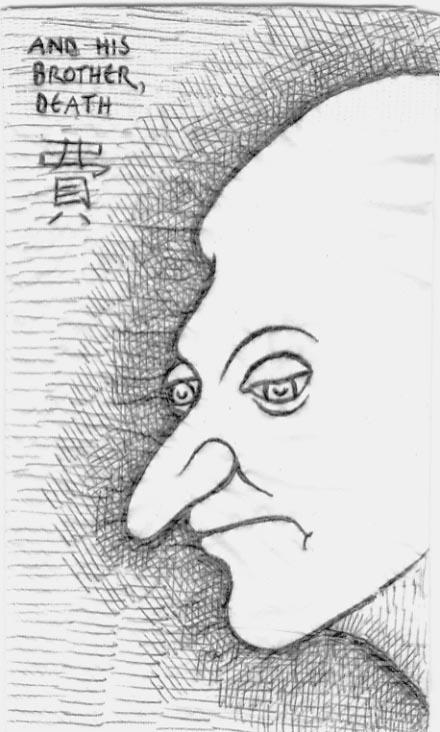
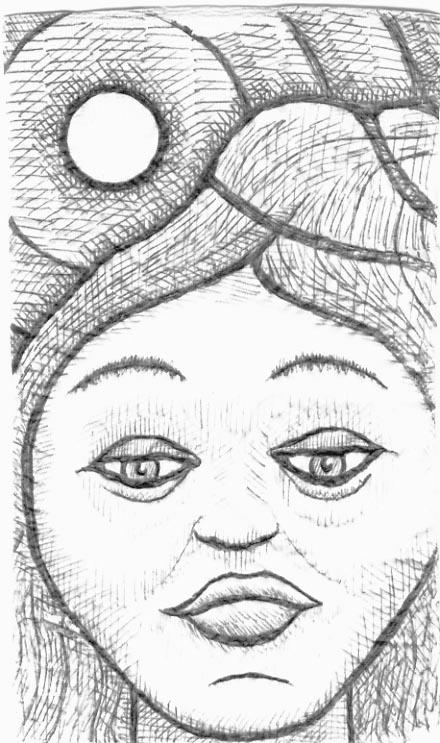
Sleep, and his Brother Death
The reference on the second napkin was obscure enough to begin with, but having remembered it backwards makes it so obscure that I better footnote it. It's from the opening of Shelley's Queen Mab, which I had in mind as I drew these two cartoons:
How wonderful is Death,
Death, and his brother Sleep!
One, pale as yonder waning moon
With lips of lurid blue;
The other, rosy as the morn
When throned on ocean's wave
It blushes o'er the world;
Yet both so passing wonderful!
The reference on the second napkin was obscure enough to begin with, but having remembered it backwards makes it so obscure that I better footnote it. It's from the opening of Shelley's Queen Mab, which I had in mind as I drew these two cartoons:
How wonderful is Death,
Death, and his brother Sleep!
One, pale as yonder waning moon
With lips of lurid blue;
The other, rosy as the morn
When throned on ocean's wave
It blushes o'er the world;
Yet both so passing wonderful!
Saturday, August 13, 2005
One Word
Most good bloggers are easy to quote. Good bloggers tend to be aphoristic -- they know they don't have their audience for long. They write pithy comments, short poems, 200 word essays in five paragraphs. That's what I do, or try to. I figured out just what it is that I love about Zhoen's writing when I tried to begin this post with a quotation from her blog. I couldn't do it.
There were plenty of memorable sentences and there was plenty of pith. But every great sentence depended on some other sentence. I couldn't find anything to pull out. It was all connected and interlaced.
Zhoen has all the time in the world. Her essays build up slowly, layer upon layer. I come back to them again and again, and every time discover more connections. The structure and progression of the essays isn't obvious. They can seem to be wandering, if you're not paying attention. Just variations on a theme. They're not always polished, and they're never slick. But the interweaving is intricate, and it's all made of real stuff. The concrete world. Memories of childhood. Footwear. Tattoos.
Zhoen has washed the bodies of the dead, and to me that illustrates her groundedness. Death is no abstraction for her. Death is a matter of of breathing that finally dies away, bodies that need to be cleaned up, relatives who need to be informed. She tells the whole story of a bad marriage, vividly, with a passing mention of wet sneakers in the Tetons.
Read what she has to say about tattoos. Or being activated to serve in the first Gulf War. Or Death. But really, you can start anywhere. Everything connects to everything else.
Most good bloggers are easy to quote. Good bloggers tend to be aphoristic -- they know they don't have their audience for long. They write pithy comments, short poems, 200 word essays in five paragraphs. That's what I do, or try to. I figured out just what it is that I love about Zhoen's writing when I tried to begin this post with a quotation from her blog. I couldn't do it.
There were plenty of memorable sentences and there was plenty of pith. But every great sentence depended on some other sentence. I couldn't find anything to pull out. It was all connected and interlaced.
Zhoen has all the time in the world. Her essays build up slowly, layer upon layer. I come back to them again and again, and every time discover more connections. The structure and progression of the essays isn't obvious. They can seem to be wandering, if you're not paying attention. Just variations on a theme. They're not always polished, and they're never slick. But the interweaving is intricate, and it's all made of real stuff. The concrete world. Memories of childhood. Footwear. Tattoos.
Zhoen has washed the bodies of the dead, and to me that illustrates her groundedness. Death is no abstraction for her. Death is a matter of of breathing that finally dies away, bodies that need to be cleaned up, relatives who need to be informed. She tells the whole story of a bad marriage, vividly, with a passing mention of wet sneakers in the Tetons.
Read what she has to say about tattoos. Or being activated to serve in the first Gulf War. Or Death. But really, you can start anywhere. Everything connects to everything else.
Friday, August 12, 2005
Counting Coup
Long after your rough artist's tongue had illustrated my skin, the sky darkened; we slept, and grief gathered.
Long after our eyes met, you came, and cried tears for me that had been bought for another. This is not called embezzling.
Long after you wrote this poem, there was lightning, and I counted the seconds. But even now, no thunder.
Long after your rough artist's tongue had illustrated my skin, the sky darkened; we slept, and grief gathered.
Long after our eyes met, you came, and cried tears for me that had been bought for another. This is not called embezzling.
Long after you wrote this poem, there was lightning, and I counted the seconds. But even now, no thunder.
Thursday, August 11, 2005

Credo
Rachel of Velveteen Rabbichallenged her readers to produce their own credos. Saying "I believe" is a bit problematic for a Buddhist, so I made mine just a list of seven assertions. Three of them, as you might expect (if you know me), come pretty much straight from the mouths of English poets.
1) There is no set of guidelines, no matter how kindly, profound, or elaborate, that will ever be a better guide to action than paying mindful attention in the present moment with an open heart.
2) Everything that can be imagined is an image of truth.
3) Conceptual thought is a good servant but a bad master.
4) Every ill deed is engendered in dishonesty.
5) Nothing important is fair.
6) There are more things in heaven and earth than are dreamt of in your philosophy. Or mine.
7) Everything that lives is Holy.
Rachel of Velveteen Rabbichallenged her readers to produce their own credos. Saying "I believe" is a bit problematic for a Buddhist, so I made mine just a list of seven assertions. Three of them, as you might expect (if you know me), come pretty much straight from the mouths of English poets.
1) There is no set of guidelines, no matter how kindly, profound, or elaborate, that will ever be a better guide to action than paying mindful attention in the present moment with an open heart.
2) Everything that can be imagined is an image of truth.
3) Conceptual thought is a good servant but a bad master.
4) Every ill deed is engendered in dishonesty.
5) Nothing important is fair.
6) There are more things in heaven and earth than are dreamt of in your philosophy. Or mine.
7) Everything that lives is Holy.
In which I Fascinate Denver
Sitemeter has expanded the information they give about visits from the US. Now they give a city and a state. This is very entertaining, although I imagine that the location is just the place where the visitor's ISP lets go of their traffic -- not necessarily anyplace very close to where they were when they sent it. Still, it's a clue, and an intriguing one.
One visitor began to fascinate me. Referrer blocked, but the visits were coming from Denver. I knew someone who read my blog, I thought, in Denver. But no, he showed up, & I recognized his referring URL. This had to be someone new.
But this new visitor behaved oddly. He racked up a dozen page views in no time, but he almost never seemed to go to the archives. So what was he doing? Refreshing to see if his comments got responses?
And today, here he was again, my greatest fan, apparently. Somebody in Denver loved me. Upwards of twenty hits. And he'd stay there all day. Who was this person? Would he comment, eventually? Propose marriage, maybe? Offer me a book contract?
You've figured it out by now, right? Yeah. I just verified it by experiment. Apparently when I'm surfing from work, all my traffic goes out from -- Denver. That's who was so fascinated by me.
There must be a word of Germanic origin for this. Chagrin is far too mild.
Sitemeter has expanded the information they give about visits from the US. Now they give a city and a state. This is very entertaining, although I imagine that the location is just the place where the visitor's ISP lets go of their traffic -- not necessarily anyplace very close to where they were when they sent it. Still, it's a clue, and an intriguing one.
One visitor began to fascinate me. Referrer blocked, but the visits were coming from Denver. I knew someone who read my blog, I thought, in Denver. But no, he showed up, & I recognized his referring URL. This had to be someone new.
But this new visitor behaved oddly. He racked up a dozen page views in no time, but he almost never seemed to go to the archives. So what was he doing? Refreshing to see if his comments got responses?
And today, here he was again, my greatest fan, apparently. Somebody in Denver loved me. Upwards of twenty hits. And he'd stay there all day. Who was this person? Would he comment, eventually? Propose marriage, maybe? Offer me a book contract?
You've figured it out by now, right? Yeah. I just verified it by experiment. Apparently when I'm surfing from work, all my traffic goes out from -- Denver. That's who was so fascinated by me.
There must be a word of Germanic origin for this. Chagrin is far too mild.
Tuesday, August 09, 2005
And By the Way
I love you as the cat loves the mouse,
As it hears the bones crack between its teeth,
And the blood spurt in its mouth.
I love you as the sun loves the early morning dew.
I love you as the sea loves the sandspit.
I love you as the Emperor loves his army, dreaming of glory.
I love you as baby loves its mother,
As the moon loves the shadowed hillside,
As the Son loves the Father.
I love you as the wine loved Omar,
And as the mouse loves the cat when it bites.
I love you as the cat loves the mouse,
As it hears the bones crack between its teeth,
And the blood spurt in its mouth.
I love you as the sun loves the early morning dew.
I love you as the sea loves the sandspit.
I love you as the Emperor loves his army, dreaming of glory.
I love you as baby loves its mother,
As the moon loves the shadowed hillside,
As the Son loves the Father.
I love you as the wine loved Omar,
And as the mouse loves the cat when it bites.

Monday, August 08, 2005
Kham and Oregon
I lay on my back, my head on a meditation cushion, a mug of tea resting on my chest. My feet were stretched out towards Michael. I thought briefly of how shocked a Asian Buddhist would be, to see me sprawled in the shrine room, with my feet pointing at a teacher. But my back was tired. I'm an American, and so is Michael. I lay there on the zabutons, squinting occasionally over my nose at Michael, resting peacefully.
Leah, beside me, was asking a question. Her eyes were fixed on Michael. Her short-clipped hair frizzed tight on her round skull. The proportions of her head have always fascinated me -- there are two spheres struggling to establish themselves, the sphere of her skull and the sphere of her face, creasing together at the line of the eyes. It's a strong but unsettling face.
We had been talking about persistent thoughts, things that returned again and again. As Leah spoke I became aware that this was a real question, and I focused. "...you said it was not like having a bullet in your arm. But some thoughts are like a bullet in the arm. Some things that were established when I was a child. Memories that won't go away, things that got set up a long time ago, and they're part of myself, they were there when my self was being formed --"
She broke off. The apparent vagueness of her question was only apparent. There's a memory of violation behind this. There was no one in the room, suddenly, but she and Michael: everything else was dark.
"So is there any hope for getting rid of it?"
The pieces of Michael's answer built up gradually. Karma, said Michael, never repeats. It's never the same thing over again, no matter how much it looks like it. No mental state remains fixed, by its own power. If it stays there, it's because we're holding it there somehow.
This is a place, he said, where Western psychological traditions and Dharma traditions diverge. We look for the whole establishment of our psychology to have occurred in this life, and so tracing things back to their origins in childhood is terribly important, and we see our childhoods and our relationships with our parents as formative. But the Buddhist psychological tradition sees the origins as stretching back over countless lives. Most of the karma that comes to fruition in this life was incurred in other lives. We will never be able to trace it back. Our early relationships and experiences are indeed paradigmatic, but not because they were formative, but rather, because we chose them, because we were drawn to the relationships and experiences we already knew.
We will never be able to trace it back, but we are ultimately responsible for it. Which means that we no longer have the luxury of blaming anyone else for it, but it also means that it's within our power to get free of it.
And there are two ways to do that. One is simply to purify each moment as it comes. Every time the supposedly persistent thought arises, and we don't react to it, we're done with one piece of karma, done forever. But of course to purify it all takes about as long as it took to incur it all, thousands upon thousands of lifetimes. So the other thing to do is to learn to see through it. It still will arise -- nothing, absolutely nothing, prevents karma from ripening once it's been planted; not even a buddha escapes karma. But once we have learned to see through it, it loses its power to inflict suffering. It arises like the events of a dream; we see it as dreamlike. It comes and it goes, the emotion rises and falls, but we are no longer rising and falling with it.
Leah's face was intent, but unreadable. A banked fire.
A murmur of voices. I'm accustomed to hearing emotional tones, rather than words: my hearing is not very good, so I often have no idea of what has been said, but I recognized the tone of wrapping up. I slowly sat upright. Set my empty cup on the floor. Put my hands together and softly intoned the dedication of the merit. Waited for the the three slow rings of the bell. Bowed.
I stopped on my way out and look back into the shrine room. Leah was -- unconsciously, I take it -- crouched in front of Michael in the posture of someone taking their refuge vows, one knee down and one knee up, forearm resting against the up-knee, hands together, talking earnestly. Jef was carefully emptying the offering-bowls into a pitcher. Above him was the trembling scrawl of Kalu Rinpoche's Tibetan calligraphy. Rinpoche was very old when he wrote it. The letters trail down the page -- awkward, child-like. Suddenly the distance opens in front of me. The distance between Kham, seventy years ago, and Oregon now -- the distance between old age and middle age -- the distance between Tibetan and English -- the distance between Feudalism and Capitalism. These shaky letters. One old man.
I lay on my back, my head on a meditation cushion, a mug of tea resting on my chest. My feet were stretched out towards Michael. I thought briefly of how shocked a Asian Buddhist would be, to see me sprawled in the shrine room, with my feet pointing at a teacher. But my back was tired. I'm an American, and so is Michael. I lay there on the zabutons, squinting occasionally over my nose at Michael, resting peacefully.
Leah, beside me, was asking a question. Her eyes were fixed on Michael. Her short-clipped hair frizzed tight on her round skull. The proportions of her head have always fascinated me -- there are two spheres struggling to establish themselves, the sphere of her skull and the sphere of her face, creasing together at the line of the eyes. It's a strong but unsettling face.
We had been talking about persistent thoughts, things that returned again and again. As Leah spoke I became aware that this was a real question, and I focused. "...you said it was not like having a bullet in your arm. But some thoughts are like a bullet in the arm. Some things that were established when I was a child. Memories that won't go away, things that got set up a long time ago, and they're part of myself, they were there when my self was being formed --"
She broke off. The apparent vagueness of her question was only apparent. There's a memory of violation behind this. There was no one in the room, suddenly, but she and Michael: everything else was dark.
"So is there any hope for getting rid of it?"
The pieces of Michael's answer built up gradually. Karma, said Michael, never repeats. It's never the same thing over again, no matter how much it looks like it. No mental state remains fixed, by its own power. If it stays there, it's because we're holding it there somehow.
This is a place, he said, where Western psychological traditions and Dharma traditions diverge. We look for the whole establishment of our psychology to have occurred in this life, and so tracing things back to their origins in childhood is terribly important, and we see our childhoods and our relationships with our parents as formative. But the Buddhist psychological tradition sees the origins as stretching back over countless lives. Most of the karma that comes to fruition in this life was incurred in other lives. We will never be able to trace it back. Our early relationships and experiences are indeed paradigmatic, but not because they were formative, but rather, because we chose them, because we were drawn to the relationships and experiences we already knew.
We will never be able to trace it back, but we are ultimately responsible for it. Which means that we no longer have the luxury of blaming anyone else for it, but it also means that it's within our power to get free of it.
And there are two ways to do that. One is simply to purify each moment as it comes. Every time the supposedly persistent thought arises, and we don't react to it, we're done with one piece of karma, done forever. But of course to purify it all takes about as long as it took to incur it all, thousands upon thousands of lifetimes. So the other thing to do is to learn to see through it. It still will arise -- nothing, absolutely nothing, prevents karma from ripening once it's been planted; not even a buddha escapes karma. But once we have learned to see through it, it loses its power to inflict suffering. It arises like the events of a dream; we see it as dreamlike. It comes and it goes, the emotion rises and falls, but we are no longer rising and falling with it.
Leah's face was intent, but unreadable. A banked fire.
A murmur of voices. I'm accustomed to hearing emotional tones, rather than words: my hearing is not very good, so I often have no idea of what has been said, but I recognized the tone of wrapping up. I slowly sat upright. Set my empty cup on the floor. Put my hands together and softly intoned the dedication of the merit. Waited for the the three slow rings of the bell. Bowed.
I stopped on my way out and look back into the shrine room. Leah was -- unconsciously, I take it -- crouched in front of Michael in the posture of someone taking their refuge vows, one knee down and one knee up, forearm resting against the up-knee, hands together, talking earnestly. Jef was carefully emptying the offering-bowls into a pitcher. Above him was the trembling scrawl of Kalu Rinpoche's Tibetan calligraphy. Rinpoche was very old when he wrote it. The letters trail down the page -- awkward, child-like. Suddenly the distance opens in front of me. The distance between Kham, seventy years ago, and Oregon now -- the distance between old age and middle age -- the distance between Tibetan and English -- the distance between Feudalism and Capitalism. These shaky letters. One old man.

Saturday, August 06, 2005
Launch
Written Yesterday.
Two pelicans glide over the gleam of the water. Pelicans mean business, when they fly. No erratic swooping for them. They fly in column, laboring at their flight like oarsmen in a galley, straight from source to destination. I've never seen one fishing. Presumably they break order, dawdle, and dart, as they fish, but I've never seen them at it in all my years here. I only see them voyaging, silent, solemn lines of five or ten, toiling from Devil's Punchbowl to Gull Rock, or from the Dutchman to Cape Foulweather. Usually at dusk, against the setting sun. I only see their sillouettes.
It's high tide, and the area of the seals' haulout has narrowed, so that they cluster together, like a careless heap of gray, brown and mottled white sacks of grain. They barely stir, when they're lying on the rocks. You'd think they were ill, or exhausted. One will occasionally drag itself a few inches, with a huge effort, and then collapse. Another will raise its head and bark hoarsely. Otherwise they lie inert.
Then one will struggle to the water, and launch itself off the rocks, and suddenly it's a lithe, fluent sea-creature, flashing sinuously through waves and between rocks, brief flashes of head and tail, otter-quick. The transformation always catches me by surprise.
The rampart of Gull Rock appears, hovers a while, and fades again into the fog. No whales this year. We've come too early. Even the year-rounders don't seem to be here.
And up until today, the day before we're going home, the sea has been meaningless to me. I've felt no awe and no pleasure. Sun, sand, wind, water -- they've been no different to me from streetlights, pavement, buildings, and traffic. I'm old enough not to be alarmed by this. It will come back, I thought. And I was right. Today the fitful gleams through the fog are intimations, and the endless wavering snare-drum-roll of the waves is a whisper of words to me. Unknown words, but words. I've never expected, after all, to know what they mean.
Written Yesterday.
Two pelicans glide over the gleam of the water. Pelicans mean business, when they fly. No erratic swooping for them. They fly in column, laboring at their flight like oarsmen in a galley, straight from source to destination. I've never seen one fishing. Presumably they break order, dawdle, and dart, as they fish, but I've never seen them at it in all my years here. I only see them voyaging, silent, solemn lines of five or ten, toiling from Devil's Punchbowl to Gull Rock, or from the Dutchman to Cape Foulweather. Usually at dusk, against the setting sun. I only see their sillouettes.
It's high tide, and the area of the seals' haulout has narrowed, so that they cluster together, like a careless heap of gray, brown and mottled white sacks of grain. They barely stir, when they're lying on the rocks. You'd think they were ill, or exhausted. One will occasionally drag itself a few inches, with a huge effort, and then collapse. Another will raise its head and bark hoarsely. Otherwise they lie inert.
Then one will struggle to the water, and launch itself off the rocks, and suddenly it's a lithe, fluent sea-creature, flashing sinuously through waves and between rocks, brief flashes of head and tail, otter-quick. The transformation always catches me by surprise.
The rampart of Gull Rock appears, hovers a while, and fades again into the fog. No whales this year. We've come too early. Even the year-rounders don't seem to be here.
And up until today, the day before we're going home, the sea has been meaningless to me. I've felt no awe and no pleasure. Sun, sand, wind, water -- they've been no different to me from streetlights, pavement, buildings, and traffic. I'm old enough not to be alarmed by this. It will come back, I thought. And I was right. Today the fitful gleams through the fog are intimations, and the endless wavering snare-drum-roll of the waves is a whisper of words to me. Unknown words, but words. I've never expected, after all, to know what they mean.
Sunday, July 31, 2005
Out There
The candlewhite, the slow tightening of the coils of the mind around -- something, anything -- hardly matters -- my mind runs not like a stream but like a pen on a napkin, back and forth, fretting its groove, returning again and again to thicken and widen its cartoon representations. Restlessly making the curves smooth and the lines straight. Obliterating the reality under the conception.
Of course, without flaws, there is no drawing; without the irregularity and startlement of what doesn't fit, nothing interesting would happen at all. Everything would collapse to a single straight line or a single circle. So we admit a little of it, a little awkwardness. But then the whole force of the mind scours away at it. It goes looking for it, but the first thing it tries to do is contain it, insulate it, domesticate it.
It's an interesting exercise, to go looking for the origins of the awkward and irregular. Not because of what we find, but because of what we don't find. It comes from -- vague wave of the hand -- out there.
The candlewhite, the slow tightening of the coils of the mind around -- something, anything -- hardly matters -- my mind runs not like a stream but like a pen on a napkin, back and forth, fretting its groove, returning again and again to thicken and widen its cartoon representations. Restlessly making the curves smooth and the lines straight. Obliterating the reality under the conception.
Of course, without flaws, there is no drawing; without the irregularity and startlement of what doesn't fit, nothing interesting would happen at all. Everything would collapse to a single straight line or a single circle. So we admit a little of it, a little awkwardness. But then the whole force of the mind scours away at it. It goes looking for it, but the first thing it tries to do is contain it, insulate it, domesticate it.
It's an interesting exercise, to go looking for the origins of the awkward and irregular. Not because of what we find, but because of what we don't find. It comes from -- vague wave of the hand -- out there.
Thursday, July 28, 2005
Failure
Well, it's official then -- I've failed.
I had thought I knew what failure would look like, but of course I didn't. I imagined a dam breaking or a building collapsing, roaring water or clouds of dust; but what has happened is -- nothing. Nothing has happened. Except realizing just how entrenched this habit of self-conflict is. It's not so easy to set it aside. Virtually everything I've ever known, felt, or thought about food has been in the context of trying to control myself. I have no other way to think about it. I have no other relationship with food to fall back on. This will all be new.
Many of my earliest memories are of my mother eating chocolate. She would buy cans of ready-made chocolate frosting and eat them, while reading or watching TV. She was fat, sometimes very fat, but she was haunted by the dream of being skinny. If her will had only been strong enough, she thought, she would have been skinny. And if she had been skinny she would have been happy.
No happiness. I have no clearer image of misery than my mother huddled in her armchair, doggedly eating her way through whole cans of frosting.
My father would point out the health risks of obesity -- he was conscious of the health implications of diet long before it became a national obsession. He would explain, patiently, relentlessly, why she shouldn't eat that way. It was my first lesson in the limits of reason and will. My mother already knew all that. If she could have stopped, she would have. She was utterly miserable. She was well aware that she was killing herself: in fact I'm not at all sure that wasn't part of the project.
The irony now, is that none of her health problems have turned out to have anything to do with her diet. When they opened up her heart to do the bypass, they found a perfectly healthy heart, apart from the defective valve. She's being taken down by multiple myeloma and and the tubercular infection it's enabled. She'd be dying the same death if she'd lived on raw vegetables all her life.
All that misery. And none of the supposed consequences of being fat every came into play. She's never been alone or abandoned -- she's divorced twice, but she was the one to leave, both times -- and her health never really suffered from it. But the misery of knowing herself to be flawed and weak stained the whole fabric of her consciousness.
My own history with food echoes this, on a lesser scale. Most of my life I've been thirty or forty pounds overweight. It humiliates me in odd ways. I don't really mind the belly so much; I'm even fond of it, but I hate how quickly I become red-faced and sweaty. I've always exercised in private, so no one can see that. And for the same reason I have avoided dancing, which I love, most of my life. It was one of the things I was going to do when I lost weight. Likewise, going to massage school. Who wants to be massaged by a stout red-faced man, dripping sweat?
This morning, contemplating breakfast, I kept drawing a blank. What did I want to eat? I had no idea. I knew what I ought to eat, and I knew what I could eat if I meant to thumb my nose at prudence and authority. But I had no idea what I wanted to eat. Accepting failure, which I had pictured so clearly, turns out to be a puzzle. I'm not sure how to do it.
Well, it's official then -- I've failed.
I had thought I knew what failure would look like, but of course I didn't. I imagined a dam breaking or a building collapsing, roaring water or clouds of dust; but what has happened is -- nothing. Nothing has happened. Except realizing just how entrenched this habit of self-conflict is. It's not so easy to set it aside. Virtually everything I've ever known, felt, or thought about food has been in the context of trying to control myself. I have no other way to think about it. I have no other relationship with food to fall back on. This will all be new.
Many of my earliest memories are of my mother eating chocolate. She would buy cans of ready-made chocolate frosting and eat them, while reading or watching TV. She was fat, sometimes very fat, but she was haunted by the dream of being skinny. If her will had only been strong enough, she thought, she would have been skinny. And if she had been skinny she would have been happy.
No happiness. I have no clearer image of misery than my mother huddled in her armchair, doggedly eating her way through whole cans of frosting.
My father would point out the health risks of obesity -- he was conscious of the health implications of diet long before it became a national obsession. He would explain, patiently, relentlessly, why she shouldn't eat that way. It was my first lesson in the limits of reason and will. My mother already knew all that. If she could have stopped, she would have. She was utterly miserable. She was well aware that she was killing herself: in fact I'm not at all sure that wasn't part of the project.
The irony now, is that none of her health problems have turned out to have anything to do with her diet. When they opened up her heart to do the bypass, they found a perfectly healthy heart, apart from the defective valve. She's being taken down by multiple myeloma and and the tubercular infection it's enabled. She'd be dying the same death if she'd lived on raw vegetables all her life.
All that misery. And none of the supposed consequences of being fat every came into play. She's never been alone or abandoned -- she's divorced twice, but she was the one to leave, both times -- and her health never really suffered from it. But the misery of knowing herself to be flawed and weak stained the whole fabric of her consciousness.
My own history with food echoes this, on a lesser scale. Most of my life I've been thirty or forty pounds overweight. It humiliates me in odd ways. I don't really mind the belly so much; I'm even fond of it, but I hate how quickly I become red-faced and sweaty. I've always exercised in private, so no one can see that. And for the same reason I have avoided dancing, which I love, most of my life. It was one of the things I was going to do when I lost weight. Likewise, going to massage school. Who wants to be massaged by a stout red-faced man, dripping sweat?
This morning, contemplating breakfast, I kept drawing a blank. What did I want to eat? I had no idea. I knew what I ought to eat, and I knew what I could eat if I meant to thumb my nose at prudence and authority. But I had no idea what I wanted to eat. Accepting failure, which I had pictured so clearly, turns out to be a puzzle. I'm not sure how to do it.
Wednesday, July 27, 2005
Mischief Managed
Ah, but you see, this moment, all thoughts of desiring are gone, the sun bright, only a calm friendliness rising from the cool earth. I walk unseen in the garden of your heart, content.
I will not always be asking and wanting, resenting and demanding. There are times when I am really quite like an adult.
Their eyes, their ancient glittering eyes are gay.
Forty-seven years old, and I have learned a little. About letting messages go into darkness, to rest without replies, to be happy with the ghosts of echoes and with connections that are not proven or proveable. It's okay.
And today I held hands with you, as I used to imagine it, nine years old and hearing the Beatles song for the first time, in the long sunlight of summer mornings so far gone and so present. More than enough.
Ah, but you see, this moment, all thoughts of desiring are gone, the sun bright, only a calm friendliness rising from the cool earth. I walk unseen in the garden of your heart, content.
I will not always be asking and wanting, resenting and demanding. There are times when I am really quite like an adult.
Their eyes, their ancient glittering eyes are gay.
Forty-seven years old, and I have learned a little. About letting messages go into darkness, to rest without replies, to be happy with the ghosts of echoes and with connections that are not proven or proveable. It's okay.
And today I held hands with you, as I used to imagine it, nine years old and hearing the Beatles song for the first time, in the long sunlight of summer mornings so far gone and so present. More than enough.
Monday, July 25, 2005
Insurrection
There are two things I've been trying to accomplish for all of my adult life -- establish a regular exercise routine, and change my eating habits. I ordinarily see myself as failing repeatedly at both of them.
I've decided I have to treat these two projects the way I'd treat any project at work -- set measureable goals and milestones, and set criteria for success. Because I'm realizing the cost of having these perpetual projects -- to wit, that I'm always failing. I'm always failing, but I have never failed. If I failed I could just move on, and make room for other projects. But I've made failure unthinkable in my mind. I have to change that. To fail at a couple of things is tolerable. To fail at the same things, over and over, all my life, is just intolerable. And unnecessary.
I've always made these projects open-ended in some way. The change of diet has never had a deadline, and the exercise has never had a distinct end-goal. So I've set a deadline for the one and a goal for the other.
If I can't observe the dietary restrictions I've set myself for four weeks -- I've made them mild, and allowed for treats -- then I'm simply going to acknowledge that I've failed, and stop mucking with it. So I don't eat right. Most Americans don't. It isn't a disaster. I'll take it off the goal list and put it on the wish list, things I might take on after I've retired. And then, if I make the four-week goal, I'll monitor it for a year. If I can't then keep it up for the year, barring the typical Christmas-time spinout and one other contained collapse, then, again, I've simply failed, and I'm done.
It's difficult to make this thinkable, after it's been so long unthinkable. But I'm just sick of it. Not going to live there anymore.
The exercise is a slightly different. I've actually been fairly successful at this, but I always fail eventually, in my own mind, because I've always set up systems -- generally detailed and elaborate ones, because that's the kind of man I am -- that have me doing progressively more and more. More reps. Longer walks. More laps. Faster cycling times. Which is fine -- it is the way to improve one's physical condition -- but the problem is that eventually I get sick or injured, and then I can't keep up the progression. And since these progressions have had no terminus ad quem, I spin out at those points. My goals keep getting ahead of me, till they eventually vanish out of sight. So I fail perpetually at that, too.
So I've set end goals this time around. This is what I intend to do, and no more. When I get there, that's enough. I'm done. I don't try to get a little stronger, a little further, a little faster. The open-ended programs have all really rested on a denial of mortality, a denial of limitations. The fantasy of becoming extraordinary somehow has always whispered there -- usually, just out of range of my explicit awareness, but it's always been there. Gradually, secretly, I would achieve more and more until finally everyone would realize my greatness. I have to let that go.
These changes of view and expectation sound minor, but they are actually a serious insurrection against my ordinary habits of mind. As such, we can expect a counter-insurgency. Stay tuned.
There are two things I've been trying to accomplish for all of my adult life -- establish a regular exercise routine, and change my eating habits. I ordinarily see myself as failing repeatedly at both of them.
I've decided I have to treat these two projects the way I'd treat any project at work -- set measureable goals and milestones, and set criteria for success. Because I'm realizing the cost of having these perpetual projects -- to wit, that I'm always failing. I'm always failing, but I have never failed. If I failed I could just move on, and make room for other projects. But I've made failure unthinkable in my mind. I have to change that. To fail at a couple of things is tolerable. To fail at the same things, over and over, all my life, is just intolerable. And unnecessary.
I've always made these projects open-ended in some way. The change of diet has never had a deadline, and the exercise has never had a distinct end-goal. So I've set a deadline for the one and a goal for the other.
If I can't observe the dietary restrictions I've set myself for four weeks -- I've made them mild, and allowed for treats -- then I'm simply going to acknowledge that I've failed, and stop mucking with it. So I don't eat right. Most Americans don't. It isn't a disaster. I'll take it off the goal list and put it on the wish list, things I might take on after I've retired. And then, if I make the four-week goal, I'll monitor it for a year. If I can't then keep it up for the year, barring the typical Christmas-time spinout and one other contained collapse, then, again, I've simply failed, and I'm done.
It's difficult to make this thinkable, after it's been so long unthinkable. But I'm just sick of it. Not going to live there anymore.
The exercise is a slightly different. I've actually been fairly successful at this, but I always fail eventually, in my own mind, because I've always set up systems -- generally detailed and elaborate ones, because that's the kind of man I am -- that have me doing progressively more and more. More reps. Longer walks. More laps. Faster cycling times. Which is fine -- it is the way to improve one's physical condition -- but the problem is that eventually I get sick or injured, and then I can't keep up the progression. And since these progressions have had no terminus ad quem, I spin out at those points. My goals keep getting ahead of me, till they eventually vanish out of sight. So I fail perpetually at that, too.
So I've set end goals this time around. This is what I intend to do, and no more. When I get there, that's enough. I'm done. I don't try to get a little stronger, a little further, a little faster. The open-ended programs have all really rested on a denial of mortality, a denial of limitations. The fantasy of becoming extraordinary somehow has always whispered there -- usually, just out of range of my explicit awareness, but it's always been there. Gradually, secretly, I would achieve more and more until finally everyone would realize my greatness. I have to let that go.
These changes of view and expectation sound minor, but they are actually a serious insurrection against my ordinary habits of mind. As such, we can expect a counter-insurgency. Stay tuned.

Saturday, July 23, 2005

Napkin Art
Oh, this is way fun. Here we have a sample of my famous napkin art. Note the coffee stain center-left, one of the marks of authenticity. The rules of napkin art are quite strict: they must be real indigenous greasy-spoon napkins, and only a medium bic pen may be used. The drawing must be completed in the course of one breakfast, and it must be left on the table when you leave.
(This immediately creates a difficulty, of course. How can they ever be scanned, then? Grudgingly we allow as how one may be taken away as long as one is left. So I'll draw a new one tomorrow, and leave this one in its place.)
As you see, Alan got a scanner for his birthday. Ain't I generous? I'll let him use it any day now.
Friday, July 22, 2005
Morning
Wet leaves. The last flickers of lightning. Dawn pouring up into the sky, like dirty milk, after a dim night of halfhearted thunderstorms. The earliest crows mutter irritably in the distance.
My young cousin's eager face lingers in my mind. She is fearless. Filled up to the trembling brim with light -- it spills and scatters from her. The only bright figure at that table for eight, last night.
Wet leaves. The last flickers of lightning. Dawn pouring up into the sky, like dirty milk, after a dim night of halfhearted thunderstorms. The earliest crows mutter irritably in the distance.
My young cousin's eager face lingers in my mind. She is fearless. Filled up to the trembling brim with light -- it spills and scatters from her. The only bright figure at that table for eight, last night.
Thursday, July 21, 2005
In Which I Hit You Up for Money
$1.2 million down, $800,000 to go. We've got a matching gift for $400,000, so every dollar you give counts for two. And we're finally set up to take donations online. And, as a special inducement, you can see pictures of Martha clearing barbed wire (she loathes this picture) and Tori planting trees on the retreat land.
I believe there's no place you could spend your money more wisely to prevent America from further despoiling the environment and lurching into more wars. It's the beginning of a very long term solution, and I'm the first to admit it's a longshot, but it's where I'm placing my bets.
May all things done to benefit sentient beings accomplish the intended end.
May the authentic teachings of this and all genuine spiritual traditions continue to manifest in suitable ways for every single sentient being.
May this world be so filled with the wisdom of accomplished beings in all traditions that even the memory of suffering and negative influences is forgotten.
May we never forget the generosity and kindness of our teachers in this very life, without whom we might have never imagined an alternative to suffering.
$1.2 million down, $800,000 to go. We've got a matching gift for $400,000, so every dollar you give counts for two. And we're finally set up to take donations online. And, as a special inducement, you can see pictures of Martha clearing barbed wire (she loathes this picture) and Tori planting trees on the retreat land.
I believe there's no place you could spend your money more wisely to prevent America from further despoiling the environment and lurching into more wars. It's the beginning of a very long term solution, and I'm the first to admit it's a longshot, but it's where I'm placing my bets.
May all things done to benefit sentient beings accomplish the intended end.
May the authentic teachings of this and all genuine spiritual traditions continue to manifest in suitable ways for every single sentient being.
May this world be so filled with the wisdom of accomplished beings in all traditions that even the memory of suffering and negative influences is forgotten.
May we never forget the generosity and kindness of our teachers in this very life, without whom we might have never imagined an alternative to suffering.
Tuesday, July 19, 2005
Shameless Flowering Temples
This sense of another world being terribly close. This feeling that if I just turned a fraction, or tilted my head, I would see another country -- if I just ran my fingers over the nearest wall I would be able to feel the outline of a door. And even sometimes, in hot oppressive weather, a faint cool draft might come out of somewhere -- just a moment -- and I would think, it's a draft from there.
And then sometimes, of course, you see people from there. Just a glimpse, usually. A moment of recognition. No need to shush, to whisper "pretend not to know me!" because we're both being hustled down the main avenue of life, manhandled by events, by fear, by wanting. But our eyes meet, and we know. Maybe.
Your hands close on my wrists, and hold them very tight. You're trying to bring me somewhere. Where?
I love the faintly salt taste of your lips, the strength of your tongue, the hint of your teeth, as we kiss.
Our bodies open, as they grow older. Become less secretive. Doctors open them up, and pry here and there. The doors and windows of our souls fit more and more loosely. The vulva blossoms, a red-coral-purple flower opening. Our breasts and stomachs and buttocks spread. There's some slack. We don't need to hold the fiction quite so tight, that all our parts fit together. We know they don't. We even lose some of them. Ovaries, gall-bladders, uteruses, appendixes, breasts; here and there a tooth and a toenail. Various tubes get tied and cut. Hair comes out. Scars expand. Veins reveal themselves at the surface. We get used to workarounds for the joints that don't quite work as they're supposed to, and the eyes that don't quite see what they used to.
It's just a body, she said. And that becomes clearer, all the time. It's not a mystery, not a tightly-wrapped bud. It's a blowsy, smelly, gone-to-seed creature, a lumbering mammal, kin to bears and orangatans.
When she was young, Martha says, she wondered how middle-aged people had sex. They couldn't possibly be attracted to each other. So how did they go about it?
Apparently we manage. Not in spite of the spaces opening, but because of them.
I don't really miss the tight-wrapped buds, the smooth-functioning bodies. They always pretended to be doors into other countries, and they seldom were. But these bodies, these shameless flowering temples, they really are doors.
A breath of cool air. Come on.
----------------
The seed of this post was in Brenda's meditation on the middle-aged erotic body
This sense of another world being terribly close. This feeling that if I just turned a fraction, or tilted my head, I would see another country -- if I just ran my fingers over the nearest wall I would be able to feel the outline of a door. And even sometimes, in hot oppressive weather, a faint cool draft might come out of somewhere -- just a moment -- and I would think, it's a draft from there.
And then sometimes, of course, you see people from there. Just a glimpse, usually. A moment of recognition. No need to shush, to whisper "pretend not to know me!" because we're both being hustled down the main avenue of life, manhandled by events, by fear, by wanting. But our eyes meet, and we know. Maybe.
Your hands close on my wrists, and hold them very tight. You're trying to bring me somewhere. Where?
I love the faintly salt taste of your lips, the strength of your tongue, the hint of your teeth, as we kiss.
Our bodies open, as they grow older. Become less secretive. Doctors open them up, and pry here and there. The doors and windows of our souls fit more and more loosely. The vulva blossoms, a red-coral-purple flower opening. Our breasts and stomachs and buttocks spread. There's some slack. We don't need to hold the fiction quite so tight, that all our parts fit together. We know they don't. We even lose some of them. Ovaries, gall-bladders, uteruses, appendixes, breasts; here and there a tooth and a toenail. Various tubes get tied and cut. Hair comes out. Scars expand. Veins reveal themselves at the surface. We get used to workarounds for the joints that don't quite work as they're supposed to, and the eyes that don't quite see what they used to.
It's just a body, she said. And that becomes clearer, all the time. It's not a mystery, not a tightly-wrapped bud. It's a blowsy, smelly, gone-to-seed creature, a lumbering mammal, kin to bears and orangatans.
When she was young, Martha says, she wondered how middle-aged people had sex. They couldn't possibly be attracted to each other. So how did they go about it?
Apparently we manage. Not in spite of the spaces opening, but because of them.
I don't really miss the tight-wrapped buds, the smooth-functioning bodies. They always pretended to be doors into other countries, and they seldom were. But these bodies, these shameless flowering temples, they really are doors.
A breath of cool air. Come on.
----------------
The seed of this post was in Brenda's meditation on the middle-aged erotic body
Sunday, July 17, 2005
Ghosts of Leaves
In the summer we let the vines -- some kind of clematis, I'm told -- climb up the back porch and over the back door, till now, in high summer, a curtain of green hangs over the doorway, and to go out back I have to part it and duck through. I'm always reminded of the beaded doorways of the ramshackle hippie houses I used to know -- strings of cheap plastic sparkly beads, swaying in stale air that smelled of incense, dope, and candle-wax. This living, fragrant curtain was, maybe, what they were groping towards.
It's not good maintenance, of course; it encourages infestation, and it gives the house an unkempt aspect. But I love surrendering the house to the embrace of summer. In the winter it all dies down and we tear away the brown stems and withered gray leaves, and then the window of the back door frames the bones of the ancient, leaning apple tree. But now the porch is all leaves. Martha trains it over the kitchen window, as well; the morning sun throws moving leaf-shadows on the floor, and the kitchen is full of whispering and dappling.
This year the clematis discovered that it could push a tendril through the ill-fitting top sash of the window of the back bedroom. It's grown up to the ceiling, hoping to find sunlight, but not much sun gets in there, so the vine is not green, but pale yellow. It hovers there like the ghost of summers past.
Across the room is the shrine, where the refuge-tree stands when I do my prostrations. Its leaves are always thick, and restlessly moving and speaking, in counterpoint to the murmur of the pechas. Vajrayogini, glowing blood-red and fierce, anklets and bracelets clashing and ringing, dances there on the lowest branch. I wonder what she sees, when she looks at that ghostly vine. I wonder what she sees when she looks at me.
-----------------
(My description of the prostrations and refuge-tree is here; a picture of Vajrayogini is here)
In the summer we let the vines -- some kind of clematis, I'm told -- climb up the back porch and over the back door, till now, in high summer, a curtain of green hangs over the doorway, and to go out back I have to part it and duck through. I'm always reminded of the beaded doorways of the ramshackle hippie houses I used to know -- strings of cheap plastic sparkly beads, swaying in stale air that smelled of incense, dope, and candle-wax. This living, fragrant curtain was, maybe, what they were groping towards.
It's not good maintenance, of course; it encourages infestation, and it gives the house an unkempt aspect. But I love surrendering the house to the embrace of summer. In the winter it all dies down and we tear away the brown stems and withered gray leaves, and then the window of the back door frames the bones of the ancient, leaning apple tree. But now the porch is all leaves. Martha trains it over the kitchen window, as well; the morning sun throws moving leaf-shadows on the floor, and the kitchen is full of whispering and dappling.
This year the clematis discovered that it could push a tendril through the ill-fitting top sash of the window of the back bedroom. It's grown up to the ceiling, hoping to find sunlight, but not much sun gets in there, so the vine is not green, but pale yellow. It hovers there like the ghost of summers past.
Across the room is the shrine, where the refuge-tree stands when I do my prostrations. Its leaves are always thick, and restlessly moving and speaking, in counterpoint to the murmur of the pechas. Vajrayogini, glowing blood-red and fierce, anklets and bracelets clashing and ringing, dances there on the lowest branch. I wonder what she sees, when she looks at that ghostly vine. I wonder what she sees when she looks at me.
-----------------
(My description of the prostrations and refuge-tree is here; a picture of Vajrayogini is here)
Saturday, July 16, 2005
Monochrome
I've just been reading a blog that horrified me. I had been searching for blogs referring to massage or bodywork, looking for some clues as to how other people have worked with that avocation, and I came across the blog of a man who worked at it full time, doing a heavy schedule of massage, as well as teaching it part time.
There was nothing so awful about it, really. It began two years ago, as he was beginning an affair with a married woman. He carefully recorded that beginning, but rapidly she became background material, and he was noting down the details of other flirtations. Sometimes at the bottom of the page he would score the day, on a scale apparently running from zero to twelve, over a varying number of categories, such as "money," "passion," "hugs" -- he meticulously noted the various hugs women gave him, and analyzed their meaning and nuance, as eskimos supposedly note the meaning and nuance of snow.
Occasional remarks about his clients, and a sort of "Bush delendum est" refrain as the 2004 elections approached, but otherwise it was a relentless monotone -- which pretty women would touch him, how much, with what intent. Nothing else could hold his attention.
Sometimes notes of a woman who flirted outrageously with him, whom he dismissed impatiently -- she was in his vocabulary, "queen-sized," whereas his attention was riveted on small women with "tight buns." Never a flicker of acknowledgement that the queen-sized woman was inhabiting the same hungry-ghost realm as he was; never a gleam of compassion for a fellow-sufferer. But he kept having lunch with her. A flirtation with someone he wasn't interested in was small-change, apparently, but money is money, and he wasn't going to just leave it on the table.
For two years it goes on, this monochrome, obsessive life. For all the detail, the character of these women who fill his field of vision remains a blank. They exist for him only as measures of his own importance and acceptance. Once one has accepted him as a lover, her usefulness as a yardstick is compromised, and he begins to find her attention importunate and annoying.
It was harrowing but fascinating. I felt I was reading the autobiography of my own damnation. I turned away from it with exhausted gratitude that somehow, by the grace of something, my life did not turn out like his. It was close enough, at times.
I've just been reading a blog that horrified me. I had been searching for blogs referring to massage or bodywork, looking for some clues as to how other people have worked with that avocation, and I came across the blog of a man who worked at it full time, doing a heavy schedule of massage, as well as teaching it part time.
There was nothing so awful about it, really. It began two years ago, as he was beginning an affair with a married woman. He carefully recorded that beginning, but rapidly she became background material, and he was noting down the details of other flirtations. Sometimes at the bottom of the page he would score the day, on a scale apparently running from zero to twelve, over a varying number of categories, such as "money," "passion," "hugs" -- he meticulously noted the various hugs women gave him, and analyzed their meaning and nuance, as eskimos supposedly note the meaning and nuance of snow.
Occasional remarks about his clients, and a sort of "Bush delendum est" refrain as the 2004 elections approached, but otherwise it was a relentless monotone -- which pretty women would touch him, how much, with what intent. Nothing else could hold his attention.
Sometimes notes of a woman who flirted outrageously with him, whom he dismissed impatiently -- she was in his vocabulary, "queen-sized," whereas his attention was riveted on small women with "tight buns." Never a flicker of acknowledgement that the queen-sized woman was inhabiting the same hungry-ghost realm as he was; never a gleam of compassion for a fellow-sufferer. But he kept having lunch with her. A flirtation with someone he wasn't interested in was small-change, apparently, but money is money, and he wasn't going to just leave it on the table.
For two years it goes on, this monochrome, obsessive life. For all the detail, the character of these women who fill his field of vision remains a blank. They exist for him only as measures of his own importance and acceptance. Once one has accepted him as a lover, her usefulness as a yardstick is compromised, and he begins to find her attention importunate and annoying.
It was harrowing but fascinating. I felt I was reading the autobiography of my own damnation. I turned away from it with exhausted gratitude that somehow, by the grace of something, my life did not turn out like his. It was close enough, at times.
Friday, July 15, 2005
A Vast Fluttering
So it's a real stretch for me now to find that particular smallest movement that will make the biggest difference -- not just in absenting pain, but for unhinging the gates, at the other end of which the hordes of choice, a vast fluttering.
Maria has taken my breath away again.
That's what bodywork is all about.
So it's a real stretch for me now to find that particular smallest movement that will make the biggest difference -- not just in absenting pain, but for unhinging the gates, at the other end of which the hordes of choice, a vast fluttering.
Maria has taken my breath away again.
That's what bodywork is all about.
Wednesday, July 13, 2005
The Whiteness, Waiting
The trees above my house are very tall. Just now their leaves stand out still against a still white sky, the serrated serrations of a thousand maple leaves, each turned a slightly different way. Behind them the untidy swoop and knot of power lines. And behind it all the whiteness, waiting.
The trees above my house are very tall. Just now their leaves stand out still against a still white sky, the serrated serrations of a thousand maple leaves, each turned a slightly different way. Behind them the untidy swoop and knot of power lines. And behind it all the whiteness, waiting.
Three Theories
Depression hit yesterday, silently, murderously. Like being struck by a huge, hot sandbag. When I got home I didn't have the wherewithal to get out of the van. I laid my hands on the steering wheel and my head on my hands, and breathed. Waited. I don't know how long.
Today is better. Almost back to normal.
This last week has been full of resolutions and thinking about how life really ought to be and how a person really can reach for their dreams.
Here are three theories:
Theory One is that thinking a person can reach for their dreams sets me up for a fall, when I find myself, inevitably, failing in all the old, familiar ways -- so I shouldn't think that way, not only because it's not a Buddhist approach to desire, but also because it's just opening the door to depression.
Theory Two is that I have mistaken depression for Dharma, and that -- while the whole structure of craving and expectation does indeed have to be deconstructed -- replacing large, joyful cravings & expectations with small, dreary ones has nothing to do with Buddhist path. It has to do, instead, with brain chemistry.
Theory Three is the new one, which I find most interesting at the moment. It says that being full of resolutions and thinking about how life ought to be, rather than being the cause of a later depressive episode, is actually just an early symptom, an early sign that mood turbulence is setting in. There may be no causal relation between the two at all.
Depression hit yesterday, silently, murderously. Like being struck by a huge, hot sandbag. When I got home I didn't have the wherewithal to get out of the van. I laid my hands on the steering wheel and my head on my hands, and breathed. Waited. I don't know how long.
Today is better. Almost back to normal.
This last week has been full of resolutions and thinking about how life really ought to be and how a person really can reach for their dreams.
Here are three theories:
Theory One is that thinking a person can reach for their dreams sets me up for a fall, when I find myself, inevitably, failing in all the old, familiar ways -- so I shouldn't think that way, not only because it's not a Buddhist approach to desire, but also because it's just opening the door to depression.
Theory Two is that I have mistaken depression for Dharma, and that -- while the whole structure of craving and expectation does indeed have to be deconstructed -- replacing large, joyful cravings & expectations with small, dreary ones has nothing to do with Buddhist path. It has to do, instead, with brain chemistry.
Theory Three is the new one, which I find most interesting at the moment. It says that being full of resolutions and thinking about how life ought to be, rather than being the cause of a later depressive episode, is actually just an early symptom, an early sign that mood turbulence is setting in. There may be no causal relation between the two at all.
Sunday, July 10, 2005
Five things that will happen in the last two Harry Potter books
But enough of trivial stuff. We are in the final run-down to the release of the Half-Blood Prince, and I had better note down my predictions, lest people think I'm just being wise after the event, when I boast about how I knew exactly what Rowling had in mind. Here are some things that have to happen in the last two books:
1) Hagrid has to die. The perpetual innocent always has to be sacrificed, in an epic. Expect to see him go doing something absurdly generous and loving and ill-advised. (I hope this one is wrong because I'm very fond of Hagrid. But he's a character like Coll in the Prydain books -- obviously marked out as a victim.)
2) Snape's history will be revealed, and it will be rather nasty. He will not be rehabilitated, but he may well die heroically, battling death-eaters.
3) Dumbledore has to be gotten off the stage somehow: he'll have to be gone for the last book to resolve, because a new order will have to be established, and if he's still actively onstage there will be no room for the new people.
4) Ron and Hermione have to realize they're in love, so a rival for Hermione's affections has to appear. (Otherwise Ron and Hermione could just go on like this forever.) Look for Viktor Krum to resurface, dashingly. Well, as dashingly as a duck-footed introvert can.
5) This won't happen till the last book, but it's actually Neville, not Harry, who will finally take Voldemort down.
There. Remember, you heard it here first.
But enough of trivial stuff. We are in the final run-down to the release of the Half-Blood Prince, and I had better note down my predictions, lest people think I'm just being wise after the event, when I boast about how I knew exactly what Rowling had in mind. Here are some things that have to happen in the last two books:
1) Hagrid has to die. The perpetual innocent always has to be sacrificed, in an epic. Expect to see him go doing something absurdly generous and loving and ill-advised. (I hope this one is wrong because I'm very fond of Hagrid. But he's a character like Coll in the Prydain books -- obviously marked out as a victim.)
2) Snape's history will be revealed, and it will be rather nasty. He will not be rehabilitated, but he may well die heroically, battling death-eaters.
3) Dumbledore has to be gotten off the stage somehow: he'll have to be gone for the last book to resolve, because a new order will have to be established, and if he's still actively onstage there will be no room for the new people.
4) Ron and Hermione have to realize they're in love, so a rival for Hermione's affections has to appear. (Otherwise Ron and Hermione could just go on like this forever.) Look for Viktor Krum to resurface, dashingly. Well, as dashingly as a duck-footed introvert can.
5) This won't happen till the last book, but it's actually Neville, not Harry, who will finally take Voldemort down.
There. Remember, you heard it here first.
Friday, July 08, 2005
Furniture
My mother looked pleased, but puzzled.
"How did you know I was here?" she asked.
I rolled the dinner tray away from her bed, and attempted a cheerful smile. "We brought you here, remember?" I had ridden in the ambulance with her, two days before.
Her face clouded. "No," she said. "No, I don't remember." Troubled, for a moment, but then it was too much effort, and the trouble faded away.
A few moments later, she embarked on a narrative that I could not follow at all. Her eyes all the time on the television bolted to the ceiling, showing a young couple laying a tile patio. They were laying this tile very seriously, and the voice-over spoke in hushed, important tones, as though it was a historical documentary about, say, building the Burma Road. I had tried to turn the television off when I came in, but the only control I could find just switched channels. It was supposed to alter the volume, too, but those buttons seemed not to have any effect. So the television whispered along with all of our conversation. Somebody, she was telling me, had made her do something she had not wanted to do.
"Was that physical therapy?" I asked. She didn't answer for a little bit. Then she resumed: "They tried to tell me I was in a hospital!" she said, and smiled. Was it indignation? Did she know it was a hospital now? Was it a joke about how out of it she had been? Or was she fishing to see where I thought she was? I was at a loss for words. I smiled encouragingly, I hope, though I daresay it was wanly.
Later I understood that she had been made to sit upright for an hour, and that she thought she was in a furniture store. Very tired of it, and she wanted to go home: why did we just keep on hanging around?
Occasionally I struck a theme that interested her, and I could see, almost as a physical transformation, the intelligence return to her face. Something about Tory's shyness. A mention of Alan liking having grown taller than his mother. Anything having to do with psychology or personality. I wished I had thought to bring a quilting book -- color and design were the other things that might have fetched back that brief intelligence. I labored on, but I've never been good at making conversation, and anyway there are very few things we are both interested in. At the lulls of the conversation, which were frequent, she would read aloud the sentences the nurses had written on the whiteboard, or the little signs posted here and there. Was there a response to them that we were supposed to be sharing, or was it entirely automatic? I couldn't tell.
Finally she said, during one of those quick returns of intelligence, "Well, you better be getting home."
"I suppose I had better," I said, feeling relieved, and guilty at feeling relieved. "Can I bring you anything, before I go?"
This question seemed to strike her as very odd -- perhaps we were still in the furniture store -- but she shook her head. I leaned over to give her the odd half-hug that hospital beds grudgingly permit, and went out. I tried half-heartedly to catch the eye of one of the nurses, to ask about my mother's condition, but none of them looked my way. And I was too tired. Martha was better at that sort of thing, anyway.
As I shuffled down the long corridor to the elevators, I thought of how hateful, and how familiar, the smell of hospitals has become to me. It was hard for me to imagine thinking it was someplace as pleasant as a furniture store.
My mother looked pleased, but puzzled.
"How did you know I was here?" she asked.
I rolled the dinner tray away from her bed, and attempted a cheerful smile. "We brought you here, remember?" I had ridden in the ambulance with her, two days before.
Her face clouded. "No," she said. "No, I don't remember." Troubled, for a moment, but then it was too much effort, and the trouble faded away.
A few moments later, she embarked on a narrative that I could not follow at all. Her eyes all the time on the television bolted to the ceiling, showing a young couple laying a tile patio. They were laying this tile very seriously, and the voice-over spoke in hushed, important tones, as though it was a historical documentary about, say, building the Burma Road. I had tried to turn the television off when I came in, but the only control I could find just switched channels. It was supposed to alter the volume, too, but those buttons seemed not to have any effect. So the television whispered along with all of our conversation. Somebody, she was telling me, had made her do something she had not wanted to do.
"Was that physical therapy?" I asked. She didn't answer for a little bit. Then she resumed: "They tried to tell me I was in a hospital!" she said, and smiled. Was it indignation? Did she know it was a hospital now? Was it a joke about how out of it she had been? Or was she fishing to see where I thought she was? I was at a loss for words. I smiled encouragingly, I hope, though I daresay it was wanly.
Later I understood that she had been made to sit upright for an hour, and that she thought she was in a furniture store. Very tired of it, and she wanted to go home: why did we just keep on hanging around?
Occasionally I struck a theme that interested her, and I could see, almost as a physical transformation, the intelligence return to her face. Something about Tory's shyness. A mention of Alan liking having grown taller than his mother. Anything having to do with psychology or personality. I wished I had thought to bring a quilting book -- color and design were the other things that might have fetched back that brief intelligence. I labored on, but I've never been good at making conversation, and anyway there are very few things we are both interested in. At the lulls of the conversation, which were frequent, she would read aloud the sentences the nurses had written on the whiteboard, or the little signs posted here and there. Was there a response to them that we were supposed to be sharing, or was it entirely automatic? I couldn't tell.
Finally she said, during one of those quick returns of intelligence, "Well, you better be getting home."
"I suppose I had better," I said, feeling relieved, and guilty at feeling relieved. "Can I bring you anything, before I go?"
This question seemed to strike her as very odd -- perhaps we were still in the furniture store -- but she shook her head. I leaned over to give her the odd half-hug that hospital beds grudgingly permit, and went out. I tried half-heartedly to catch the eye of one of the nurses, to ask about my mother's condition, but none of them looked my way. And I was too tired. Martha was better at that sort of thing, anyway.
As I shuffled down the long corridor to the elevators, I thought of how hateful, and how familiar, the smell of hospitals has become to me. It was hard for me to imagine thinking it was someplace as pleasant as a furniture store.
Thursday, July 07, 2005
English Faces
I don't usually think fondly of nations. I think nationalism is a curse, a virus of irrational bigotry that incubated in German universities in 19th Century, and then spread rapidly all over the world to make the 20th Century the worst of all human centuries. The idea that every people with their own language, religion, and customs should have their own sovereign government was a disaster, and continues to be a disaster. So nationalistic paeans about the supposed virtues and denunciations of the supposed vices of whole nations have always left me cold, if not hostile. And I've known too many gregarious Englishmen and humble French and easygoing Germans and reserved Italians to find them very convincing.
But this morning I am deeply aware of how much I love England and the English. How much I owe them, collectively and individually. And there is a commonality there, though I doubt it's wise to even try to identify it. I could say the English are headstrong, emotional, sentimental. In some ways, a people -- like the Russians, perhaps -- made for suffering. I could say that they -- especially if you set them beside the Americans -- are intensely aware of pain, decay, and death. Of how things come apart. Of how many things cannot be helped. And how it's precisely because of this, that their bravery is so moving. They are a people who go into every battle expecting to lose.
It was a queer fate that made them for a time the most successful of all imperial nations. It's made them maybe a little more sympathetic to us than nations that haven't been through it. They understand the fey mood that takes a country when it seems that it just can't lose, that fate has dealt it every winning card. The Swedes and the French and the Canadians and the Swiss can believe that they would act differently from us, if they were masters of the world. But the English know all too well that no people can resist the stupidities of imperial success. The rest of the world views us as arrogant, violent, insensitive, and hypocritical by nature. Only the English seem to understand that it's just the cards we were dealt.
But -- this was not at all the post I set out to write. Yes, I am sorry, England, that we involved you in this ill-advised, obscurely-motivated, and spectacularly badly-planned occupation. But I feel strangely distant from that. What is near me now is the leaves of Russel Square, the kindliness of round English faces, and the quick patter of English voices. I am sorry that anyone ever suffers this, but I'm especially sorry that it should be you, the people dearest to me of all peoples.
I don't usually think fondly of nations. I think nationalism is a curse, a virus of irrational bigotry that incubated in German universities in 19th Century, and then spread rapidly all over the world to make the 20th Century the worst of all human centuries. The idea that every people with their own language, religion, and customs should have their own sovereign government was a disaster, and continues to be a disaster. So nationalistic paeans about the supposed virtues and denunciations of the supposed vices of whole nations have always left me cold, if not hostile. And I've known too many gregarious Englishmen and humble French and easygoing Germans and reserved Italians to find them very convincing.
But this morning I am deeply aware of how much I love England and the English. How much I owe them, collectively and individually. And there is a commonality there, though I doubt it's wise to even try to identify it. I could say the English are headstrong, emotional, sentimental. In some ways, a people -- like the Russians, perhaps -- made for suffering. I could say that they -- especially if you set them beside the Americans -- are intensely aware of pain, decay, and death. Of how things come apart. Of how many things cannot be helped. And how it's precisely because of this, that their bravery is so moving. They are a people who go into every battle expecting to lose.
It was a queer fate that made them for a time the most successful of all imperial nations. It's made them maybe a little more sympathetic to us than nations that haven't been through it. They understand the fey mood that takes a country when it seems that it just can't lose, that fate has dealt it every winning card. The Swedes and the French and the Canadians and the Swiss can believe that they would act differently from us, if they were masters of the world. But the English know all too well that no people can resist the stupidities of imperial success. The rest of the world views us as arrogant, violent, insensitive, and hypocritical by nature. Only the English seem to understand that it's just the cards we were dealt.
But -- this was not at all the post I set out to write. Yes, I am sorry, England, that we involved you in this ill-advised, obscurely-motivated, and spectacularly badly-planned occupation. But I feel strangely distant from that. What is near me now is the leaves of Russel Square, the kindliness of round English faces, and the quick patter of English voices. I am sorry that anyone ever suffers this, but I'm especially sorry that it should be you, the people dearest to me of all peoples.
Tuesday, July 05, 2005
In which I go Visiting
Looking for
A self-unmade man
Is both easier and harder than you'd think.
I roll up a few shirts and shorts
And a new pen
And walk out of the door, it's a July morning,
And I hitchhike to London,
(The Atlantic being the hard part)
And I make Jean give me a berth on her sofa,
She being kind, and unwise
As the wise often are
When the sun hits the concrete, and the glare spills over.
(And now for a moment
Excuse me
I wonder, could I make her laugh? She has
A wonderful laugh,
I know, though
I can't say how. But I digress.)
And that is my last stop
Because once I reach it,
The North Sea, it's only Heinrich Heine and me,
And Heinrich, you know --
I stickle for details --
Is dead. But I, for reasons that have not been explained to me,
Any more than they were explained
To nTexas,
Am alive. But still self-made. So still travelling.
After the last stop,
(See? Not so fast)
I will catch a freighter into Houston, and look for that tavern
Where all precepts evert,
And where nTexas
Will have left a clue, and I will follow it, till I'm dizzy
And stumbling backwards
Into New Mexico
I will sit down hard, and she will smile at me.
And we will just lean heads together
For an hour
And almost I will be self-unmade, but there is more,
Because, as I said
(I said this, remember)
It's harder than you'd think. So I will leave the waterfall,
And walk in Lekshe's garden,
In the cool of the day,
Hoping vainly that she will show up;
And then from there
Because (as you
Will recall, I also said), it's easier than you think,
I will wander down
To Tosi's
And have breakfast. Self-unmade, and hungry.
I will eat eggs,
And drink coffee,
And murmur the Lord's prayer. Give us this day.
Looking for
A self-unmade man
Is both easier and harder than you'd think.
I roll up a few shirts and shorts
And a new pen
And walk out of the door, it's a July morning,
And I hitchhike to London,
(The Atlantic being the hard part)
And I make Jean give me a berth on her sofa,
She being kind, and unwise
As the wise often are
When the sun hits the concrete, and the glare spills over.
(And now for a moment
Excuse me
I wonder, could I make her laugh? She has
A wonderful laugh,
I know, though
I can't say how. But I digress.)
And that is my last stop
Because once I reach it,
The North Sea, it's only Heinrich Heine and me,
And Heinrich, you know --
I stickle for details --
Is dead. But I, for reasons that have not been explained to me,
Any more than they were explained
To nTexas,
Am alive. But still self-made. So still travelling.
After the last stop,
(See? Not so fast)
I will catch a freighter into Houston, and look for that tavern
Where all precepts evert,
And where nTexas
Will have left a clue, and I will follow it, till I'm dizzy
And stumbling backwards
Into New Mexico
I will sit down hard, and she will smile at me.
And we will just lean heads together
For an hour
And almost I will be self-unmade, but there is more,
Because, as I said
(I said this, remember)
It's harder than you'd think. So I will leave the waterfall,
And walk in Lekshe's garden,
In the cool of the day,
Hoping vainly that she will show up;
And then from there
Because (as you
Will recall, I also said), it's easier than you think,
I will wander down
To Tosi's
And have breakfast. Self-unmade, and hungry.
I will eat eggs,
And drink coffee,
And murmur the Lord's prayer. Give us this day.
Monday, July 04, 2005
Fat Man
The fat man went walking along the shore, and the sand squirted up between his toes. He was such a pondering weight that the force of his steps fused the sand to glass, and it hung just as it spurted, in frozen splashes of light. Mother-of-pearl fronds.
The fat man squatted there on the beach, and his round head settled into his jowls, like an egg settling into its nest. Chins flowed down to his breasts, and breasts flowed down to his belly, and bellies flowed down to his thighs, all of it quaking and trembling, while the blood flowed through it all. His huge chambered heart pounded.
He reached out with his great puffy fingers and grasped handfuls of the gleaming sand. Waves roared into the holes he left, and broke unnoticed on his bulk.
The fat man was thinking.
I have eaten the crabs and the mussels, he thought. I have eaten the gulls and the sandpipers, the sandfleas and the weedworms. I have eaten the cows and the pigs, the chickens and the turkeys, the buffalo and the oxen. I have eaten the ground wheat and the rolled oats and the milled corn. I have eaten the pale green salads and the sharp green onions. I have drunk the olive oil the spinach swam in, and the wine in wooden bowls, and the sweet licorice-tasting ouzo in shot-glasses. And now I am big.
The fat man raised his fist suddenly and struck the beach. All the shoreline rocked, and huge waves raced away. "I am content!" he bellowed.
And at that the stars began to drop from above, just a few at first, and then a steady drizzle, vanishing into the sea -- and then the sky itself peeled back, daysky and nightsky, all peeled back, and the moon and the sun went rolling away unregarded, like dog-chewed tennis balls. The fat man stood up.
"I have been waiting for you," he said quietly. "I have been waiting a long time."
"I know," she answered. "But now you are finally big enough."
The fat man went walking along the shore, and the sand squirted up between his toes. He was such a pondering weight that the force of his steps fused the sand to glass, and it hung just as it spurted, in frozen splashes of light. Mother-of-pearl fronds.
The fat man squatted there on the beach, and his round head settled into his jowls, like an egg settling into its nest. Chins flowed down to his breasts, and breasts flowed down to his belly, and bellies flowed down to his thighs, all of it quaking and trembling, while the blood flowed through it all. His huge chambered heart pounded.
He reached out with his great puffy fingers and grasped handfuls of the gleaming sand. Waves roared into the holes he left, and broke unnoticed on his bulk.
The fat man was thinking.
I have eaten the crabs and the mussels, he thought. I have eaten the gulls and the sandpipers, the sandfleas and the weedworms. I have eaten the cows and the pigs, the chickens and the turkeys, the buffalo and the oxen. I have eaten the ground wheat and the rolled oats and the milled corn. I have eaten the pale green salads and the sharp green onions. I have drunk the olive oil the spinach swam in, and the wine in wooden bowls, and the sweet licorice-tasting ouzo in shot-glasses. And now I am big.
The fat man raised his fist suddenly and struck the beach. All the shoreline rocked, and huge waves raced away. "I am content!" he bellowed.
And at that the stars began to drop from above, just a few at first, and then a steady drizzle, vanishing into the sea -- and then the sky itself peeled back, daysky and nightsky, all peeled back, and the moon and the sun went rolling away unregarded, like dog-chewed tennis balls. The fat man stood up.
"I have been waiting for you," he said quietly. "I have been waiting a long time."
"I know," she answered. "But now you are finally big enough."
Sunday, July 03, 2005
Reserves
So we come to the end. Not a bad run. Let be all the fussing. It could well be worse; it has been worse. Let the hands drop loosely to the sides. We have been outwitted, outgeneraled, at the last. When the French general sent to retrieve Sedan asked after the reserves, he was told there are no reserves. Which was, he said later, when he realized that the war was lost.
-----
Things break sometimes. Sometimes things are irretrievable. Friends and lovers die, and so do enemies; and suddenly all our plans for them are revealed for what they are: sequences of thought, patterns of expectation. Oh yes, they seem real, before you take off the lenses of immortality. Practical people never take them off, of course, so they are helpless in the face of death, and they run from every hint of it. "Take a realistic view," they say, by which they mean "Keep pretending we will all live forever, and resolutely ignore the occasional disappearances!" And they settle the lenses tighter on their noses, and scoff at the dreamers and sentimentalists, who read poems by dead poets and listen to music by dead composers and visit the graves of old friends. And who talk to the dead who cluster at their windows in the early morning.
-----
"But -- haven't you died?" the children ask the apparition of their friend, in Lewis's book, and the friend answers, "Most people have, you know."
-----
Herriot writes of looking at the necrotic paw of a dog slowly, nobly, and patiently recovering from having been caught in a trap. The rotting flesh had sloughed off clear down to the bone, and as Herriot looked at it he suddenly saw the metacarpals and phalanges of a human hand. Not so different, under the flesh.
-----
When I came to pick up Alan, Jonquil's mother appeared from the back, in a skimpy black skirt and tube top, which she couldn't quite carry off, at forty. She refuses to be an adult. Trickles profanity and scorn, flirts with her daughters' friends, and imposes her will by tantrum or trickery, when she can, rather than by authority. And she's quite right that accepting the authority of a mother is the beginning of accepting all kinds of decay. Our culture generally harbors contempt for this particular refusal. But there are dozens of others just as destructive, which we by and large encourage. Never give up on your dreams, we say. Well, Jonquil's mother hasn't. That's what it looks like, not giving up on your dreams.
-----
Jonquil insisted on coming with me to the store. At the checkout line, she methodically turned around the first magazine in each slot, so that the whole rack was a row of back-page ads. She has the adolescents' faith in oddity and inconvenience leading to awareness. She doesn't understand that the real enemy of awareness is not complacency, but exhaustion. "The beginning of revolution, Jonquil," I didn't say, "is a good night's sleep. Don't make anyone's life harder than it has to be."
So we come to the end. Not a bad run. Let be all the fussing. It could well be worse; it has been worse. Let the hands drop loosely to the sides. We have been outwitted, outgeneraled, at the last. When the French general sent to retrieve Sedan asked after the reserves, he was told there are no reserves. Which was, he said later, when he realized that the war was lost.
-----
Things break sometimes. Sometimes things are irretrievable. Friends and lovers die, and so do enemies; and suddenly all our plans for them are revealed for what they are: sequences of thought, patterns of expectation. Oh yes, they seem real, before you take off the lenses of immortality. Practical people never take them off, of course, so they are helpless in the face of death, and they run from every hint of it. "Take a realistic view," they say, by which they mean "Keep pretending we will all live forever, and resolutely ignore the occasional disappearances!" And they settle the lenses tighter on their noses, and scoff at the dreamers and sentimentalists, who read poems by dead poets and listen to music by dead composers and visit the graves of old friends. And who talk to the dead who cluster at their windows in the early morning.
-----
"But -- haven't you died?" the children ask the apparition of their friend, in Lewis's book, and the friend answers, "Most people have, you know."
-----
Herriot writes of looking at the necrotic paw of a dog slowly, nobly, and patiently recovering from having been caught in a trap. The rotting flesh had sloughed off clear down to the bone, and as Herriot looked at it he suddenly saw the metacarpals and phalanges of a human hand. Not so different, under the flesh.
-----
When I came to pick up Alan, Jonquil's mother appeared from the back, in a skimpy black skirt and tube top, which she couldn't quite carry off, at forty. She refuses to be an adult. Trickles profanity and scorn, flirts with her daughters' friends, and imposes her will by tantrum or trickery, when she can, rather than by authority. And she's quite right that accepting the authority of a mother is the beginning of accepting all kinds of decay. Our culture generally harbors contempt for this particular refusal. But there are dozens of others just as destructive, which we by and large encourage. Never give up on your dreams, we say. Well, Jonquil's mother hasn't. That's what it looks like, not giving up on your dreams.
-----
Jonquil insisted on coming with me to the store. At the checkout line, she methodically turned around the first magazine in each slot, so that the whole rack was a row of back-page ads. She has the adolescents' faith in oddity and inconvenience leading to awareness. She doesn't understand that the real enemy of awareness is not complacency, but exhaustion. "The beginning of revolution, Jonquil," I didn't say, "is a good night's sleep. Don't make anyone's life harder than it has to be."
Friday, July 01, 2005
Little Crater Lake
I can't reconstruct the thoughts of the person who named this pool. It's circular and clear and deep, and that's the extent of the similarity I could see to the real Crater Lake -- the ruins of Mt Mazama that haunt Oregon postcard racks.
A hot blue sky. We'd been driving for a couple hours. Back up through the Warm Springs Reservation, where we saw white wild horses dotting the tumble-home of the mesas, like mountain-goats in the North Cascades; and where stranded cars in various stages of decay seemed to wash up around every homestead. Up into the Mt Hood National Wilderness. All the windows down so that the dry wind could roar through and mitigate the heat; all of us a little cross and sick of road-food. The end of our trip was in sight, when everyone starts looking ahead to what they will be able to do when they can get away from each other.
We turned off at the Timothy Lake road. One of our goals from the start had been to have a look at this "Little Crater Lake," which was on our forest-service map, but which we had never heard of. At this point we were near the balance. One complaint or squabble and we would have gone straight on over Mt Hood's shoulder and back into Portland. But everyone held their grumpy peace. Overhead, a raven soared silently over us, scanning for road-kill, or for interesting litter to come out of those open windows. Ravens don't, apparently, tire of road-food.
An empty campground. This is a jumping-off place for cross-country skiers. Not much of a summer haunt -- no way to get a boat to the lake from here. So no one was in sight as we got out of the van and wandered down a little paved path in a sea of brilliant green meadow-grass, inwoven with purple lupine. Tiny white and orange butterflies tumbled drunkenly by. All quiet, all hot. Into a stand of hemlocks. Over a mysterious style; I couldn't imagine what animals might be being kept out, or in. Riding-horses? Deer?
A clearing opened, and a brimming blue pool appeared. But as we approached, its color became intenser, became an unearthly ice-cave blue, shot with phosophorescent green. The pool, maybe fifty yards across, was deeper than it was wide, and you could see all the way down. The sides were striated rock. Tree-trunks, glowing a paler blue, lay scattered at the bottom. The water was so clear that I couldn't shake the conviction that if you tried to swim here you would fall, not sink, through the water.
It's really a huge artesian well. No signs forbade swimming, but though we were all hot and the the water was cold and inviting, we all felt that to swim in this place would be wrong, even if we weren't slathered with sunscreen. I had never seen a place so obviously sacred. I cupped my hands in the water, feeling even this to be ethically dubious, and pressed them, wet and cool, to my face.
A sacred place, but the key to its meaning and ceremony are lost, and it's saddled now with this inappropriate tourist-mongering name. I wonder what its real name used to be. Names count, at a place such as this.
I can't reconstruct the thoughts of the person who named this pool. It's circular and clear and deep, and that's the extent of the similarity I could see to the real Crater Lake -- the ruins of Mt Mazama that haunt Oregon postcard racks.
A hot blue sky. We'd been driving for a couple hours. Back up through the Warm Springs Reservation, where we saw white wild horses dotting the tumble-home of the mesas, like mountain-goats in the North Cascades; and where stranded cars in various stages of decay seemed to wash up around every homestead. Up into the Mt Hood National Wilderness. All the windows down so that the dry wind could roar through and mitigate the heat; all of us a little cross and sick of road-food. The end of our trip was in sight, when everyone starts looking ahead to what they will be able to do when they can get away from each other.
We turned off at the Timothy Lake road. One of our goals from the start had been to have a look at this "Little Crater Lake," which was on our forest-service map, but which we had never heard of. At this point we were near the balance. One complaint or squabble and we would have gone straight on over Mt Hood's shoulder and back into Portland. But everyone held their grumpy peace. Overhead, a raven soared silently over us, scanning for road-kill, or for interesting litter to come out of those open windows. Ravens don't, apparently, tire of road-food.
An empty campground. This is a jumping-off place for cross-country skiers. Not much of a summer haunt -- no way to get a boat to the lake from here. So no one was in sight as we got out of the van and wandered down a little paved path in a sea of brilliant green meadow-grass, inwoven with purple lupine. Tiny white and orange butterflies tumbled drunkenly by. All quiet, all hot. Into a stand of hemlocks. Over a mysterious style; I couldn't imagine what animals might be being kept out, or in. Riding-horses? Deer?
A clearing opened, and a brimming blue pool appeared. But as we approached, its color became intenser, became an unearthly ice-cave blue, shot with phosophorescent green. The pool, maybe fifty yards across, was deeper than it was wide, and you could see all the way down. The sides were striated rock. Tree-trunks, glowing a paler blue, lay scattered at the bottom. The water was so clear that I couldn't shake the conviction that if you tried to swim here you would fall, not sink, through the water.
It's really a huge artesian well. No signs forbade swimming, but though we were all hot and the the water was cold and inviting, we all felt that to swim in this place would be wrong, even if we weren't slathered with sunscreen. I had never seen a place so obviously sacred. I cupped my hands in the water, feeling even this to be ethically dubious, and pressed them, wet and cool, to my face.
A sacred place, but the key to its meaning and ceremony are lost, and it's saddled now with this inappropriate tourist-mongering name. I wonder what its real name used to be. Names count, at a place such as this.
Subscribe to:
Posts (Atom)