It was small wonder, then, that he suddenly flung down his brush on the floor, said 'Bother!' and 'O blow!' and also 'Hang spring-cleaning!' and bolted out of the house without even waiting to put on his coat.
------------ Kenneth Grahame
Thursday, September 22, 2022
Aurelito
Wednesday, September 07, 2022
A Twitch of Light
come snuffling to your hand.
You pet the bears and the serpents
and pat the shy outstretched hand of the orangutan
ruff up the parrot's feathers the wrong way
at which he loudly complains
and comes back for more.
It didn't
matter so much after all, did it?
Pull out the dart, and the barb remains
at a blurred purple distance under the skin
pulsing, poisoned, pretty,
permanent.
Or at least as durable as the reddened skin
which for practical purposes
is time everlasting.
I guess you really thought
the ark wouldn't come, or the dart wouldn't strike:
that there was something you could do
a way to change
the order of operations. Not because you ever said as much,
I don't mean that, but because of how stricken you are
now that everything has come to pass
feared and desired. (An uncharitable guru might say,
what did you think fear and desire were for, anyway?
But that's not how we roll.)
Stroke every loving creature;
let the barb do its work. A numbness
and a rush of gratitude:
a twitch of light behind the hills.
Monday, September 05, 2022
Intimation
The thing about D.C. Schindler -- yeah, he's a Catholic, and yeah, my list of problems with Catholicism is as long as your arm -- but the thing about Schindler is that his philosophy places beauty right square at the center of life, as the dynamic heart of experience and intelligence.
I've grown up in a world that views beauty as an option, an ornament, something you can dabble in at the end of the day if your serious work is done: a matter of private taste, with no objective importance or reality. This view is so obviously and immediately wrong, to me, that all the philosophies undergirding it -- which includes all the ones I encountered in my youth -- struck me as obviously and immediately wrong. Or at least irrelevant. I don't know much, but I do know that beauty is the center of life, not its periphery. It's not an inert thing you titillate yourself with from time to time: it starts things, it precipitates thought and action. It is the fundamental experience of orientation. How can you tell if you're faced in the right direction? If you're perceiving beauty. Life is, in some ways, as simple as that.
I think Plato and the Neoplatonists could have helped me think through this, if I had met them in auspicious circumstances, but I met Plato early as The Man Who Is Wrong About Everything, and I never met the Neoplatonists at all. The closest I got to them was the C.S. Lewis of The Abolition of Man, or the G.K. Chesterton of Orthodoxy (and Tolkien's Lord of the Rings, though I was slow in recognizing it.) Religious conservatives were to me simply the Enemy in those days: the people whose philosophy found its fullest expression in napalming little girls in faraway countries: the gulf was just too wide to cross. And in those days I believed in the redemptive power of Freedom and Socialism: let them work their magic, and beauty, as the natural state of things, would follow as a matter of course. (I suppose I still subscribe to Freedom and Socialism, in some of the stricter political senses of those words, but I no longer believe either one can save us, or make our world significantly more meaningful or beautiful. They're just political strategies to me, now.)
So while I found Lewis and Chesterton and Tolkien weirdly attractive, and I thought their critique of modern habits of thought was in some ways persuasive, I still didn't really, finally, take them seriously. They were a side-street in my mind, a lane I found myself turning into over and over, even though I knew that it couldn't lead anywhere.
But now, with Schindler -- by way of John Vervaeke -- it suddenly seems to me this street does lead somewhere. I kept turning here because it was, in fact, the direction in which I wanted to go. I don't need to become a Catholic to take truth and beauty seriously. Lots of people have taken truth and beauty seriously. More of them than haven't, actually.
I'm not saying that "beauty" can stand in for "goodness." Beauty is an intimation, and it can be a misleading one. It suggests that there is something to be understood, that there is a form and a structure and a logic to something, even though I can't immediately grasp it; but of course I can mistakenly think I have grasped it, and embrace things that are bad because I have misunderstood. This happens all the time: in fact it might be fair to call that mistaken grasp the stuff of daily life. Some traditions lay so much stress on the delusiveness of beauty that they reject it altogether. But I think that's ridiculous. A person who is blind to beauty is blind, period. There is no other place to start.
Tuesday, August 23, 2022
Dismantling
I am occasionally asked if I believe in God. Making answers to that question can be a parlor game. The easiest move is to say: "you tell me what you mean by God, and I'll tell you if I believe in it." The people who are most likely to ask the question generally refer to a clotted tangle of nonsense by the word "God," and you can lead them into perplexities, if you like that sort of thing, by asking them a few questions about just what this "God" is. It's not a way to make friends.
In the past I have imagined saying, "if you mean a being who is all-knowing, all-powerful, and completely good, who is also someone you can have a nice chat with and ask for favors, then, decidedly, the answer is no." They usually do mean that -- among other things -- and I usually would mean no.
But the problem is that "no" is the wrong answer, in two ways, to two different questions, which are maybe what they're more urgently asking. The first question is: "do we have any common ground? Can we talk to each other about the important things?" And the answer to that is emphatically yes. Of course we can.
And the other question is: "is reality like a person?" The answer to that is yes, too. That is, it's more like a person than it's like a rock or a toaster. I often have much more in common with the person who asks if I believe in God, however naive their conception, than I have with someone who believes that reality is like a great big rock, or a great big toaster. It's not that I think reality is very like any of these things: but it seems to me that it is immensely complex, inexhaustible, structured, self-organized, and self-transcending. And also, surprisingly intelligible. Which makes it far more like a person than like a rock or a toaster.
It's still not very much like a person. It leads you easily into absurdities to think of it as a person. It's a natural mistake, because, as social mammals, the most complex things we're designed to understand are persons, so when we try to understand something even more complex, we play to our strengths. We're groping. We can only use the tools we have.
The most important question behind the question is: is reality something we can have a relationship with? Is it something that we can love? Is is something that can love us? And my answer to that, again emphatically -- passionately -- is yes. It's not only possible, it's necessary. We already do love it: it already loves us. To understand and unfold that is a work much larger than a lifetime, larger than all the lifetimes. But we did not step into reality from somewhere outside it. We are not strangers here, looking to strike up an acquaintance. To see the universe as alien and unintelligible -- that is a really extravagant philosophical position, a totally untenable one. That we, each of us, popped into existence ex nihilo, and must grope about looking for ways to make contact with an alien universe -- that is the default philosophical position of the modern world, and it makes even less sense than God as a patriarch of ancient Palestinian herdsmen. We are not foreigners here. We love, and are loved, from the very beginning to the very end. For better and for worse.
Such a sweeping statement prompts the question, "am I really saying anything? What is this love worth, if everyone has it all the time? This love isn't (necessarily) passion, or fondness, or esteem: it's only a philosophical assertion of connectedness. It's not what one hankers for on a lonely Saturday night by a silent phone.
In a way, no, it's not saying anything. But it flips figure and ground. It changes the question of loneliness from, "how do I connect in this alien, unintelligible universe?" to "what must I do to shake off this delusion of separation?" My loneliness is not something I have found: it is something that I make, moment by moment. The task is to not to start something, or build something; it's to stop something, dismantle something.
Tuesday, August 09, 2022
The House with the White Roses
I can hear the sugar, the sweet coffee, as a ripple or a purl in my tinnitus: the sugar makes it sing in a slightly more textured tone.
Dear love, I tried to explain, but it falls off into hesitancies and silences. That we might think what we are doing, as Hannah Arendt said. Might we?
Or more simply that we might learn to breathe.
Beside the freeway, they are building something huge, and the sound of the pile driver echoes for miles. Every once in a while metal strikes metal: and instead of thudding, it rings like a bell.
I think of the Lewis River, or closer to home, the Washougal: I haven't seen either for years. I've developed a dread of returning to wild places I knew when I was younger. But sometimes you go to such places and they're still there. And meanwhile, the memories run, on bare feet, ahead of you. They will visit even if you don't.
Oh, don't lecture me, Favier. I am not one of the fools that you call friends.
I am reading D.C. Schindler, and I am buried in a chapter called "Beauty and Love," which possibly makes all kinds of sense if you've spent ten years reading Thomas Aquinas. I however am bogging down a bit. But. His point early on is well-taken, that modern philosophy has had remarkably little to say about beauty and love. Which is why I've mostly ignored it. If you're not talking about beauty or love, what the hell are you talking about? And why would I listen?
The little house around the corner, the one with the white roses, is for sale. I think often and often, these days, about how neither I nor anyone I know expects their house to remain in their family. We're all just camping: none of us really dwells anywhere. These sprawling encampments of the homeless offend our eyes chiefly, I think, because they don't keep a decent veil drawn over how cheap and temporary all of our places are; not to mention how endlessly we produce garbage. Trip us up a bit economically, and it all becomes visible. Our pretensions to stately homes, with rolling lawns and graveled walks, are stripped away, and there we are: fat people living in tents, surrounded by trash.
But, as Marx said, the point is to change it.
And anyway, there is also a sneaking impudent joy nibbling at my toes. That too. And I can hope that whoever buys that house keeps the roses. Back to work: back to work, sir.
Thursday, July 21, 2022
Closed for the Season
down from the hills, down from the down. Lift me up on the rocking roses
all rock-roses,
false supposes;
lift me up
and carry me out to see the sea.
The bank has crumbled, the cliff’s edge edges
air where the sea steps used to be; a moon’s bite out of the asphalt shows
the etiquette of gods at tea
isn’t what it used to be.
Lift me up
and carry me out to see the sea.
This year a dead zone out at sea: bronze fields like hammered shields
and each dint pried by the sea-sun yields
algae red as spattered blood
algae read as battered mud.
Lift me up
and carry me out to see the sea.
There was a restaurant in a little house, with surfboards dangling up above:
chowder and beer and cheese on toast, a waitress bronzed as this year’s sea
from years of summer waitressing,
years of wading in the surf,
years of surfing in the rain;
she used to admire
the doting lovers we used to be.
Old now, we stop. The windows are boarded over;
the clay toppled down to the golden sea,
the steps fallen down all the way to the beach,
the roses tumbled out of reach.
Closed for the season. Leave off asking
Reasons for this or that or each
And carry me out to see the sea.
Saturday, July 16, 2022
Escape
hung on a wicker frame, riding my neck,
painted with smiles or leers, wrinkled
with a prince's thoughts; only now
do I dare to shrug my narrow shoulders
and dart from under the screen. The paper prince
remains, brooding on the fate of kingdoms
and weighing out which uncle first to kill;
but I am free to run, with a rat's love,
my tail whipping back and forth for balance:
my spine a fishing rod, each jump a cast,
my claws as light and sharp as needles
finding purchase where the huge
and clumsy paper of my royal fingers
clutched in vain. Soon to be within the wall,
safe in my native dark, free
to seek my kind.
Thursday, July 07, 2022
A Moment of Knowing
"I really love America," said John Prine. "I just don't know how to get there any more."
---
Oh, man. Abortion. As so often, I look like a Democrat, but that's because I'm politically homeless. I think that the theory on both sides is individualistic lunacy. A fetus is not some alien intruder in a woman's body. Neither is it a brand new person planted in a convenient uterus by a person who, by virtue of his sex, is a priest of the Sky god. The fetus and the mother are the same person -- not just up until birth, if they get so far, but until long after it. Personhood is a thing that's achieved slowly, mostly after birth, and it's accomplished by love. I don't understand how anyone can look at a pregnant woman and think they're seeing two people: that seems to me like living in la-la land. So practically nothing either side says about this situation even makes sense to me. A pregnant woman is faced with the question: am I ripe for growing gradually into two people? Does that make sense? Sometimes it does and sometimes it doesn't. In any case, bringing in the cops makes not the slightest bit of sense. This is not a question the police can helpfully decide.
Doesn't the father have rights? Hell no. "Rights" again: Americans are effing crazy on the topic. You don't have the right to dictate a woman's choices just because you had sex with her, or because you married her. You get a say by earning a say. If you've failed to earn it, then too bad. Maybe you should try harder. Maybe you should grow up.
Notice that I don't particularly think a woman has "rights" over her own body. I just think she is her own body. I have a very hard time seeing "rights" as having any useful bearing on the conversation.
---
There: hopefully I've offended everybody, now.
---
What is it that I want, that I might still get, in the twilight of my days? I asked myself that, and the answer came with unexpected readiness: I might understand. I gave up on that, somewhere in the welter of the "works and days of hands," and I shouldn't have. I look into the world, and it looks into me, and the periphery fills in with color and design, and the music is there, even if I can't hear it. That much is clear. I accepted, at some point, that I would never understand anything. I think it began when I failed wretchedly to understand spherical geometry. Some light went out, and for a long time no one -- well, no one I really paid attention to -- no one told me it could be relit.
I am not as clever as I was then. But I am also far less hagridden by anxiety and neediness. I don't give a damn what anyone thinks of me. I reach out my hand and my fingers close on something. There's a moment of knowing and of purchase, prise, affordance.
Friday, June 24, 2022
First Confession
The thing is, we all do philosophy. We all decide what's real, and what's important: and we act accordingly -- or, when what we've decided doesn't actually make sense, we rebel against it in mute rage, and act otherwise. But whether we're carrying out our project or sabotaging it -- we have a project. This is how one should live.
I can't get away from it by refusing to do more philosophy. That doesn't leave me philosophy-less: it just leaves me stuck with the philosophy I happen to have now. A tattered collection of inherited prejudices and a few things I struggled to think out in my teens or early twenties, when things were so obviously Not Working that I couldn't ignore it.
And time passes. And every day new exigencies press in on me, and the box I live in gets smaller. And in due time -- if not sooner -- my health will collapse, and I'll realize that I have no resources to live differently, even if I understood how. At that point, I'll be just a steel ball in the pinball machine, batted from bank to bank. The lights will flash, and the counters will whir, but the numbers won't be tracking anything.
---
"... the true process of philosophy," wrote Iain McGilchrist, "is to cure the ills entailed on us by philosophizing."
I think this is right: but it might seem to suggest that the solution is to leave off philosophizing, which I think is wrong. There's no way to back out. Having come this far, I can only go on.
---
Ugh. I hate the liftoff of this post: that ugly "we," that my friend Jarrett so rightly identifies as "the white male we." A warning flag for me now, that says: probably drifting into posture and pose, and away from real engagement. So back up a little bit.
The most challenging thing to me about watching John Vervaeke's lectures and dialogues is his insistence on public thought. Extended consciousness. What we computer science types call distributed processing. People are wiser when they are problem-solving collectively. This runs smack into all my prejudices and sense of self. I have always, like a good little American, prided myself on going my own way and doing it all myself. And I recognize this now as stupidity (not to mention a trait that makes me a docile, easily manipulatable political subject): but God it's a hard habit to break. I even imagine having a real conversation in real time and I blanch. That's reinforced by my difficulty hearing, sure: but it predates it.
My plan has always been to work out my salvation (or enlightenment, or spiritual growth, or even just ameliorated suffering) on my own. That's good insofar as I take responsibility for it: I don't expect anyone else to walk my path for me. Nobody's going to save me. I do it myself or I don't do it at all. So that's good. But then I've never really been tempted to just submit to priestcraft: I'm a stubborn son of a bitch. The real problem with working out my own salvation -- being "spiritual, not religious" -- is that it simply imports and replicates the disasters of Puritanism. One of the main things I need to get free of is the notion that I'm an isolated individual consciousness locked inside my skull, peering out of the grimy windows of my eyes at an alien world. That's not what I am. I'm an intensely social mammal, a product of my world and my time, and to do much thinking -- and in particular to do much transformative thinking -- I need to get the hell out of my head. Transformation doesn't happen in there. The conditions are too controlled: the habits are too strong. I need, if not a church, then some close analogue.
---
Heh. That wasn't even what I was setting out to "confess," but it seems to have surfaced first.
Wednesday, June 22, 2022
Desperate Entitlement
Tuesday, June 21, 2022
On the Road from Piraeus
that deathless thing of which I'm a vague and blundering counterfeit.
All right then, angel, speak up: tell me. What is it I should do?
At the question, sudden silence. The skin of the universe twitches.
Not that there is no answer, but that the answer is reserved.
I have not asked the right way. Not in the right order: not
with the right observances. How many times must I be told?
How many ways? You must learn to ask. Well yes, that's an answer
of sorts. But I am old. A year shy of getting cheap fare on the bus.
Doesn't that work here? I guess not. On this line
It's payment in full, every time, for every one. How
democratic. Really? That's my question? How do I ask?
Monday, June 20, 2022
Improbably to Harbor
is certainly what it looked like. Maybe
somebody's pet, who knows? We met
where the sidewalk plunges between two cliffs
of juniper, a tunnel already dark when the sunset starts.
then scuttled on past. I was going south and she north
after all, and the sun was going down. Time flies,
Out along the terrace of 85th Avenue
the trees were backlit, all the branches afire:
polished gold and copper against
the slate foil of the clouds.
I was sauntering. Stopping
to look up, dumbfounded by the towers
building and collapsing in the sky. I hope
my trusting friend found her way to cover;
Wednesday, June 15, 2022
Half Light
where I stole packets of cocoa powder
and would have given them to me if I had asked.
comes up suddenly from the darkened beach.
A life of erratic tacking, whose only through-line
goes out, and the darkness magnifies, surging
on the drumhead of the beach: the skin
for the resonance. A buzz in my fingertips.
A rhythm caught and lost again. God in my mouth,
as if I did but only chew His name, and in my heart
And in my heart what? Gone before gathered.
Is it wickedness, or virtue, or some third thing?
Learn to ask has been the lesson, the one lesson
after the throb of the drum, a breath waits
but can't arrive, you can't take another
I don't think so.
It was harder then than it is now,
Tuesday, June 07, 2022
Deaf
louder but more indistinct, a growing crowd
swelling but unintelligible, an accusing choir:
I have lived my life wrong.
Still. The shock wave bends the air,
all the lines curve, the air ripples: a hiccup
of the earth or a belch of the sky. Are you deaf, man?
Yes. Oh yes.
Do you even remember which first kiss it was?
Whose was the tenderness? Which constellation
pulsed in the midnight sky? What is memory for, then?
Well, not that. Not immortality.
Where death is, I am not: where I am, death is not,
said Epicurus. But still the cognitive theorists aver
that an autopoietic system
cares for itself. Willy nilly. Say when.
Love comes late and untidy
bold and crumpled, crooked and strong:
it's a tune now hummed under my breath: it needs
no voice.
Monday, May 30, 2022
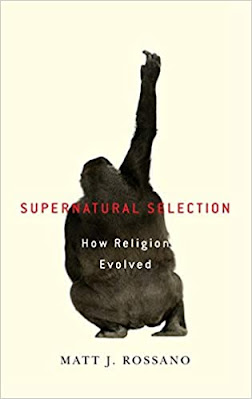
Supernatural Selection
Feeling inarticulate this morning but also feeling like it's important to speak --
I thought this book was important:
William James made a breakthrough (in my opinion) by turning his attention from the claims of religion (is this or that true?) to the experience of religion (what is it like to pray, to be in the Lord's presence, to make offerings?) Rossano turns his attention to: what does religion do? What can an endangered savannah ape that gets religion do that it couldn't do before?
Well, it can take over the world. For better or worse. Every community can redesign its modes and intensities of cooperation. Individuals can engage in practices that elevate their sensitivities and develop their intellectual and imaginative capacities. Suddenly sacred places appear, and sacred art appears in them. These apes become ever more bizarre and unpredictable.
Divinities serve -- this is my interpretation now, not Rossano's exactly -- as variables in the algebra of human relationships. When you achieve variable in mathematics you start be able to solve, not just particular problems, but general ones. And when you have divinities you start being able to think beyond the particulars of "what to I owe Joe?" or "what do I owe Nancy?" to "what do I owe people in general? What is the right way to behave? Precisely because a god -- a person with whom you have an intense but infinitely malleable relationship -- is usually absent, you can configure different solutions to human equations. You can tinker with social relations in a way that you could not before. Some of these solutions were spectacularly successful.
Tuesday, May 17, 2022
Five Years Later
Five years ago today I undertook my last weight loss attempt. I had failed so many ways so many times: I promised myself this is the last time. No more.
That was the deal I made with myself: if this didn't work, I was going to stop, and just accept being fat, and get on with my life. I had already sunk an extraordinary amount of time and effort and anguish into the project. I needed to either succeed or fail. Whatever life was for, it couldn't be for struggling endlessly with this ultimately trivial issue. Who cares if I'm fat? What difference does it make?
The date I picked for the decisive day, the day I'd decide if I succeeded, was five years in the future: May 17th, 2022. I didn't just have to lose the weight -- I'd pulled off significant weight losses before, that wasn't the problem -- I had to get it off and keep it off. My target was 180 lbs. After five years, I reckoned, you could reasonably claim victory.
Today I weighed in at 170.2 lbs. So I succeeded! Kind of. But that's twelve pounds more than it was three months ago. As I succeeded in losing weight, and dropped all the way down past 180, down into the 150s, I revised my target, as one does: my target now was to have my waist measurement be 90% of my hip measurement. I'm at 94% now. Which isn't bad: but it's not the target. And the larger fact, it seems to me, is that after all this time and work, my weight is still not stable. The whole idea of the win-or-lose showdown was to be done with the damn issue, one way or the other. The real outcome, it becomes clear, is this: I will never be done with it.
It was realizing this, perhaps, along with other stressors, that sent my on my latest series of binges. When I was really faced with doing this forever -- eating the same thing every day, tracking meticulously, weighing and measuring -- a large part of me rebelled. Screw that. What is it for? said the rebels, and for a few weeks they had the upper hand, and binge-eating was the order of the day. (Or the order of the evening, actually: the evenings are generally when these collapses occur.)
What drove all this was the idea that my daily life might look different, at my goal weight: that I might be able to indulge occasionally, as normal people do, without getting fat. This is clearly untrue (For myself as I am now. There may be future selves that have wider options, who knows?) As I am now, I have only two paths open to me.
So this is clarifying. And which path I take is obvious. Onerous and discouraging as the path of restriction is, it is less onerous and discouraging than the path of bingeing. The thing about the bingeing is that it's intrinsically deluded. My mind is inflamed with the idea that there's satisfaction somewhere, on the far side of that bowl of ice cream. But on the far side of that bowl of ice cream is... the craving for another bowl of ice cream. And beyond that again, another. What stops the binge is not being satisfied: what stops it is the sheer discomfort of having eaten a week's worth of calories in a couple of hours, and the glut of a certain crooked longing for... humiliation? Breaking the lares? Dunno. I get gleams of pleasure -- especially early on -- but they're extinguished by the anxiety of the craving really rapidly. Very soon, only the anxiety is left. The whole thing is a chump's game. The reward never really comes. I catch certain of the rebel forces trying to convince the populace that we have in fact experienced satisfaction. My populace is not quite that dim. We have not experienced satisfaction, and they know it.
So -- there is no far side. There is no resolution. There is no being done with it.
And that actually is the resolution. What I'm faced with here is not a trivial issue, after all. What I'm faced with is life: my relationship with food is just the part that's been under the bright lights lately. If I want to be my own master -- to have agency in the world -- this is the price: exercising control. Setting limits. Planning ahead. Being an ordinary creature subject to the ordinary rules of life.
So does this mean I never get treats? Well, it does and it doesn't. Of course I will get treats. Of course my self-regulation will collapse from time to time, and I will binge: that has remained true all through this process, and presumably it remains true all my life. There will be birthday dinners and Thanksgivings. What there will not be is a magical exit from the rules of causation. Which I think is what the eagerness for treats actually amounts to: to stubbornly clinging to the hope that the structure of the universe will change. That the adults will let us stay up late and we won't get tired and we'll be able to have fun forever.
That's not the way this works. And it's not even -- to drop to the most prosaic level -- it's not even the way that maximizing pleasure works. Epicurus, who believed that the point of life was maximizing pleasure, ate simply and sparingly: not from a suspicion of pleasure, but from a wholehearted commitment to it.
Much more important than how I manage my eating is this: I am gradually learning -- this is remedial learning, something I should have learned in childhood -- to get ahead of myself a little, to plan and execute in my own person for my own ends. And that is not trivial. That's the project of inhabiting my own life, as I've written many times. I want to live in my life, not camp out in it. I don't want to be a tourist here. I want to be a local. And there is no time I feel more like a local than when I am following my own regimen: when I get up in the morning to the ritual of making the breakfast I prepped last night, or when I wash the week's apples as the finishing touch of putting away the week's shopping. Every time I follow through on a commitment to myself, there's a moment of relief, of rightness.
So call it a success, or call it a failure. It's both: but it ain't over.
Monday, May 09, 2022
After Winter
Sunday, April 24, 2022
Freeway Practice
I find myself on the freeway, a few times a week, driving home from work, and I've changed the ceremony.
Here's how it used to work: I would get on the freeway, anxiously squinting ahead to see what the traffic would be like: how many people were blocking my way home. The freeway was a thing built by a stupid people, who were willing to destroy real walkable neighborhoods for a few minutes' commute time out to their achingly ugly and stupid suburbs; and I was falling into the trap too, pitching myself into a concrete cauldron to get out to my own ugly and stupid house. Ugly and stupid all round.
And all around me the ugly and stupid were driving foolishly and recklessly, ignoring the obvious plain facts of physics, following the cars in front of them so close that even a tap on the brakes would necessarily cause a pile-up. Idiots. Others checking their damned phones: their desperation for validation easily outweighing their mild interest in not dying, not to mention their total indifference to me dying. What a bunch of fucking clowns. And there I was. If we all drove attentively and reasonably, we could move along at the speed the road was designed for. But no, they bunch up, accordion-style, coming almost to a halt and then jerking forward. If they left enough fucking room for people to get over, then they could all just flow through: it's the stickiness of the particles, not the volume of flow, that's the problem. Jesus. Does no one ever think?
After twenty or thirty minutes of this spiritual practice, I pretty reliably get the results you might expect: I feel isolated and persecuted: I hate my fellow human beings passionately, and my contempt for them is limitless.
So here's the new practice. I begin by thinking of the building of these works, which were among the world's engineering marvels when they were first built. Built by the financial contributions of millions of people for the good of the nation, and having served for a couple generations. All those people working in the rain or in the sun; all that expertise marshalled to make these soaring, curving ramps. They really are kind of amazing things. They have downsides: of course they do. But they make possible the daily respiration of a great city that I love.
That, to set the stage. Now: my project for the next twenty or thirty minutes. It's not to get home as quickly as possible. Who cares about clipping off a minute here or ten seconds there? Will I be an ounce happier? will I treasure the few minutes I've snatched away from others?
No, the project is to read the traffic so as to detect the knots forming, and do what I can to stop them. Notice when someone wants to get over, and make it possible. Speed up or slow down, so as to mitigate the bunching-up. We're all trying to get somewhere: home to see loved ones, to the store to pick up a prescription for a grandparent, home to prepare for a date. This is a project we're all in together: and my mission is to help us all achieve it. Maybe I understand the physics of this problem a little better than most people, and I can put that understanding to use.
It's a totally different twenty or thirty minutes, if I spend it that way, and I if I arrive a minute or two later than I did when I was struggling against the idiots, it's well worth it: I live in a nicer world.
Monday, April 18, 2022
No Path Back
At sixteen -- seventeen, maybe -- I first read Plato, and decided he was wrong. No further action required. Around the same time, I acquired a copy of Being and Nothingness. Maybe I even read it: I don't remember. But I decided all philosophy was wrong, or at least inapplicable. I remember thinking "what I need to learn I am not going to learn from these people," which was fair enough, at the time. There were more pressing things I had to learn: for example, "how do I stop being a repulsive jerk?" and "how do I make a living?" And also, I had Shakespeare and Tolstoy and Blake to read. I wasn't wasting time.
But that was fifty years ago, and now I meet a neo-Platonist for realz, and suddenly the summary judgements of a teenager no longer do for me. What if Plato was right? What if he was even kind of right? What if I'm not such a clever lad, after all, that I'm smarter than thousands of years of people trying to understand what we are doing?
It's too late to become a philosopher. I don't have the stamina now to do mountains of difficult reading. I'll have to accept -- as I never did, as a reader of literature -- secondary sources and summaries, watered-down versions adapted to the meanest understandings. Well, bring it, then. I'm not reading the complete works of Kant and Heidegger at this time of my life. But I may need to know something, at least, about what they meant. I don't aspire to be a figure of any sort, literary or philosophical -- which is all to the good -- but I still aspire to understand: I still aspire to live a life that might mean something. I still aspire to take a bit of the edge off my own suffering, and other people's, in whatever way I can.
It's not just reading, of course. It's practicing. It's meditation, contemplation, prayer, visualization. Mushrooms. Being a damned fool, or even a blessed one. And it's writing poetry, and possibly even making art.
I don't see what else I can do, honestly. It's not just that there's no other path forward. There's also no path back.
Sunday, April 17, 2022
Easter Moon
an impasto of cloud. The first Sunday
after the first full moon
after the vernal equinox. Christ.
The booing of the geese, the jeering of the crows.
What else? What did you expect?
The echoes fade, the light goes. The palette knife
lays down diamonds of silver, squares of slate,
banked snow mounds of white, and the moon
(remember the crescent? That was Ramadan)
is extinguished. You said
there was another life, on the far side:
you said to think of it. What life?
running, running till it runs clear. Maybe
that's not what you meant.
Done on this side, said
But the moon? The walk by moonlight?
The cloud runs from rim to rim,
the sky is painted over; no hint
of light behind. God's
theater make up: can't smile
or it will crack. Christ.