Wednesday, April 19, 2023

A Living Thing

Timaeus. The only piece of Plato's writing directly known to the early medieval world.

Plato is quite clear that the universe is “a single living thing that contains within itself all living things, mortal or immortal.” A living thing. How lovely that is, and how different from the dead universe of scientific materialism. In Plato, everything is against a living background.

Note that every human being has two souls, a mortal one based in the trunk and an immortal one based in the head, with further subdivisions and hierarchy within the mortal one. And it is part of the lower soul, seated in the liver, that dreams and practices divination. (Which must then be interpreted by the rational upper soul to make it useful knowledge.)

Then there’s the daft, immensely entertaining description of how and why the Demiurge created the human body: it’s extraordinary that seasoned veterans of of edged-weapon warfare could be so ignorant of human anatomy (no, Tim, there is one abdominal aorta in the center, not a matched pair on either side of the spine!), but there it is. Also – but this is more understandable, in a rabid patriarchy – total ignorance of embryology. The fact that every known human being starts little and grows up has apparently made no impression on these men at all. 

So yes, all the exasperation that Enlightenment science, not to mention feminism, finds in a text like this is well-earned. So much wasted intellectual effort! Start at step A and think up any old crude version of a falsifiable test, and you wouldn’t need to bother with any other steps. This is ridiculous.


And yet. And yet. Where it comes from: a deep conviction that the universe is intelligible, that satisfying explanations can be found, that everything in this living, intertwined universe has intention and desire; that our minds resonate with the world because we belong here, because everything we think shapes and is shaped by reality. Underneath my laughter and incredulity runs a current of regret: a conviction that under this heap of error there is one thing these men achieved that we cannot. They built a conceptual world that was worth living in. Can we say the same?

Monday, April 10, 2023

Theaetetus

Well, Theaetetus is one that I certainly need to reread: extraordinarily rich. This is the one in which Socrates likens the task the god has given him to midwifery: delivering other people of their ideas. He's dead serious, both about the task and about the god. And this is the one that dallies with, (but does not accept) the idea that there are irreducible unknowns ("things of which we know only the names") that are the foundational elements of all the knowns.

On to Timaeus, and then I’m done with my first rapid read of Plato’s greatest hits. Man. I had no idea how rewarding this was going to be. Nor how illuminating of the whole tradition that I’ve been nibbling at the edges of all my life: these texts are central. Ridiculous of me to have neglected them because they are philosophy, and philosophy is not something I do: how puerile an attitude is that, to be frightened away from my birthright by some cataloger’s decision to put these books on one shelf instead of another?

I wrote to a friend:
I am just marveling at Mr Plato these days. I can’t believe I never read him, in all these decades of reading. More and more resentful (irrationally, I know) of The Republic for giving me such a skewed and squinted view of him. Imagine if you were introduced to Dostoevsky by some lengthy antisemitic Russian triumphalist tract (didn’t he write such a thing?) and everyone went about saying it was his best work… so after slogging through it you just skipped Brothers K and Crime and Punishment. Like that. I’m reading Theaetetus right now. So good. (So totally unpronounceable as an English name. That’s probably really why people go around recommending The Republic: they know how to pronounce it.)

Thursday, March 30, 2023

Parmenides

The problem of the One and the Many has never troubled me -- undoubtedly because I have never risen to it -- so I'm finding the Parmenides rough going. Plato, however, is at his most artful: here is your chance to see young Socrates, at the moment he first got to run with the big dogs!

(Zeno murmuring, "the force is strong in this one...")

---

Yikes. The brilliant, painstaking idiocy of the Parmenides. Can he really believe he’s still meaning anything when he gets that far in to the labyrinth? I can’t tell. That this is the Zeno of Zeno’s paradox is obvious enough, though. Fascinating that Parmenides' obedient interlocutor should be young Aristotle. (Holy crap, how did I not know any of this before? A lifetime at my books, and I’m still ignorant as hell.)

---

It’s fitting that the final sentence of Parmenides, in my translation at least, is not even a sentence: if there is a main clause there, I can’t detect it.

Thursday, March 23, 2023

Dialectic

Finishing the Phaedrus. Finally, I have a definition of dialectic, a word that has bedeviled me since college. (Probably because I first met it in Marx and Hegel, who both put it to strenuous and unaccustomed work.) For Plato, it’s the art of collection and division: “seeing together things that are scattered about everywhere and collecting them into one kind,” on the one hand, and being “able to cut up each kind according to its species along its natural joints, and try not to splinter any part, as a bad butcher might do,” on the other. Note that this is not seen as imposing categories or distinctions, but as recognizing them. (Phaedrus 265d)

274c & following, is Socrates’ denunciation of depending on the written word: reading encourages you to think you know things, when you don’t; relying on texts leads to a feeble memory; writing fails to fit the message to its audience; texts are frozen and can’t answer questions. Writing is an amusement and an aide-memoire – not serious philosophy.

And now, on to the Parmenides.

If it didn’t mean wishing away the parable of the cave, I might wish Plato had never written The Republic: such an ugly book, full of Socrates at his worst: it put me off Plato, and in fact philosophy, for decades. I’m glad that I have lived long enough to meet this Socrates who prays to Pan by the riverside: asking for his daily bread, and to be made beautiful inside. A different man entirely.

Monday, March 06, 2023

Bad Algebra (or, Why I'm Reading Plato)

When I went back to school to get my Computer Science degree, I took a Calculus course. It was sort of a spiritual awakening for me: but never mind that for the moment. Sometimes the instructor would put a problem we'd had trouble with up on the blackboard. He'd work through it, get through the parts we already understood, and then, right at the most confusing moment, he would stop. 

"And the rest is just algebra," he'd say, toss the chalk back into the tray, and move on to another topic.

This happened a couple times. When the students began to ask him to work out the algebra, too, you could see a light going on for him. It was the algebra we were having trouble with?

"Look," he told us, very earnestly. "You've got to get your algebra nailed down. Your bad algebra is going to kill you."

---

He was right. There's nothing particularly difficult about calculus: its reputation for difficulty comes of the fact that you have to be comfortable with algebra in order to do it, and not many of us learned our algebra all that well. 

---

Today, I think, "my bad philosophy is going to kill me."

---

When I was young and impressionable, growing up in hick town in a backwater state, I decided that philosophy was useless. I actually had pretty good reasons for deciding so. I wanted to know how to live: and the only philosophers I encountered assured me that they could not help me. Each individual created his own meaning, they said, and he committed himself to it: reason could help him neither to find meaning nor to clarify it. (I don't even know who these philosophers were: I got their ideas mostly second-hand, and I was a young innocent. People pontificated about Sartre and Camus a lot in those days: it probably had something to do with them.)

So. If philosophy and reason were useless in figuring out how to live, it seemed to be that the next best thing was case studies. Novels offered case studies: what sort of life do you have if you set your heart on this, or cultivate that? Philosophy had no answers, maybe, but fiction had lots of local, provisional ones. So I read fiction, and wandered into literature, and basically made a life of it. Not a bad choice. I don't regret it.

---

But I had made a large mistake. I had thought that I could just leave philosophy alone, and as it turns out, that's not the way it works. Ignoring philosophy doesn't mean that you don't have ideas about who you are, what the world is, and what you should do in it. It just means your ideas are bits and pieces absorbed from anywhere, unexamined and contradictory. You build your life on these notions: you can't help it. And you find yourself then at age 64 asking once again, "how should I live?" and realizing that this is a problem that you don't have even the minimal tools for addressing.

Your bad algebra is going to kill you.

So: start over. Learn the basics. "What good is Plato going to do you?" someone said to me. "He's wrong about everything important." Maybe so: but you have to start somewhere.

Monday, February 20, 2023

Spring Slash

I am silent when called upon to witness:
I bow my head and mutter, "let each planet
take its course, let every life end where it will; why,
with no writ for life, should I open my palm for death?

Who is calling? You get no more of me
with your mighty obscurities. Say it plain
or get out of the road." My long patience
has run out. The Spring slash is burning, but no voice

comes from it. A beetle makes its slow desperate way
over the moss, while the shadows of birds and clouds
fill him with distress: O brother! We understand as much.
Our call is important to them. Yah. Fuck them.

A wind in the throat of the Gorge: a keening
and a death wail, and whitecaps on the river. It was snow
not long ago, and there'll be snow again before the year turns.
If that's a call I am not home.

Tuesday, February 07, 2023

Winter Afternoon

The pigeon's toes as he carefully
steps over his own feet: the cock
of his head at the swish of a car:
the night-echo of 4 p.m.
when the light has (mostly) drained from the sky
and rinsed away the day's greed,
(the day's greed for now) to make
room for the evening's: oh
my dear friend I miss you:
you were always undismayed
even when terrified, and 4 p.m. 
was a trifle to you. Now I am expected
to find my own courage, 
and I have none, and no one now
wears silks of outlandish colors,
turquoise: apricot:
chartreuse: plum:
how anyone faces this hour of the day
without a visitor in motley
who carries summer in her fists
I do not know.


Saturday, January 28, 2023

Annual Report for 2022, part 2

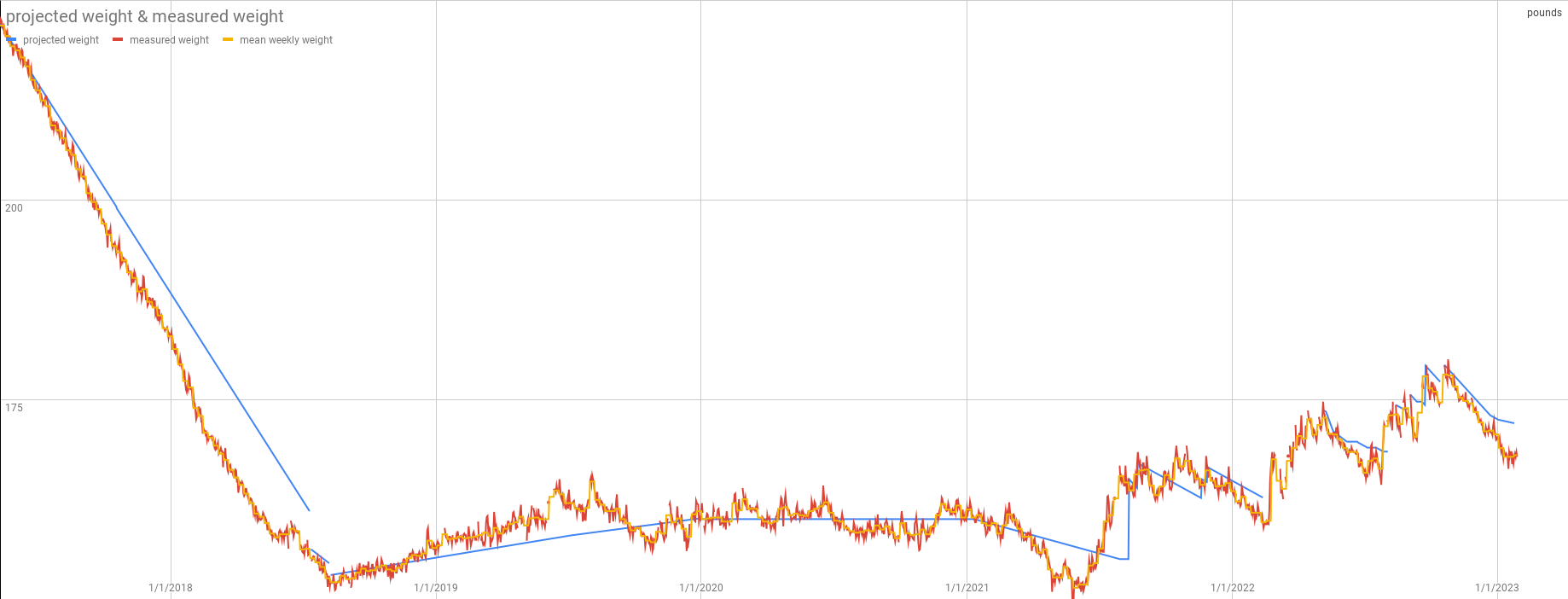
First, the grand overview, using the most familiar measure. Here's my weight in pounds, measured daily since May 2017. My discipline was very good for the first year and a half. I got down near 150 lbs, and decided I was skinnier than I liked, so I deliberately gained back 10 lbs or so. I stayed around 160 lbs for a couple of years. Then, in Spring 2021, I started experimenting with fasting. That brought my weight down rapidly, but my discipline deteriorated. Other things were going on: I was worried about my father's health. So I can't be sure, but it's hard to look at this graph and not to suspect that in Spring 2021 I disturbed my hormonal equilibrium. A pattern emerges of losing control for a few months, getting it back for a few months, and losing it again. With an overall trendline going steadily up. I didn't like the looks of this chart at all.


There were other ways to view the data that were more encouraging. I was putting on a lot of muscle through these ups and downs: I was training consistently, and I had inadvertently taken up the bodybuilder's typical bulk-and-cut method. I don't, unfortunately, have hip measurements clear back to the start of the project, but you can see that the graph of my waist/hip ratio, over those last ups and downs, makes the situation look a lot better. I was veering wildly from 90% to 95% and back again, but the overall trendline didn't look so bad. So I was alarmed, and determined to do something, but I wasn't panicked.

I had started tracking binge behavior a couple years ago -- just marking every day as "binge" or "no binge," where "binge" simply means "didn't eat exactly what I planned to." The graph of that looked, towards the end of 2022, like this:

That trendline was very alarming indeed. he whole project was threatened, if that went on. I would simply lose control entirely. I realized I needed to change my focus. A dozen pounds of weight, an inch or two around the waist, was not nearly so important as getting on top of the binge behavior. That trendline really needed to be reversed. 

So. I am back at at 90% waist/hip ratio now, and my project is to keep it there -- to hold that line horizontal -- for at least four months, and to do it without any bingeing at all. At that point I may try to steer down a little bit more; I would really rather have a slightly smaller waist; but getting the upper hand of the bingeing is obviously much more important. The binge graph now looks like this:


A better trendline, but not the one I want, yet. I'm not out of the woods.

So the 2023 project is to end the binges once and for all, and to have nice steady, stable, horizontal lines.

Tuesday, January 17, 2023

After Socrates

I've been watching John Vervaeke's new series, After Socrates. I appreciate Vervaeke very much, and I'm finding the series very worth watching.

My problem is that I roundly dislike Socrates, and have from the moment I met him. He is a humble-braggart and a busybody, minding everyone's business but his own: on his own showing he neglected his family and let them fall into poverty while he spent his time gadflying about town and picking quarrels with anyone reputed to be wise. What kind of conduct is that? 

And so often, such pettifogging, nitpicky arguments! Such sophomoric glee in mere triumphs of words! That sort of thing is forgivable in an undergraduate, but a man in his prime ought to have moved on. He should be listening to the heart by then, not to the words: and he should care more about the person he's speaking to than about scoring points in a debate. But Socrates just loves to win arguments, and to rub his opponents' noses in their defeats. I have been trying to read him fairly. Starting again, and making every assumption I can in his favor. Suppose he really does believe that God called him to this task. Suppose it wasn't particularly congenial to him. Suppose he really was trying to understand reality, with all the resources he had. Suppose he really thought he was supplying exactly what his city desperately needed, and what only he could supply. I'm trying. It's tough going.

At the same time that I find my antipathy intractable, my respect for Socrates (and the Platonic and Aristotelean tradition he begot) keeps increasing. The standpoints from which I used to despise them have proved even more fragile than theirs: the liberal, individualist ideology I was raised in has crumbled; the  projects of the Enlightenment have come to grief; the Buddhist philosophy that I once adopted now seems to me inadequate. We're back at square one. It doesn't matter whether I like him. What matters is what's true, and what it means for how we ought to live.

So I go on. I have my old college penguin paperback: I've read the Euthyphro and and the Apology; I'm making a good-faith attempt to actually understand what he means by "soul" and "God": I am taking into account -- as I couldn't, when I was an innocent undergraduate -- that translating arguments that turn on exact nuances of the source language is fiendishly difficult, and the points made almost always turn out looking either more obscure or more obvious than they do in the original. 

It's not hard to discover ways in which this Socratic argument or that are inadequate, after 2,400 years of l'esprit de l'escalier. But if I have demanded more of Socrates, I should demand more of myself: I should be listening to the heart.

Saturday, January 14, 2023

Comfort

I awake to dread, and the cold winter light
walking its fingers down the wall. 
There is a little comfort in the thought:
maybe God has called you to this task
not because you can do it, but because you can't.

Tuesday, January 03, 2023

Feast Days (annual report part 1)

I have four designated feast days during the year, days on which I deliberately go off my regimen and eat whatever I want: Thanksgiving, Christmas, my birthday in March, and (in theory, because my sense of symmetry demands it) some unspecified day in high summer. I suppose this is a variant of the "cheat days" advocated by some diet gurus: the idea being to take some of the pressure of constant self-regulation off, and deal with binge behavior by getting ahead of it a little. But the term "cheat day" seems excessively negative, and possibly self-defeating, to me. The whole point is that I'm not cheating. Also, "cheat days" seem to happen oftener, in some versions once per week: my discipline would go to pieces if I were going off regimen that often. But there are days of celebration when it feels mean and antisocial to measure my oatmeal and weigh my potatoes. They're typically days of stress, for those of us who are trying to self-regulate: so it seems better to just roll with the holiday, have fun, eat too much, and go on with life.

It sets me back. It takes a week or even two to lose the weight I can pack on effortlessly in a single day of unregulated eating. But on the larger scale that I now think and plan in -- who cares? I'm not looking forward to some utopian liberation day. I will always need to "watch what I eat."

2022 was a hard year for me. I don't have time yet for my annual report, but the summary version is that 2022 was the first year I felt like my achievements were seriously under threat: I gained about fifteen pounds, and then lost ten, and gained fifteen more pounds, and lost ten again. That isn't as bad as it sounds, because I was packing on muscle at the same time: bodybuilders are quite right when they observe that it's a lot easier to build muscle when you're in a large calorie surplus. But if I gain ten pounds every year, in a few years I'll end up fat again. Not what I want: not what I'm going to do. It's been 70 days since I last had to record a binge day, which is the longest period since I began recording them, two years ago. Trendlines on my binge graphs are already looking less ominous, and I have (in the stock-market parlance) "broken out of the box." 

The challenge for 2023 is not to lose weight -- though I do expect to drift very slowly down another five pounds or so, and to lose another inch off my waist, still -- but to hold my graph lines more horizontal than I ever have. I know how to lose weight now, and I'm confident that if, in times of stress, I overeat, I know exactly how to to undo the damage. But what I have still never done is really hold a steady body composition, without having periods of bingeing and binge-repair. That's my ambition now. I want a nice steady horizontal graph.

(I seem to have drifted into delivering the beginning of my annual report anyway. Oh well. Graphs, with commentary, to follow :->)

Sunday, December 18, 2022

Because I Think I'm Making Progress

I know it's tiresome, the way I yatter on about my attempts to control my eating, and I know that the project seems endless. I'm well into its sixth year, and rolling out an elaborate "maintenance" plan, complete with graphs and algorithms, and I think it would be reasonable for a reader to say, "why don't you just get the hell over it and think about something different, and more interesting, for a change? Nobody else gives a damn about this"

Which is quite true: there's really nobody anymore who cares that much whether I weigh 150 or 250 pounds. And it doesn't even matter to me that much: I'm close enough to the end of my life that moving life expectancies around by 5% or 10% doesn't, in absolute terms, amount to much. Who cares?

There's three reasons I do care. One psychological: it's that this bears crucially on the narrative of my life. I grew up believing that under challenge I would always collapse, and that being fat was the outward sign of my cowardice and lack of fortitude. I believed also, like my mother, that this doomed me to being perpetually, and essentially, unlovable. So psychologically, it's as fraught as it can be. Is it my fate to become ever fatter and ever less loved? 

That reason is nonsense and always has been. It was nonsense of my mother as well, who grew ever fatter and had three devoted husbands. The fat wasn't particularly a problem, even to her longevity: she made it into her early 80s. The Doom of our House was always a stupid fiction.

So if this was only a psychological problem, it would make sense to simply drop it. Who cares how much I eat? Nobody. It's of compelling interest to no one at all.

However. The second reason has to do, not with longevity or lovability, but with physical well-being. Being fat renders me sulky, pimply, smelly, and impotent. It makes me susceptible to joint pain and back problems. Very little of that has to do with subcutaneous fat, which is pretty harmless: I think it has to do with visceral fat and chronic systemic inflammation. When I have a big belly my baseline is feeling really pretty crappy.

I used to think that people were exaggerating all these things, in the interests of the diet industry and so forth. Now that I have direct experience of it, I no longer think so. The differences are large, unmistakable, and unmistakably tied to a very particular threshold of belly fat. My body hates being fat.

The third reason though is much more important, and it has to do with -- I know a lot of you dislike this way of talking about it -- cultivating virtue. 

The opposite of gluttony is supposedly temperance, but in my case the virtue I'm cultivating is actually fortitude. It is the virtue I have always missed most. It has to do with keeping resolutions, and remaining steadfast in the face of adversity: it has to do keeping commitments. It has to do with not letting passing whims and glittery little distractions drive your life. The reason I keep practicing "whupping the food thing" is that I keep benefitting from it. Fortitude generalizes, in all sorts of ways. It keeps making me a better person: it keeps making my life better. Pablo Casals, when asked why he continued practicing the cello at age 96, answered simply, "because I think I'm making progress." And that's my answer too.

The difference in how I work, now, is striking: I used often to hit a wall -- if I was lucky, not till mid-afternoon -- beyond which I was utterly unable to push myself to do anything more. This happened daily; and there were days when I never managed to work at all. That just doesn't happen to me now. I get tired, sure, but if I look at a stack of work that will just take an hour more, and make tomorrow much easier -- I just do the work. No fuss, no bucking or shying of the mind. This is intimately related to restraining my eating: it's subjectively obvious that the virtue that enables me to proceed with work is the same one that enables me to refrain from eating what I've decided not to eat. I'd call it fortitude. Psychologists call it self-regulation. The general public calls it will power. 

I really think fortitude is a better name. Because it's not a matter of one part of me dominating the other parts: it's a matter of holding fast to a larger understanding of what's going on, and a matter of the various constituents of my spirit being better aligned. Self-regulation and will power suffer all the ills of despotism: blindness and caprice and grandiosity. And they're prone to sudden catastrophic failure. Fortitude is the opposite of that. I don't try to not to be tired, or not to be hungry. I just do what needs to be done anyway.

There is not much glory to this progress. I am well aware that this is remedial work. Many people were trained up in fortitude, as children, or at least discovered it early. I came to it late: so I'm celebrating triumphs more appropriate to a nine-year-old than a sixty-four-year-old. But it was the obvious, first thing that I needed to do, and I'm doing it.
Thursday, December 08, 2022

How to Live

The leitmotif of my social, political, and personal life: we don't know how to live. At one point I was thinking: you know, Dale, maybe all you mean is I don't know how to live. There's a great deal of profit in mulling that one over, and I'm not done doing it, but I think I'll stand by the first formulation. This is not just my problem. This is our problem. 

It's a political problem in the local and immediate sense that until we know how to live, our opponents have not the slightest reason to listen to us. If we're not offering a better life, why should they? We consider ourselves just reeking with virtue and goodness, but of course so do they, for equally flimsy reasons. Given that we can't and won't talk to each other, what else could we ground our choices on? Each of us looks at the other and thinks, "well, that looks like a petty and stupid life." And we're both right. So. Impasse.

It's our problem, not just mine, also in this way: I can't work it out by myself. I can't unilaterally start living a different life. I need people to live it with. And, more importantly, I need people to work it out with. Hegel (I'm told) said of Kant, "he wants to learn to swim before he gets in the water," and that's what I think I'm doing when I try to figure out how to live before I have a community to live with. That's not how how to live works. But I'm so imbued with individualist doctrine that any whiff of community panics me. I might be circumscribed! Horrors! As if this present life was freedom.

---

"Every particular view of the virtues is linked to some particular notion of the narrative structure or structures of human life." Alisdair MacIntyre, After Virtue, p 174.

I used to like the way my Buddhist teachers talked about ethics. They likened it to gardening. You clear away weeds, not because you hate weeds, but because you're trying to grow something else, something not yet robust, that might otherwise be crowded out. Likewise you clear away vices, obstructions (kleshas) to make room for wisdom and compassion to grow.

The narrative structure of human life implicit here is of growth over time. And it's unproblematic to Buddhists because they have lots of time: life after life. Clear the weeds and time will do the rest. 

One of the things that alienated me from Buddhism was that I never thought reincarnation was likely, or even particularly plausible in its own terms. No one of course insisted that I "believe in" reincarnation -- that's not the way modern Western Buddhists do things. They just suggested that I hold my opinions of death lightly, and imagine that it might not be so. Good advice. I did that.

It's not terribly easy to tell the difference between holding your opinions lightly, and pretending to believe something you don't: but at some point I realized I had gone from one to the other. I really don't think anything continues after death. I think life ends -- like a candle flame that's blown out, or a song that comes to a close. There isn't any more after that, and it doesn't make any sense to justify what we do now in terms of what will happen then. Holding that lightly felt less and less authentic. There was a wobble in my practice that I didn't know how to handle.


Thursday, December 01, 2022

Alisdair MacIntyre

 "... it was because a moral tradition of which Aristotle's thought was the intellectual core was repudiated during the transitions of the fifteenth to seventeenth centuries that the Enlightenment project of discovering new rational secular foundations for morality had to be undertaken. And it was because that project failed, because the views advanced by its most intellectually powerful protagonists, and more especially by Kant, could not be sustained in the face of rational criticism that Nietzsche and all his existentialist and emotivist* successors were able to mount their apparently successful critique of all previous morality. Hence the defensibility of the Nietzschean position turns in the end on the answer to the question: was it right in the first place to reject Aristotle?" After Virtue, 3rd ed., p 117

*emotivism: the doctrine that all moral positions are subjective emotions masquerading as objective truths 

Smite the Vices

Here I am in the sixth year of my weight-loss project, and it is still the project that consumes most of my disposable will-power. Humiliating, but there’s nothing to be gained by trying to ignore or conceal it. It gains a certain shabby philosophical dignity if I call it “cultivating temperance,” I guess. It has the advantage of being easily and precisely calculable. If my waist/hip ratio is over 91%, then I’m not temperate enough. Hardly a full account of the virtue, but as a heuristic it works fine. Some virtues are difficult to evaluate. Not this one.

Looming behind this is the project of cultivating chastity. Lest this one should seem interesting – it amounts to not squandering precious work time on stupid, repetitive, commercial pornography. This also is humiliating, but there it is. But until I have the temperance habits fully in place, and have freed up some self-regulatory oomph, I may not make much progress on it. Although I think the temperance skills have already been transferring to this realm. (But possibly that’s just age-related decline of libido. Here again, the nuts and bolts of cultivating virtue contribute all too generously to the prime virtue of humility.)

There is the danger of sinking into a sort of mindless video game of smite the vices, and forgetting what all this is in aid of. The vices and virtues are not the point. Unbearable, dazzling beauty: being overwhelmed by the infinite fractal elaboration of the worlds, visible and hidden – that is the point. I could win the game and lose the life. This is necessary, but it’s not sufficient. Remember that.

Monday, November 14, 2022

Inventing the Wheel

Well, la! One head on the little YouTube screen
says we need a new religion, and another says
it's stupid to reinvent the wheel. And I would think
the second was right (because I like cathedrals),

but then I think: those of us unchurched 
are creating a new religion willy nilly, 
and the only question is do we do it right
or do we do it like chuckleheads -- worship at the temples
of commerce, make offerings to the algorithms
of liking, train our attention
to ever greater feats of distraction. That
is our present devotion. We're inventing it anyway,
a lonely lopsided Flintstone 
pentagon of a wheel. Stop.

Here is what we do in our church: 
we never gather and we never sing
we blame but never praise
we cultivate indulgence; we wallow in dread;
we pick the scabs of anxiety.
The stupidest Congregation of the Bigot
in Podunkville does better than that.

Any meditation, any contemplation, any prayer
is better than this. Any tradition, old or made up.
And the thing is, I have always had it backwards
You don't find out the truth first and then 
go looking for the church that matches. That's
a project bound to fail. 

The people of the church
must gather first, and build and find together.
What we know is: this does not work. That's
enough to start with. The rest comes later.


Thursday, November 03, 2022

Aureliano José

There is a family tree at the beginning of Gregory Rabassa's splendid English translation of Cien años de soledad, but I found it confusing, because it didn't preserve birth order. So I've been constructing my own as I go along, and this is where I presently am:

                     José Arcadio Buendía

                     = Úrsula Iguarán

|

—---------------------------------------------------------------------------------

| | |

José Arcadio Buendía Colonel Aureliano Buendía   Amaranta

= Rebeca Buendía = Remedios Moscote

|           |

—----             -

|             |

by Pilar: Arcadio         by assorted women: 17 assorted Aurelianos

= Santa Sofia de la Piedad By Pilar: Aureliano José 

|

—--------------------------------------------------------

|          |                                   |

 Remedios José Arcadio Segundo Aureliano Segundo

            = Fernanda del Carpio

                                 |

—--------------------------------------------------------------------

|                         |     |

José Arcadio Renata Remedios (Meme) Amaranta Úrsula


Laid out this way, the figure who keeps catching my eye is the person at the center, Aureliano José, son of the Colonel by Pilar Ternera. He's a minor character, although he is the only child of the Colonel who is actually raised in the household. He is murdered in the general slaughter of the Colonel's sons, and vanishes from the novel, without leaving much trace. His main significance seems to be as a link between the incest anxiety of the first generation and the actual incest of the last generation. He falls in love with his aunt Amaranta, into whose bed he regularly creeps as a boy. She shoos him away eventually, after some ambiguous dalliance. He goes away to fight in one of the Colonel's insurrections:
Así padeció el exilio... hasta que le oyó contar a alguien el viejo cuento del hombre que se casó con una tía que además era su prima, y cuyo hijo terminó siendo abuelo de sí mismo.

—¿Es que uno se puede casar con una tía? —preguntó él, asombrado.

—No solo se puede —le contestó un soldado— sino que estamos haciendo esta guerra contra los curas para que uno se pueda casar con su propia madre.
Two things to note here: the point of the shaggy-dog incest story, as told to Aureliano José, is that a man becomes his own grandfather -- the extremity of individualist, even solipsist fantasy -- and the identification of why the Liberal revolutionaries are fighting against the priests: so that one can marry one's own mother. This is not exactly the standard interpretation of the Liberal cause.

The question is: why? Why is this incestuous solitude what all of the Buendías seem to be struggling for?

I saw one of those silly lists of "the fifty greatest books" the other day. It was a composite, assembled by some algorithm that searched out a bunch of such ranked lists and crunched them together somehow. Cien años de soledad came in third, on this list. I doubt this conveys much information about greatness, but it certainly conveys a lot about current popularity and prestige. This is a central novel of our time, which suggests to me that this theme resonates far beyond the particular psychology of Gabriel García Márquez. 

Wednesday, October 19, 2022

Fall 2022

Struggling to rise again from a fall. Winded. Sick of an old grief,
scolded by regrets of such long standing that they qualify for pensions (go ahead,
retire, please!) and the long low bank of dirty cloud carries particulates 
from sweet mossy forests that were never meant to burn, but are burning now.

What I have to ask myself is, do I feel lucky? And I do not. Lucky all my life
but not today. Dust off the knees of my old-man jeans; straighten the last few inches
that used to come for free. The masks for the pestilence work very well
for fire smoke. Isn't that convenient! And the various stupid accomplishments

of the past decade slide away. Tired of it all, and ready to arrange my limbs,
settle my debts, confirm my suspicion that the chips I'm playing 
are actually worth nothing at the desk. 
Poor Grendel's had an accident: so may you all.

Friday, October 14, 2022

America

If I'm really done with Locke and I think I am
Renouncing my inheritance, the social contract, that government
instituted to secure these rights
, then I am giddily set free,
let loose (or abandoned) to imagine other things, but then

so was that young neurotic Austrian painter of landscapes
and designer of Aryan battle flags: he imagined his people
right into hell. So soft, soft on that, please. Go slow.

Listen. Suppose there is an America, drunk and unsteady,
made of dreams and pixilated stories, lost and looking for the way home:
a person of sorts. Suppose it's our job to try to get him home to bed
without damaging himself (or others) more than can be helped.
Suppose he is us, and our every imagining blazes a path
in the flickering net of his brain. Suppose his incoherent weeping 
is ours. Suppose 
it all matters dreadfully, and we are to hang his mask on our faces
and learn to face the world.


Thursday, September 22, 2022

Aurelito

Martha being in Colorado a couple days makes me realize some things I ought to have realized long ago, but being me -- a substance considerably more dense than the marrow of a neutron star -- I had not actually realized: to wit, that none of my problems of concentration or of maintaining self or social ties have to do with Martha's presence: in fact I do substantially worse when she is not here than when she is. I am less likely to read carefully, to stay on task, to keep my diet, to stay in touch with people, to exercise, to maintain the house. I deteriorate by every measure I track, and by every one I can think of that I don't. It is only due to Martha's presence that I am not already a fat and aimless hermit. So there's that. 

Not that I actually blamed Martha for my deficiencies. That is not my way: dense though I am, I am not quite that dense. But I think from time to time I have refrained from blaming her, which is for some purposes the same thing. No, old friend, no: all these tendencies are my own, and all solutions will grow out of the only soil in which any of the goods of my life have grown. 

Throw the windows wide. Comfort poor Van, who is appalled by Martha's disappearance, and sleeps all day on her spot on the couch, not even rousing himself at the sound of a can of cat food being opened. (His consciousness is on strike: it refuses to return to work until she's back). Water the plants. Muse on the variations of cloud building and dissolving, north over the neighbor's gable. Count, if I must. One hundred and fifty breaths is one attempt at falling asleep. Fifteen long breaths, if I'm lying on my belly, opens the subway stops along the lumbar spine. How many before Martha is back? Too many to count. It's only a day, by the reckoning of the world.

---

--Esto es un disparate, Aurelito --exclamó.
--Ningún disparate --dijo Aureliano-- es la guerra. Y no me vuelva a decir Aurelito, que ya soy el coronel Aureliano Buendía.

---

Reading Schindler's Freedom from Reality. The first part is a close-reading of Locke, which is just so good and so telling, and illuminates so much about the American political predicament.