Wednesday, June 15, 2022

Half Light

I remember the half light of the pantry, 
where I stole packets of cocoa powder 
from people who had been only kind to me,
and would have given them to me if I had asked.

If I had asked? Who knows how to ask? The wind
comes up suddenly from the darkened beach.
It was a weary long time, before I would think to ask.
A life of erratic tacking, whose only through-line

was a desperate desire 
to disappear as I was and to appear as I was not.
No wonder the past now is a flicker, 
and nothing holds still. The light

goes out, and the darkness magnifies, surging
through the windows. Below, the surf beats 
on the drumhead of the beach: the skin
of countless deaths stretched tight, 

bound down
for the resonance. A buzz in my fingertips.
A rhythm caught and lost again. God in my mouth,
as if I did but only chew His name, and in my heart

And in my heart what? Gone before gathered.
Is it wickedness, or virtue, or some third thing?
Learn to ask has been the lesson, the one lesson
I can't learn, may never learn. 

A quiet comes
after the throb of the drum, a breath waits
but can't arrive, you can't take another 
before you release the last. Was it ever simple?

I don't think so. 
I don't remember it ever being simple.
It was harder then than it is now, 
and it's still too hard. Every grain of powder from the packet, 

searched 
with fingers and tongue:
and then the empty packet to hide
like a body. But I knew all about hiding things.
Tuesday, June 07, 2022

Deaf

The years whisper away and the voices behind
louder but more indistinct, a growing crowd
swelling but unintelligible, an accusing choir:
I have lived my life wrong.

Still. The shock wave bends the air, 
all the lines curve, the air ripples: a hiccup
of the earth or a belch of the sky. Are you deaf, man?
Yes. Oh yes.

Do you even remember which first kiss it was?
Whose was the tenderness? Which constellation
pulsed in the midnight sky? What is memory for, then?
Well, not that. Not immortality.

Where death is, I am not: where I am, death is not,
said Epicurus. But still the cognitive theorists aver
that an autopoietic system
cares for itself. Willy nilly. Say when.

Love comes late and untidy
bold and crumpled, crooked and strong:
it's a tune now hummed under my breath: it needs
no voice.

Monday, May 30, 2022

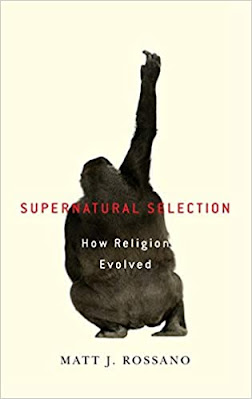
Supernatural Selection

Feeling inarticulate this morning but also feeling like it's important to speak --

I thought this book was important:

William James made a breakthrough (in my opinion) by turning his attention from the claims of religion (is this or that true?) to the experience of religion (what is it like to pray, to be in the Lord's presence, to make offerings?) Rossano turns his attention to: what does religion do? What can an endangered savannah ape that gets religion do that it couldn't do before? 

Well, it can take over the world. For better or worse. Every community can redesign its modes and intensities of cooperation. Individuals can engage in practices that elevate their sensitivities and develop their intellectual and imaginative capacities. Suddenly sacred places appear, and sacred art appears in them. These apes become ever more bizarre and unpredictable.

Divinities serve -- this is my interpretation now, not Rossano's exactly -- as variables in the algebra of human relationships. When you achieve variable in mathematics you start be able to solve, not just  particular problems, but general ones. And when you have divinities you start being able to think beyond the particulars of "what to I owe Joe?" or "what do I owe Nancy?" to "what do I owe people in general? What is the right way to behave? Precisely because a god -- a person with whom you have an intense but infinitely malleable relationship -- is usually absent, you can configure different solutions to human equations. You can tinker with social relations in a way that you could not before. Some of these solutions were spectacularly successful.

Tuesday, May 17, 2022

Five Years Later

Five years ago today I undertook my last weight loss attempt. I had failed so many ways so many times: I promised myself this is the last time. No more.

That was the deal I made with myself: if this didn't work, I was going to stop, and just accept being fat, and get on with my life. I had already sunk an extraordinary amount of time and effort and anguish into the project. I needed to either succeed or fail. Whatever life was for, it couldn't be for struggling endlessly with this ultimately trivial issue. Who cares if I'm fat? What difference does it make?

The date I picked for the decisive day, the day I'd decide if I succeeded, was five years in the future: May 17th, 2022. I didn't just have to lose the weight -- I'd pulled off significant weight losses before, that wasn't the problem -- I had to get it off and keep it off. My target was 180 lbs. After five years, I reckoned, you could reasonably claim victory.

Today I weighed in at 170.2 lbs. So I succeeded! Kind of. But that's twelve pounds more than it was three months ago. As I succeeded in losing weight, and dropped all the way down past 180, down into the 150s, I revised my target, as one does: my target now was to have my waist measurement be 90% of my hip measurement. I'm at 94% now. Which isn't bad: but it's not the target. And the larger fact, it seems to me, is that after all this time and work, my weight is still not stable. The whole idea of the win-or-lose showdown was to be done with the damn issue, one way or the other. The real outcome, it becomes clear, is this: I will never be done with it.

It was realizing this, perhaps, along with other stressors, that sent my on my latest series of binges. When I was really faced with doing this forever -- eating the same thing every day, tracking meticulously, weighing and measuring -- a large part of me rebelled. Screw that. What is it for? said the rebels, and for a few weeks they had the upper hand, and binge-eating was the order of the day. (Or the order of the evening, actually: the evenings are generally when these collapses occur.)

What drove all this was the idea that my daily life might look different, at my goal weight: that I might be able to indulge occasionally, as normal people do, without getting fat. This is clearly untrue (For myself as I am now. There may be future selves that have wider options, who knows?) As I am now, I have only two paths open to me.

So this is clarifying. And which path I take is obvious. Onerous and discouraging as the path of restriction is, it is less onerous and discouraging than the path of bingeing. The thing about the bingeing is that it's intrinsically deluded. My mind is inflamed with the idea that there's satisfaction somewhere, on the far side of that bowl of ice cream. But on the far side of that bowl of ice cream is... the craving for another bowl of ice cream. And beyond that again, another. What stops the binge is not being satisfied: what stops it is the sheer discomfort of having eaten a week's worth of calories in a couple of hours, and the glut of a certain crooked longing for... humiliation? Breaking the lares? Dunno. I get gleams of pleasure -- especially early on -- but they're extinguished by the anxiety of the craving really rapidly. Very soon, only the anxiety is left. The whole thing is a chump's game. The reward never really comes. I catch certain of the rebel forces trying to convince the populace that we have in fact experienced satisfaction. My populace is not quite that dim. We have not experienced satisfaction, and they know it.

So -- there is no far side. There is no resolution. There is no being done with it.

And that actually is the resolution. What I'm faced with here is not a trivial issue, after all. What I'm faced with is life: my relationship with food is just the part that's been under the bright lights lately. If I want to be my own master -- to have agency in the world -- this is the price: exercising control. Setting limits. Planning ahead. Being an ordinary creature subject to the ordinary rules of life.

So does this mean I never get treats? Well, it does and it doesn't. Of course I will get treats. Of course my self-regulation will collapse from time to time, and I will binge: that has remained true all through this process, and presumably it remains true all my life. There will be birthday dinners and Thanksgivings. What there will not be is a magical exit from the rules of causation. Which I think is what the eagerness for treats actually amounts to: to stubbornly clinging to the hope that the structure of the universe will change. That the adults will let us stay up late and we won't get tired and we'll be able to have fun forever.

That's not the way this works. And it's not even -- to drop to the most prosaic level -- it's not even the way that maximizing pleasure works. Epicurus, who believed that the point of life was maximizing pleasure, ate simply and sparingly: not from a suspicion of pleasure, but from a wholehearted commitment to it.

Much more important than how I manage my eating is this: I am gradually learning -- this is remedial learning, something I should have learned in childhood -- to get ahead of myself a little, to plan and execute in my own person for my own ends. And that is not trivial. That's the project of inhabiting my own life, as I've written many times. I want to live in my life, not camp out in it. I don't want to be a tourist here. I want to be a local. And there is no time I feel more like a local than when I am following my own regimen: when I get up in the morning to the ritual of making the breakfast I prepped last night, or when I wash the week's apples as the finishing touch of putting away the week's shopping. Every time I follow through on a commitment to myself, there's a moment of relief, of rightness.

So call it a success, or call it a failure. It's both: but it ain't over.

Monday, May 09, 2022

After Winter

It took an unexpected bounce. I was following the thing to the end,
because I believe in following things to the end, and because I 
didn't want to, and I believe in doing things I don't want to do, too.

Eventually. So it seemed clear enough: I couldn't find any mistakes 
in the chain of reasoning. Elect one thorough nut-job per century
to the helm of a nuclear power, and sooner or later, the bombs fly. 

And then all the people are dead. At which point most things
are drained of what we usually call meaning, right? The kids 
you worked so hard to keep alive, their kids, everybody's kids --

Welp, there they all go. What was the point of that? I mean, you
can rhapsodize about eternity in an hour, and all that, but I find
the blackened corpses of my descendants discouraging. Maybe

it's just me. But to proceed: I read somewhere that someone 
thought eukaryotes anyway would make it through a nuclear winter. 
And from there the game could begin again. We've still

got billions of years: plenty of time. Though I'm sorry about the cats.
So then I think: do I care what happens to the creatures
who finally make the leap? Make it for real, I mean? And I thought

well, I do if they're good. And there I paused: a new scent
was on the wind. If they love what's beautiful and worry what's true:
well, sure I care. And I wonder how to leave them a message, and then

I wonder what message I would leave? "Be careful, dears, there's
a tricky part that comes when you industrialize"? "Put your house
in order before you learn how to burn it down"? Hard to know

what they'll need to know, and whether they could learn it from us anyway.
Maybe every teenager needs to wreck his own car. I don't know. But
True, and Beautiful, and Good: those are Plato's words, and

I would have sworn I'd left them long behind. But suppose, suppose
these things come down from the top as well as up from the bottom.
Suppose the god is imaginary to start with, but slowly becomes real

And begins to create his creators. Suppose the flow reverses, or rather
suppose it goes in both directions, both at once, all the time: the ideas 
rising from our snuffly snouts and dreams of fruit, but also seeping down

and making sense of us, make sense through us. How do we know
after all, that what we grope for is not a thing that is becoming real,
more real than the hand that seizes it? How do we know? That scent:

a new scent on the wind. And I, as old as Odysseus's dog,
lifting my head. Wine and wrestling oil and clothes 
damp with sea-rinse: surely I knew once what that meant? 

Sunday, April 24, 2022

Freeway Practice

I find myself on the freeway, a few times a week, driving home from work, and I've changed the ceremony.

Here's how it used to work: I would get on the freeway, anxiously squinting ahead to see what the traffic would be like: how many people were blocking my way home. The freeway was a thing built by a stupid people, who were willing to destroy real walkable neighborhoods for a few minutes' commute time out to their achingly ugly and stupid suburbs; and I was falling into the trap too, pitching myself into a concrete cauldron to get out to my own ugly and stupid house. Ugly and stupid all round.

And all around me the ugly and stupid were driving foolishly and recklessly, ignoring the obvious plain facts of physics, following the cars in front of them so close that even a tap on the brakes would necessarily cause a pile-up. Idiots. Others checking their damned phones: their desperation for validation easily outweighing their mild interest in not dying, not to mention their total indifference to me dying. What a bunch of fucking clowns. And there I was. If we all drove attentively and reasonably, we could move along at the speed the road was designed for. But no, they bunch up, accordion-style, coming almost to a halt and then jerking forward. If they left enough fucking room for people to get over, then they could all just flow through: it's the stickiness of the particles, not the volume of flow, that's the problem. Jesus. Does no one ever think?

After twenty or thirty minutes of this spiritual practice, I pretty reliably get the results you might expect: I feel isolated and persecuted: I hate my fellow human beings passionately, and my contempt for them is limitless.

So here's the new practice. I begin by thinking of the building of these works, which were among the world's engineering marvels when they were first built. Built by the financial contributions of millions of people for the good of the nation, and having served for a couple generations. All those people working in the rain or in the sun; all that expertise marshalled to make these soaring, curving ramps. They really are kind of amazing things. They have downsides: of course they do. But they make possible the daily respiration of a great city that I  love.

That, to set the stage. Now: my project for the next twenty or thirty minutes. It's not to get home as quickly as possible. Who cares about clipping off a minute here or ten seconds there? Will I be an ounce happier? will I treasure the few minutes I've snatched away from others? 

No, the project is to read the traffic so as to detect the knots forming, and do what I can to stop them. Notice when someone wants to get over, and make it possible. Speed up or slow down, so as to mitigate the bunching-up. We're all trying to get somewhere: home to see loved ones, to the store to pick up a prescription for a grandparent, home to prepare for a date. This is a project we're all in together: and my mission is to help us all achieve it. Maybe I understand the physics of this problem a little better than most people, and I can put that understanding to use.

It's a totally different twenty or thirty minutes, if I spend it that way, and I if I arrive a minute or two later than I did when I was struggling against the idiots, it's well worth it: I live in a  nicer world.

Monday, April 18, 2022

No Path Back

At sixteen -- seventeen, maybe -- I first read Plato, and decided he was wrong. No further action required. Around the same time, I acquired a copy of Being and Nothingness. Maybe I even read it: I don't remember. But I decided all philosophy was wrong, or at least inapplicable. I remember thinking "what I need to learn I am not going to learn from these people," which was fair enough, at the time. There were more pressing things I had to learn: for example, "how do I stop being a repulsive jerk?" and "how do I make a living?" And also, I had Shakespeare and Tolstoy and Blake to read. I wasn't wasting time.

But that was fifty years ago, and now I meet a neo-Platonist for realz, and suddenly the summary judgements of a teenager no longer do for me. What if Plato was right? What if he was even kind of right? What if I'm not such a clever lad, after all, that I'm smarter than thousands of years of people trying to understand what we are doing?

It's too late to become a philosopher. I don't have the stamina now to do mountains of difficult reading. I'll have to accept -- as I never did, as a reader of literature -- secondary sources and summaries, watered-down versions adapted to the meanest understandings. Well, bring it, then. I'm not reading the complete works of Kant and Heidegger at this time of my life. But I may need to know something, at least, about what they meant. I don't aspire to be a figure of any sort, literary or philosophical -- which is all to the good -- but I still aspire to understand: I still aspire to live a life that might mean something. I still aspire to take a bit of the edge off my own suffering, and other people's, in whatever way I can.

It's not just reading, of course. It's practicing. It's meditation, contemplation, prayer, visualization. Mushrooms. Being a damned fool, or even a blessed one. And it's writing poetry, and possibly even making art.

I don't see what else I can do, honestly. It's not just that there's no other path forward. There's also no path back. 

Sunday, April 17, 2022

Easter Moon

The Easter moon recedes behind
an impasto of cloud. The first Sunday
after the first full moon
after the vernal equinox. Christ.

The booing of the geese, the jeering of the crows.
What else? What did you expect? 
The echoes fade, the light goes. The palette knife
lays down diamonds of silver, squares of slate,

banked snow mounds of white, and the moon
(remember the crescent? That was Ramadan)
is extinguished. You said
there was another life, on the far side:

you said to think of it. What life?
What side? I think of the side
running, running till it runs clear. Maybe
that's not what you meant. 

Done on this side, said 
St Lawrence: also not what you meant.
But the moon? The walk by moonlight?
The cloud runs from rim to rim,

the sky is painted over; no hint
of light behind. God's 
theater make up: can't smile 
or it will crack. Christ.

Thursday, April 14, 2022

Before Morning

Begin when all the rest had left behind them 
Headlong death in battle or at sea  
I had thought it was morning. I lay in bed awake, having counted my breaths in a desultory manner, losing track always somewhere in the sixties, but not proceeding on to sleep; tugged at by worry and a growing sense of failure. The window seemed lightening, as if dawn was outside, so I finally maneuvered myself awkwardly out of bed. (The bed is shoved up against the wall for now, so Martha can get her rebuilt knee in and out, on her side; which means that I have to crabwalk carefully to the foot of the bed to get out of it.) But now the windows of my breakfast nook are dead black, and there's nothing to be seen in them but the reflection of my lamp. Well. There's no sleep in me anyway. Get my breakfast underway. The advantage of getting up this early is that my back hasn't had a chance to stiffen up with a night's immobility, so I can skip my stretches and breathing exercises. It's after 4:30, and by the laws of the realm that counts as morning. The sun will be along presently.

There is a drumming in the distance, as always, nowadays; the natives are restless. And the silver song of my tinnitus. The distant roar of the refrigerator motor, to take the place of the sea that Sophocles would have heard. 

This life -- is not to my taste.

Still. What good to linger in some artificial preserve of nature? That's not where we're going. We're going forward with the roar of the refrigerator in our ears, for the foreseeable future, if we're going forward at all.

Supposing Vervaeke is right, that there is still a path to wisdom that would draw me to into closer contact with reality. A wisdom that would make me understand more, rather than less. Then what could I do but follow it? In fact, if there's even a chance that there's such a path, I would have to follow it. If there is any way in which I could find purchase, any ledge for my fingers or toes, I have to grope for it. 

I've read most of Graeber and Wengrow's book, The Dawn of Everything; I have only the conclusion left to read. It's as good a case for political hope as I can imagine, and I'm grateful for the attempt, but it doesn't sway me. Not really: not the way Vervaeke does. I can imagine -- barely -- becoming wiser. Usefully participating in revolution, as a shy, deaf, effete intellectual, is an absurdity I really can't imagine.

The conviction has grown on me, as the years dribble away, that only a religious "great awakening" can save us. Of course, it would more likely damn us finally and completely, but still. William Morris observed that "you can't build socialism without socialists," and I would fall back to an even more primitive starting point. You can't build humanity without human beings. If we have no way of being human, we're defeated before we begin.

Monday, March 28, 2022

The Death of Thomas Painte

Shakespeare collaborated, in this play, with an impecunious young playwright by the name of Thomas Painte: Shakespeare was to take a couple of the silliest romances of the age and write the poetic speeches for them, and Painte was to fill in some touches of continuity and plausibility. But poor Painte died of a sudden ague before the work had fairly begun, and -- King James having hinted that he wanted something new -- the play was rushed to the stage without Painte's work. "Never mind," said William. "The audience will never miss it. I've got some songs that will knock their socks off." And so we have Cymbeline.

---

A ghostly Spring comes: faint clouds of new green appear, in some lights, around the bare branches; fruit trees and tulip trees lay out enormous sums on gorgeous designer outfits, which will be ruined by the first good rain. None of it seems real to me. Here, too, we miss the work of young Thomas Painte. One thing was supposed to be connected to another. One Spring was supposed to promise another. Winter was supposed to yield, not to vanish. At any moment Summer is going to stumble onto the stage with his wig askew, blurt out a few lines, and exit, pursued by wildfire. 

---

But over the housetops, a young birch tree like a fountain, sketched in white, with greeny yellow lines smudged in here and there: so much that ought to be familiar and reassuring, but which only seems sinister. I am not thinking clearly. I may not ever think clearly again. Oh, Thomas: God took you too soon, poor friend.

Friday, March 11, 2022

Sweet and Low

 The wind comes down from the hills, bitter cold;
it's not spring yet. There's another war, and people
are surprised. A folded-up Russian at the end of a long table
struggles not to grow old. He's surprised too. We're all surprised.

At night, I walk, and the glare of lights 
makes the sky illegible. Is that Jupiter? A plane? Is that
the wink of a satellite? God knows: so much in orbit above,
so much light below. The clouds glow softly, like 
the radium dial of a watch. I remember

the deep black skies of my boyhood. 
Long time ago now. 

My dad sings "Sweet and Low":
his doctors advised him that singing 
would strengthen his voice. It's a song from a songbook
already old when he was a boy: we're drifting backwards,
as old men do.

His voice wanders back and forth across the notes,
hitting some by accident. We used to sing in the car, 
driving home at night from a day on the mountain,
and I'd watch the snowflakes in the headlights:
they'd fall sleepily into view, and speed up
suddenly into white streaks that flickered away:
somewhere in the dark behind us 
they must have settled softly to rest.

Wednesday, February 16, 2022

Inside the Box: the Maintenance Plan

I did not have a very well-thought-out maintenance plan, the last couple times I got to my goal: just a fairly vague idea that I would "level out" by adding some calories back in. Exactly how many calories, and how I would pace myself on them, I didn't specify, so naturally what happened was that I just eased the restraints a bit, and what naturally happened after that was a period of binge-eating. Just as revolutions tend to break out when conditions are getting better, bingeing tends to happen when my calorie allowances are increased. The urge to break out of restraints is stronger when those restraints are loosened.

It didn't help that my graphs were all weight-loss graphs, not weight-maintenance graphs. They weren't  well adapted to visualizing what I wanted to visualize. These things matter, for me.

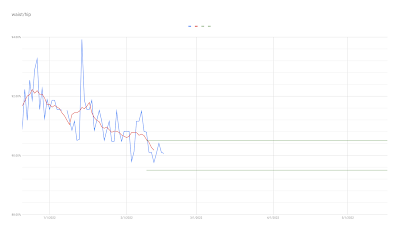
So the new graph is this one here:


The thing being measured here is my waist measurement divided by my hip measurement, expressed as a percentage. The blue line is a three-day rolling average, and the red line is an eight-day rolling average; and the object of the game is to keep the red line "inside the box," that is, in between the two green lines, which mark out 89.5% and 90.5%. The plan is to keep my current regimen until the red line bashes into the bottom of the box, probably in about a month, and then to add a daily hundred calories, so as to spend a month wandering back up until it bashes into the top. Then reduce calories again, and repeat, indefinitely. (One of the things to be discovered is roughly how many calories it takes to "change direction.")

I mulled over other plans, but I think I like this best. I don't want to be "changing direction" daily or even weekly. Plus I suspect that it will be easier to build and retain muscle if I have weeks-long periods of mild calorie- and protein-surplus, alternating with weeks-long periods of mild calorie- and protein-deficit. I used to envision a steady state, a stable weight that stayed within a couple pounds of some number or other. I no longer think that would be necessarily desirable -- or an easy state to attain. Things shift too much: demands and stresses alter. I need a dynamic system that accommodates them. I hope this plan will be easier, and more flexible without entailing more decision fatigue. 

Monday, February 14, 2022

A Northern Bank

My kind is doomed
but since when was I a partisan of men?
My country is ruined
but since when was I a patriot?

My loyalties
are elsewhere. To the violet
swell of the sky against the east:

to the long pull of words
muttered by soldiers going
to pile their bones by the lake.

I have Du Fu for company,
and Ovidius Naso; 
you could travel further
and do worse.

Here on the desolate shore
the geese in desperate strength
lurch into the air, 
grunting and bleating
laboring and creaking
with the weight of wings and wind:
doomed like the rest
but clear on what they want:

A quiet shore,
and a partner to glide
a wings-length behind and a hand to the right
into the shadow of a northern bank.

Monday, February 07, 2022

Golden

Halfway through Daniel Walker Howe's What Hath God Wrought: it thoroughly deserved its Pulitzer. 

The biggest illumination from my American history binge so far: the Civil War was every bit as popular in the North, at its outset, as in the South. Finally the gloves were off. The South had held the Senate in a hammerlock for long enough. The North was going to kick the slaveholders' butts six ways to Sunday, and it was looking forward to it. Volunteers flooded in faster than they could be armed and organized.

The war was a religious one. They were going to purge America of sin. And what would become of the slaves and free blacks afterwards... well, that would fix itself somehow when the time came. What the pro-war Northerners wanted was not so much to release the slaves, as to release themselves from the South's continual sabotage of their efforts to create the Great Universal Republic of the New World. They wanted to be emancipating slaves, building canals and railroads, facilitating capital, civilizing savages: the Southern bloc prevented them at every turn. They couldn't just let the South go, because it was bound up with dreams of empire and manifest destiny. A rival republic was the last thing they wanted, politically or ideologically. They considered their virtue and their polity the manifest endpoint of history, the denouement of God's plan for bettering mankind. I think you miss the point of the Civil War if you don't grasp just how offended and insulted the North felt.

Of course there were individuals who were motivated by compassion for the slaves, and even a few who would subsequently welcome free Blacks into the North. But there weren't all that many. Mostly they were fighting for that shining city on the hill. It's a story that gets into your blood. We sang that song again in the 1970s:

We are stardust; we are golden.

And here we are: having learned nothing: wanting to learn nothing: itching to resume the war.

---

Personally? I would fight the Civil War over again in a heartbeat. If General Grant sent me against the trenches at Cold Harbor, up and over I would go. I'm not immune to the shining city.

---

But if we are going to draw any lessons: surely the first is that problems do not fix themselves.

---

Well. A dirty sky, and a dreary cold day ahead. This winter has settled into my bones as no other ever has: for the first time I understand people going away to sunny places for vacations. I could stand a week or two dreaming in the sun.

Saturday, January 29, 2022

Joy in Wapping

 My weight-loss endpoint has hove (hoven? heaved?) into view again, and this time I'm more ready for it: I have made the plan to stay "inside the box" completely precise and concrete.

The endpoint, as my long-suffering readers well know, is to have my waist measurement be 90% or less of my hip measurement. I take these numbers daily, and although they are irritatingly bouncy -- any one measurement of the hips has a play of 1/4 inch; and any one measurement of the waist has a play of 1/2 an inch -- they are the most direct measurement I have of what I'm most interested in: to wit, minimizing my visceral fat while maximizing my muscle mass. 

I've hit that endpoint three times: briefly once, and for a couple of weeks twice. I have found it difficult to stay there, and it's possible of course that it's the wrong endpoint: I might wrestle less with 91% or 92%. But I suspect the difficulty is not where the endpoint is, but simply being at the endpoint. The interest goes out of the game, after you've won it.

So the new game, when I get there again, is the game of staying inside the box, that is to say, keeping that number -- which is an 8-day rolling average -- in between 89.5% and 90.5%. And the way I do that is by having two triggers for slightly changing my calorie intake. If I see 89.5 (or smaller) I'll increase my snack from 1/8 of a cup of peanuts and one small banana to 1/4 cup of peanuts and one large banana. If I see 90.6 (or greater) I'll go back to the smaller amounts. 

I may of course need to adjust either one of these amounts -- they may not be enough to make me "change direction." But I have enough experience now to know that I can't be far off. If I cross the upper bound while eating the smaller snack, or the lower bound while eating the larger, then I'll know that the amounts need to change. That's not hard.

There's not much glory in "maintenance": but it's where push comes to shove. 

The five-year anniversary of when I started this project comes up in May, and I devoutly hope to be inside the box when it does. 

Oh there was joy in Wapping when the news flew through the land;
At Maidenhead and Henley there was dancing on the strand.
Rats were roasted whole at Brentford, and at Victoria Dock,
And a day of celebration was commanded in Bangkok.

Friday, January 28, 2022

Reading American History

I've wandered into reading the Oxford History of the United States, starting with James McPherson's Battle Cry of Freedom. I already knew quite a bit about the Civil War, and the immediate run-up to it, and its aftermath, but I thought: I really need to know what happened in the era before that. I've never much liked reading American history, but it seems desperately important to understand, right now. So I put the volume before it on hold at the library. It was taking a while to come in, so in the meantime I read the volume before that one, the beginnings-of-the-republic one, Gordon Wood's Empire of Liberty. It was fascinating to read a full-bore partisan of Jefferson, at this late date: I'm still digesting that. When I was young of course I was devoted to Jefferson. In sour middle age I became more of a John Adams guy. In my dotage, here, I'm simply lost: I find it harder and harder to manufacture opinions, or to believe they would matter if I did. Still, I ache to understand.

So now I've got Daniel Walker Howe's book, What Hath God Wrought, which is really the book I wanted to read in the first place. But I'm glad I read Wood first, because I'm nicely grounded for finally tackling the Age of Jackson.

It's a vain quest, looking for the solution to the present in the past: but it is comforting, in a melancholy way, to find that Americans have been at each other's throats for most of their history. We are all Americans, Biden is fond of saying, but -- which kind of American? The kind of American, like Jefferson, who would betray us to the godless Jacobins of France, or the kind of American, like Adams, who would betray us to the priestcraft and aristocracy of England? 

And so it goes on: and in American history I find myself most moved by Ulysses S. Grant, who thought -- of the Mexican War, but I suspect he thought of the Civil War this way too -- "if we must fight, let's get it over and done with quick, so that we can be friends again." (Don't quote me here: that's from memory.) Grant, swamped, as president, by an economy and a history that no one yet could understand; clinging to fundamentals -- gold and friendship -- that turned out to be phantoms. I hope we may yet restore Grant to his historical place: he's been shamefully misused. If there are great men, he was a great man.

Anyway. The days tick by. The sun has taken to get up earlier: there's a faint light behind the curtain when I awake. This winter will pass, like every other; like the one that eventually takes me with it.

Monday, January 17, 2022

Because The Tuning

Because the tuning of my ears is out, 
and I can no longer hear music --
only remember it. Because dawn comes as I write 
and in the stillness before the first bird 
there is a restlessness, and the trees rock, and trail their fingers
over the fence tops; and the last bit of moon 
is eaten up by cloud.  Because the new crop will happen
after my time, and in this now, the wrinkled apple
is the sweetest to be found --
because the truth is, no one wants the truth.

Tuesday, November 16, 2021

The Foggy World of Misplaced Righteousness

Yesterday I was hungry -- somewhat late taking my nap -- had run short of romaine so had a smaller salad than usual -- thought, “after all, these bananas are smaller than usual -- and so I after having my “snack,” my banana and ¼ cup of peanuts, I had a second banana and a second ¼ cup of peanuts.

I’ve gone back and forth in my mind about whether this counts as a “binge.” If the defining characteristic of a binge is eating off-regimen, and engaging in self-deception (how exactly did the size of the bananas justify the extra peanuts?), then it was a binge. But if the defining characteristic of a binge is eating treats uncontrollably -- not being able, for a certain period of time, to recover even the intention of staying on regimen -- then it was not. I’ve decided that I’ll choose not to call it a binge or record it as such, for the rather unrespectable reason that chasing the record of “bingeless days” seems to motivate me to stay on program, and setting that counter back to zero would be discouraging. It’s paltering, maybe. We’ll see. If it encourages us actually to do more of the same behavior, then it will have been the wrong choice. But the decision is made: yesterday counts as my eighteenth bingeless day. Ipse dixit.

I believe the largest contributor to my lapse was that Martha asked me to buy chocolate ice cream -- a treat we don’t usually keep in the house -- and I was working not to cave in to eating it. This translated, in the foggy world of misplaced righteousness where all these decisions take place, as having earned the right to a minor indiscretion. Earned? Right? Good Lord. Save us from this sort of juvenile moral arithmetic. What has all that to do with eating the way I want to eat?

Monday, November 15, 2021

An Unexpected Reprieve

This is my fifteenth binge-less day, so I think we can affirm that the collapse of Favierian civilization has been postponed. My ambition is to have no binge days at all. I have three feast days scheduled during the year, which I will not count as binges: Thanksgiving, my birthday (in March) and some as-yet unspecified high summer date in July or August.

Since I have been tracking binges, my longest binge-less streak has been 46 days. My primary focus right now is securing the habit of binge-less eating: what happens to my weight or waistline is irrelevant if it’s not under control and sustainable. So while I still have the goal of getting a 90% waist-hip ratio, eventually, and/or my 32” waist, it can wait indefinitely while I nail this down: it doesn’t much matter which way the ship happens to be pointed if I have no steerageway. I’m going to be very wary of cutting my calorie intake while I get this settled. I’d do it if my waistline started expanding, I guess, but I won’t do it just to make it shrink. A 34” waist is fine, and a timeline of five years to get to my final goals would be fine. First things first.

I suspect, though I don’t know -- sample of one, & all that -- that fasting destabilized me, and that it may not be a tool I can use. Anyway, I won’t be experimenting with it again for a while.

---

The longer I think about my truncated icosahedron, for representing my world, the happier I am: thinking of the pentagons as open sea was one kind of delightful, but another and even more delightful thought is that they can be otherworldly places. Annuvin. Faerie. Mordor. Places you can't see into from outside, and where, once you have crossed their thresholds, the rules are all different. Maps don't quite match up: but what else would you expect? It's not actually a game defect: it's a game opportunity.  Sure, you can go there, but can you get back? You go over a few restricted passes, or through a tunnel, or you open a gate, and suddenly you're not in Kansas any more. Making some of the world by hand will be its own kind of delight.

---

Washed clean by the autumn sun, and by the wind blowing from the fresh snow in the mountains, and by the serious rains rolling in over the Coast Range. This Indian summer of my life: I have never been so happy, or so at ease. An unexpected reprieve. May it come to all of us.

Thursday, November 11, 2021

A Truncated Icosahedron

I think that by the time I finish the first project in Python Crash Course I’ll have the tools to proceed with my to-do list thing. But really, the more I’ve looked at them, the more I think I want to do all three of the projects in the book: they’re all things that I’d like to be able to do. 

I start to wonder about the difficulty of representing a sphere tiled with hexagons. Take a fishnet stocking with hexagonal windows, rather than square ones, and pull it over a globe: if the hexagons are small enough, could only very small tweaks in the side lengths  accommodate the sphere? The problem is beyond my casual geometric imagination, but I bet somebody has thought it out. It would be cool to have an imagined planet with its whole surface tiled with a hexagonal grid. You could always hack the seams with inaccessible polar ice caps, but it would be splendid to have a real and elegant solution.


Note post hoc: Amit Patel, as usual, was there way before me, and the the answer is: no, there’s not a real and elegant solution. But there is a solution in which you hide the inevitable pentagons in inaccessible regions. Of course, quite a bit of distortion and irregularity is perfectly acceptable if you place limits on zooming -- all that matters is that it *looks* like a hexagonal tiling, locally, and that the vague relationships (i.e. Siberia is closer to Alaska than Hawaii is to California) be more-or-less observed. For pre-Steam human history, this works fine: no European really knew how long it was going to take to reach Japan. It was just over there across the ocean. If your sea travel is simulated at all well, distance distortions will impinge far less than storms and prevailing winds… look at those awful Mercator projections I grew up on: I still learned geography.


Comparison of truncated icosahedron and soccer ball
Image by Aaron Rotenberg via Wikimedia Commons


The best solution for my purposes might be a truncated icosahedron (the soccer ball pattern) with the pentagons being the seeds for seas: the constraint would be that all (reachable) land would have to lie within the hexagonal regions (which after all are well over half the surface of the polyhedron). That’s plenty of land surface available, for an earthlike planet with a surface that’s largely water. It would rule out a mega-continent like Eurasia, but I’m not particularly attached to megacontinents. Open sea navigation could be handled (if it were handled at all) totally differently. It was not until the 20th Century that fleets could really find each other at sea. For technology of the 15th through the 19th Centuries, a player could just kiss their ships goodbye, when they entered the open sea, and hope they showed up on the far side somewhere, some months later. Actually kind of a nice representation. It’s ridiculous to have a simulation that suggests that Ferdinand and Isabella were conducting business by nudging model ships over a map of the Atlantic ocean. Columbus disappeared: and then maybe he showed up again, or maybe he didn’t.


So my world map would basically be twenty hexagonal maps stitched together at the sides, each map with land on it bordering (at most) three other maps. Sea travel that you could *see* would be limited to some coastal zone.